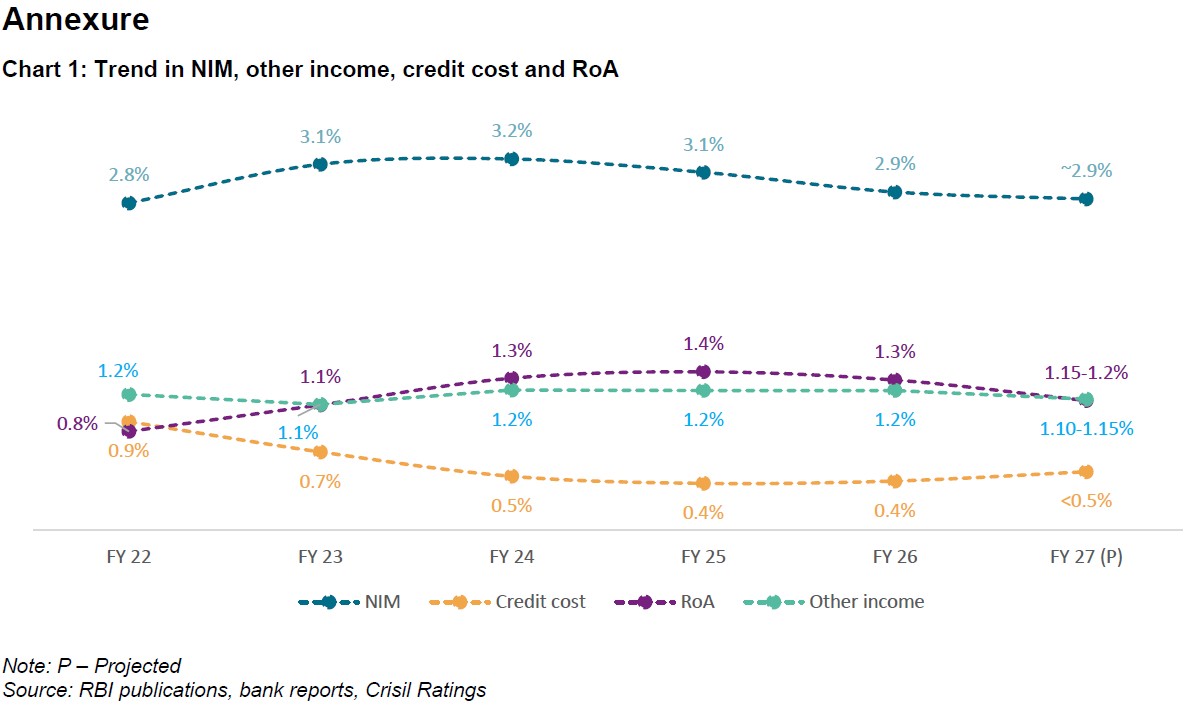
The Indian banking industry is expected to see its return on assets (RoA) slip to 1.15-1.2% this fiscal, from ~1.3% last fiscal, owing to two factors: first, reduced treasury income due to rising bond yields and, second, pre-emptive provisioning by banks ahead of the transition to the expected credit loss (ECL) framework that takes effect in April 2027.
The RoA will, however, remain well above the 20-year average of 0.8% and 10-year average of 0.6%.
Net interest margin (NIM) on a full-year basis is expected to remain stable, although higher deposit costs may lead to a correction from last fiscal’s exit NIM1.
Our base-case scenario assumes a stable policy rate this fiscal.
Says Subha Sri Narayanan, Director, Crisil Ratings, “The banking sector’s NIM is expected to hold steady at ~2.9% this fiscal, after declining 20 basis points (bps) last fiscal. Outstanding deposit rates fell ~50 bps against a decrease of ~80 bps in lending rates last fiscal, following a cumulative repo rate cut of 125 bps. However, the cost of liabilities has likely bottomed out. As credit growth continues to outpace deposit growth, competition for deposits remains intense. This, coupled with increasing reliance on pricier funding sources such as bulk deposits, would likely push deposit costs up.”
Consequently, this fiscal, NIM is expected to correct from the peak of >3%2 in the fourth quarter of last fiscal, while remaining in line with the full-year level of last fiscal.
Apart from NIM, fee and other income also impact bank earnings.
Total other income3 is expected to soften by 5–10 bps this fiscal from 1.2% last year, primarily due to normalization in treasury income. In the first half of the previous year, treasury income benefited from a sharp fall in bond yields, which led to gains on the investment portfolio.
Fee and commission income should, however, grow steadily, underpinned by healthy growth4 in bank credit.
Last fiscal, credit cost remained at a decade-low of ~0.4%, supporting overall profitability. Coupled with operating expenditure savings of almost 15 bps, this helped keep RoA range-bound, even as NIM moderated.
Provisioning expenses could see an uptick this fiscal, but not due to portfolio-quality concerns.
Says Vani Ojasvi, Associate Director, Crisil Ratings, “Banking sector provisions could rise 5-10 bps this fiscal—though remaining benign at sub-0.5%—due to proactive provisioning ahead of the new ECL framework. Although the new norms take effect on April 1, 2027, and allow for a glide path for the transition, some banks have advanced part of the provisions. This trend may continue this fiscal as well. Further, while the conflict in West Asia may strain cash flows for some borrowers, particularly for MSMEs5, government interventions such as ECLGS 5.06 are likely to limit the impact on bank credit costs.”
Operating expenditure is likely to remain largely stable, with a potential nominal increase owing to the implementation of the new labour codes7 for which the detailed guidelines are awaited.
In a scenario of a protracted West Asia conflict and inflation surging beyond the Reserve Bank of India’s (RBI) comfort zone, triggering repo rate hikes, banks’ NIM may inch up in the near term, as observed during rate hike cycles in the past.
That is because the bulk of the loan book is quickly repriced upwards as it is tied to floating rates, while deposits, which are typically on fixed rates, reprice with a lag. Only newly contracted and renewed deposits are offered higher rates. This dynamic should limit the downside risk to profitability, even when credit cost rises or non-interest income declines.
1 NIM for the fourth quarter of last fiscal
2 Last fiscal, following the repo rate cuts, advances saw a faster downward repricing compared with deposits. As a result, NIM contracted sharply in the first half and subsequently, as deposit rates too repriced, it started moving up, exceeding 3% in the fourth quarter
3 As a percentage of average total assets. It includes treasury and fee income, among others
4 Bank credit to grow ~13% this fiscal, a smidgen slower on-year
5 Micro, small and medium enterprises
6 Emergency Credit Line Guarantee Scheme 5.0, which was announced on May 5, 2026
7 On November 21, 2025, the Government of India notified four labour codes: The Code on Wages, 2019, The Industrial Relations Code, 2020, The Code on Social Security, 2020, and The Occupational Safety, Health and Working Conditions Code, 2020, collectively referred to as the ‘new labour codes’. The rules relating to these labour codes are yet to be notified