Explore Crisil, a company of S&P Global
Formerly known as Global Research & Risk Solutions
May 13, 2025
 Blog
Blog
Blog
 Share
Share




Semiliquid evergreen funds are playing a crucial role in private markets
Global private markets have witnessed tremendous growth over the past decade owing to increasing investor demand, product innovation, regional developments and structural evolution.
Private market assets under management (AUMs) are forecast to grow at an annualized rate of 10%, to nearly $29.2 trillion by 2029 from $16.8 trillion in 2023, according to industry data provider Preqin.
An influx of several new fund structures, which offer investors diversification, flexibility, expanded access and improved liquidity are driving the uptick in private markets.
One such avenue is semiliquid evergreen funds, which are playing an increasingly influential role in private markets across asset classes, be it credit, equity or real estate.
What are semiliquid evergreen funds?
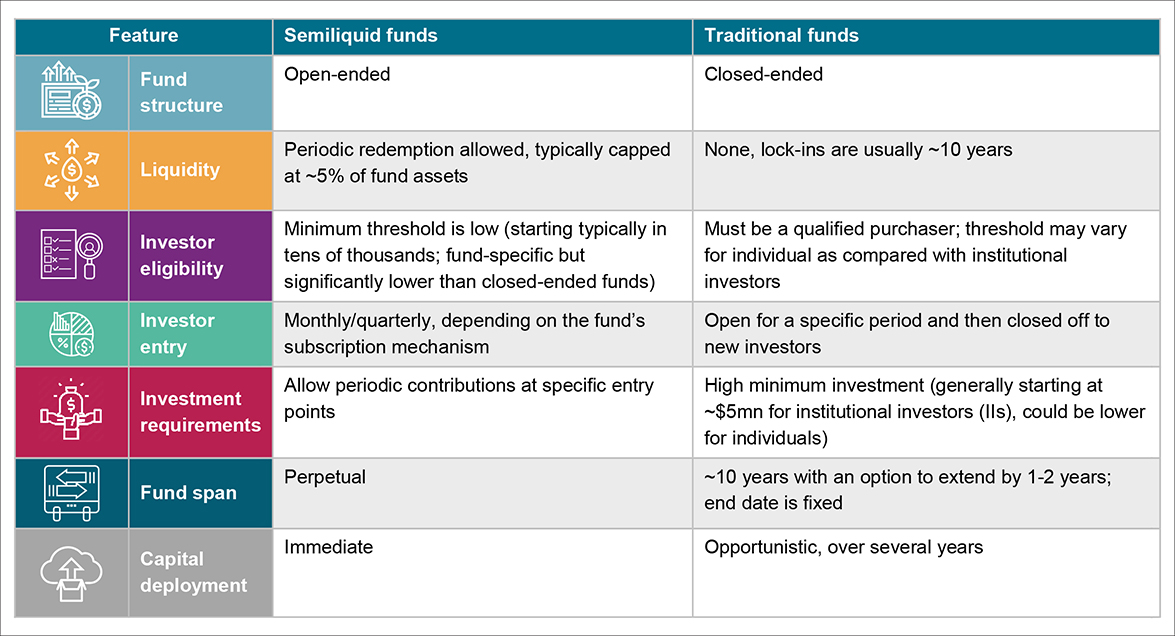
Semiliquid funds are flexible, perpetual (evergreen) investment vehicles, which allow redemption on a scheduled basis (for example, quarterly), with potential restriction/ceiling on the amount that can be redeemed (~5% of the fund’s assets per quarter, usually).
While long lock-ins, capital call drawdown structures, and higher investment minimums characterize traditional closed-ended funds, semiliquid funds offer investors flexibility, and greater and easier access to liquidity through controlled redemptions.
There is an opportunity for investor entry, exit and continuity at different points, with specific clauses in place. Thus, semiliquid funds act as the middle ground between public and private market investments, which lie at extremes of the liquidity spectrum.
Liquidity sleeve
Investor need for liquidity and potential, although limited, redemption means funds must hold a “liquidity sleeve”, - holding enough cash or liquid assets as a buffer to meet investor redemption requests without the need for a forced sale of the underlying assets. This liquidity sleeve acts as a hedge against potential liquidity risk and valuation volatility.
The differences between key features of semiliquid funds and traditional funds are as follows:
Factors driving growth of semiliquid evergreen funds
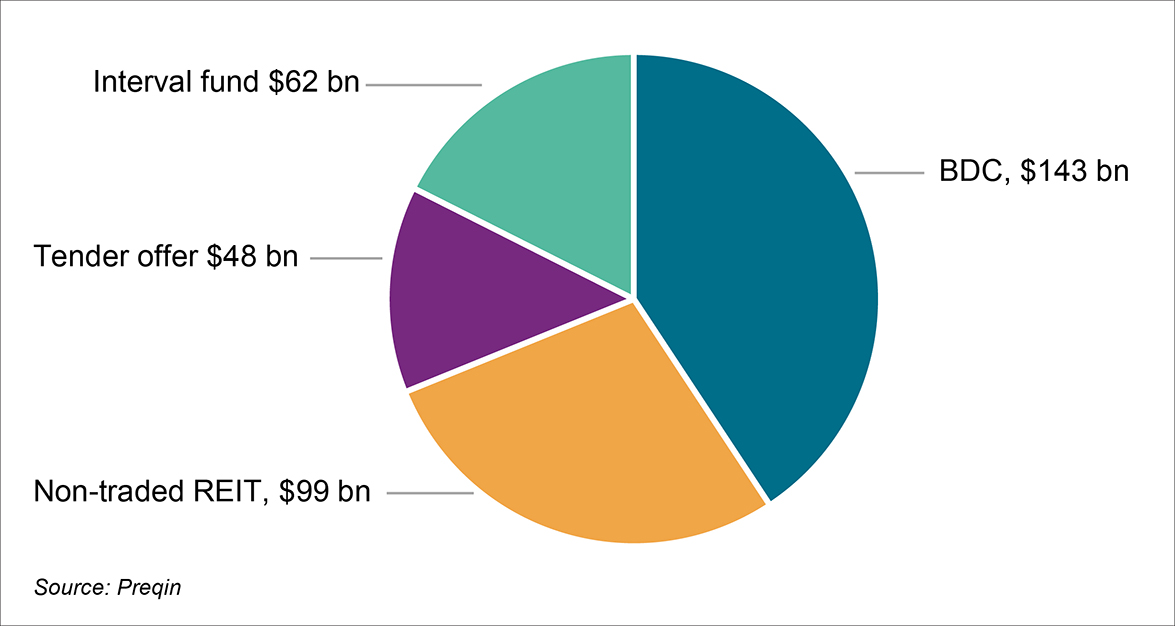
- Investor demand for private market exposure: Increasing investor demand is driving growth in innovative fund structures such as semiliquid funds. A key example would be wealthy individual clients who are slowly becoming key contributors to private markets. Further, a recent BCG report stated that wealthy individuals in the United States (US) allocated 15-20% of assets to private markets in 2023, which underscores the importance of this category. Wealthy individuals have driven the increase in the number of evergreen capital funds to 520, an increase of more than 30% in two years (and over 2x as of 2018), and representing ~$350 billion in AUM as of 2023. According to Preqin, this is a relatively conservative estimate given these numbers exclude Long-Term Asset Funds (LTAFs) and European Long-Term Investment Funds (ELTIFs) due to inadequate disclosures.
The wealth of individuals with more than $5 million in assets remains poised to grow at 8-9% annually according to a Jul 2024 BCG Global Wealth Market Sizing report. In addition to this, with Europe and Asia playing catch-up to the US in terms of private market allocations, the significance of wealth management clients for private markets, and especially evergreen funds, will remain high.
Evergreen funds: Net asset value by fund structure (as of 2023)
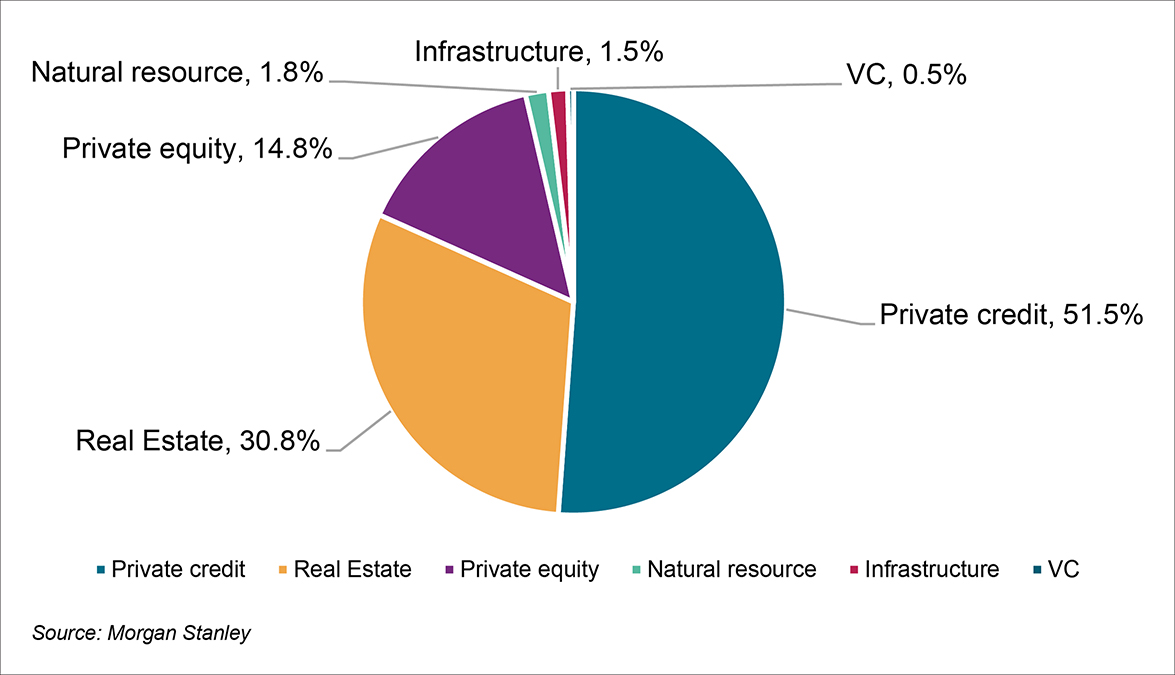
- Asset class suitability: Private credit, with its contractual income streams, predictable and stable cash flows and shorter investment horizons, aligns well with the underlying needs of semiliquid structures and is a favorable asset class for these funds.
This is evidenced by a March 2025 Morgan Stanley report, which states that private credit accounts for ~52% of the total AUMs of all semiliquid evergreen vehicles, whereas real estate contributes 31% and private equity 15%.
Total net assets in semiliquid evergreen funds
- Liquidity and flexibility: Evergreen funds attract investors hungry for private market exposure but unwilling to invest in illiquid assets. The availability of liquidity and the flexibility allowing periodic redemption makes it a very attractive option for retail, wealth as well as institutional investors, thereby broadening the investor pool.
By nature, evergreen funds allow investors to reinvest automatically, i.e., proceeds from investments made are reinvested into newer investments. The investor, of course, can choose to opt out of this but the choice to remain invested for a long term without having to periodically make investment decisions also appeals to many.
According to US-based alternative asset manager Hamilton Lane’s (AUM $956 billion) 2025 Market Overview, evergreen funds’ contribution to overall private markets is expected to reach at least 20% in the next 10 years vs. the current 5% ($700 billion).
- The power of compounding: The capital invested in evergreen funds is deployed from the first day. As a long-term investment option, the power of compounding in returns generation is a well-known fact in the investor community. Consequently, investing in evergreen funds can prove to be highly lucrative and certainly plays a major role in investor decision-making.
Challenges and focus areas
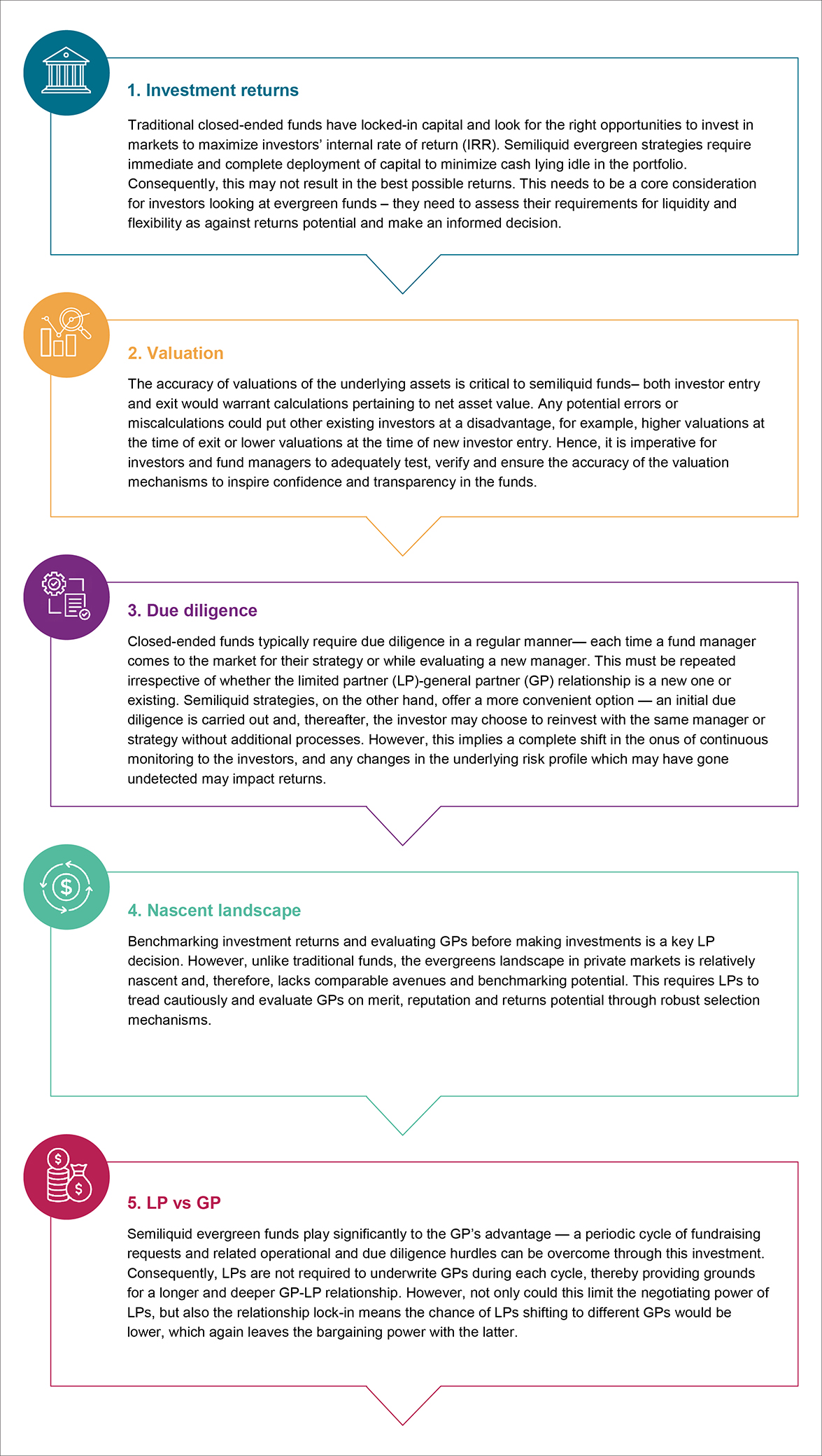
As attractive as they seem, there are five key challenges/areas of focus that investors need to consider before they choose semiliquid evergreen funds: