Explore Crisil, a company of S&P Global
Formerly known as Global Research & Risk Solutions
May 27, 2025
 Blog
Blog
Blog
 Share
Share





App-solute convenience
Neobanks are disrupting the European financial landscape.
These digital-only banks exclusively operate online, leveraging innovative technology to offer seamless and user-friendly real-time financial services on par with traditional banks, often outperforming them.
Their success in Europe is driven by the omnipresence of smartphones and the internet, which have revolutionised the way people consume banking services - with a bank in one’s pocket. Another key factor is the growing demand for transparency in financial management.
Their impressive customer base, which hit ~100 million users in 2024, will likely reach ~127 million by 2028.
Revolut - Europe's largest neobank - had over 50 million customers across 50 countries as of 2024, surpassing traditional banks such as Barclays (48 million) and HSBC (42 million). Revolut was valued at $45 billion in 2024, more than double French bank Société Générale (~$19 billion) and slightly surpassing British bank Barclays (~$43 billion).
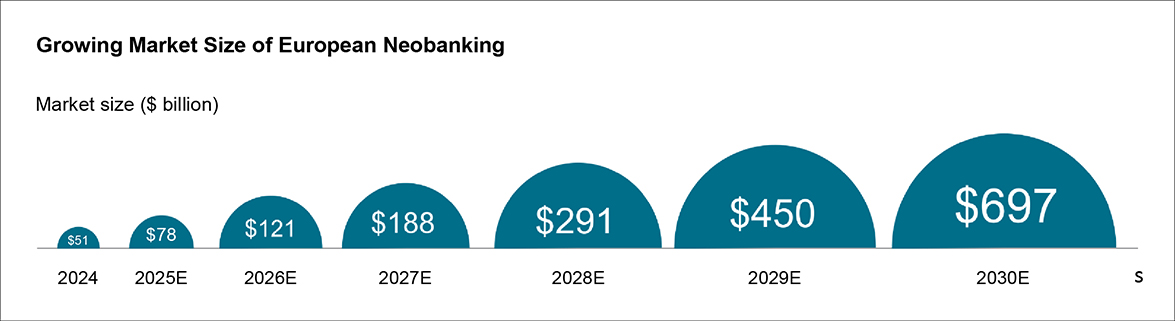
Expansion of the European neobanking market
The rising tide of neobank transaction volume
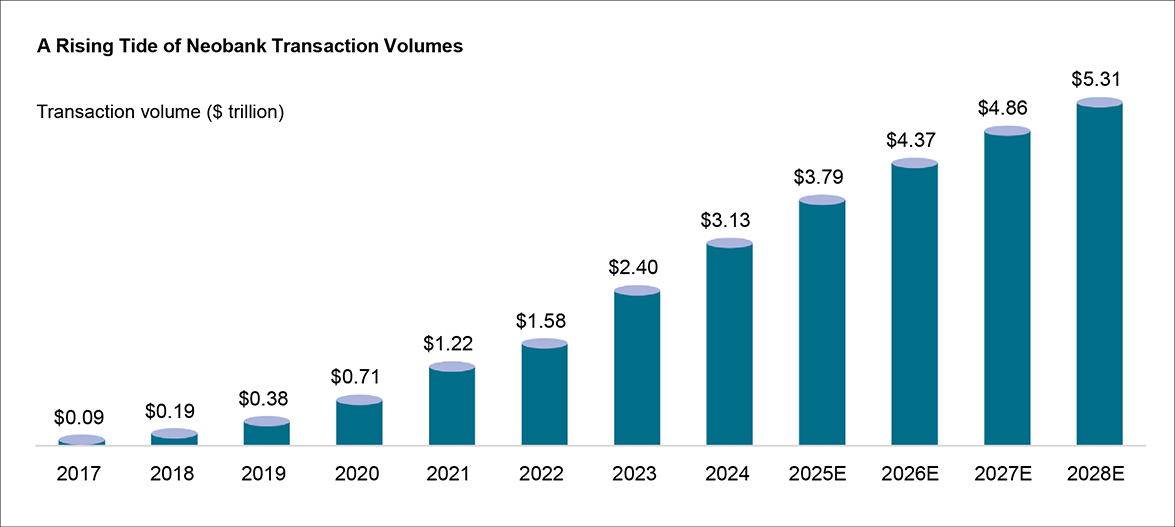
Source: Precedence Research, EBF, EU-27 data
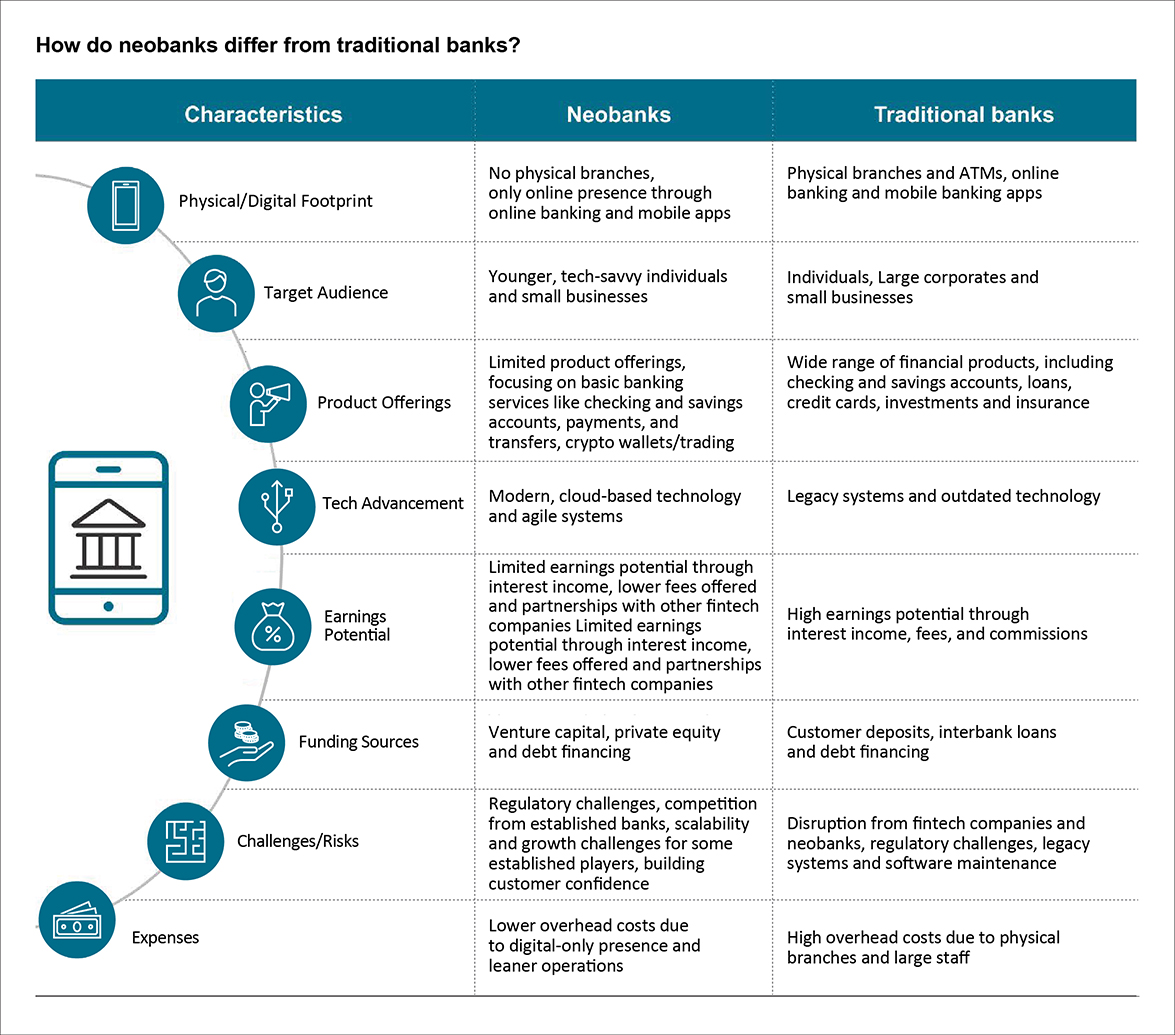
How do neobanks differ from traditional banks?
Wave sweeps Europe
Although present before the pandemic, neobanks embedded themselves into Europe’s financial arena in the Covid era.
Most financial institutions using legacy infrastructure were struggling to update their technology and invest in digital services at the time; neobanks already had their digital infrastructure in place.
Being ahead of the technology curve enabled neobanks to offer low-cost online and mobile banking services, with data-driven insights, easily capitalising on the changing customer preferences.
Moreover, neobanks have been able to challenge traditional banks and gain market share on the foundation of a favourable regulatory framework, such as the European Union's Revised Payment Services Directive (PSD2) and open banking initiatives.
These frameworks have enabled greater data sharing, customer empowerment and healthy competition, allowing neobanks to scale and innovate swiftly, as well as build more personalised offerings.
Regulations and technology make Europe a neobank hub
Although Latin America and the Asia-Pacific have large neobanks (Nubank in Brazil, Judo Bank in Australia and WeBank in China), Europe has emerged as a neobank hub because of the supportive regulatory environment, faster tech-innovation, and leading adoption with a diverse array of players catering to personal and business needs.
Innovative players such as Revolut, N26, Monzo, Starling Bank and Wise have helped transform Europe’s banking landscape.
The origins of these neobanks are rooted in a desire to challenge traditional banking norms. Revolut started as a foreign exchange card, N26 as a simplified mobile bank, Monzo as a transparent fee structure provider, Starling Bank as a customer-centric bank, and Wise as a peer-to-peer system addressing hidden fees and unfavourable exchange rates.
Now, these players have expanded their offerings to include multi-currency accounts, cryptocurrency trading, stock investments and business banking services, in addition to the existing range of offerings, such as investment products, credit-score reporting and virtual debit cards.
Moreover, Wise, Revolut and N26 products are more competitively priced that those of traditional banks. Wise charges 0.4-1% for transfers, while Revolut offers free transfers up to €1,000/month on its standard plan, with no markup on exchange rates during weekdays. In contrast, traditional banks charge €5-€25 per international transfer, plus a 2-3% markup on currency conversion.
Presence of neobanks worldwide
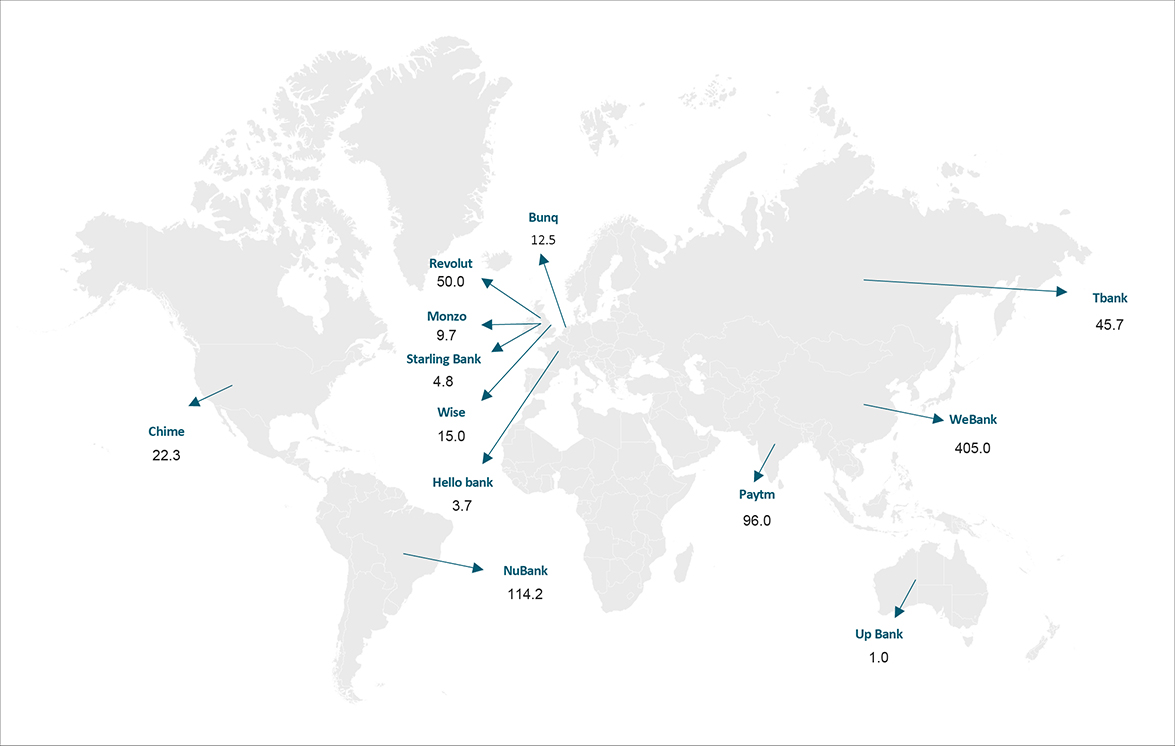
Note: Data indicates total customers in million
Neobanks grow their cost advantage
Neobanks have no branch footprint, which results in leaner operations and lower overheads cost. Also, as they are technology based, they can launch new features faster, quickly adapt to customer feedback and offer competitive fees.
On the flip side, they function on thin margins, have high customer acquisition costs, and monetising its users remains a challenge as most customers use neobanks as secondary accounts, thus leading to slower profitability growth.
As the neobanking industry expands, its growth strategy is shifting towards regional expansion, product diversification and partnerships with payment networks.
These banks are introducing new investment products, leveraging artificial intelligence (AI) to enhance customer experience and detect fraud, and planning to launch branded ATMs. Some, such as Revolut, are even entering new areas such as mortgage products.
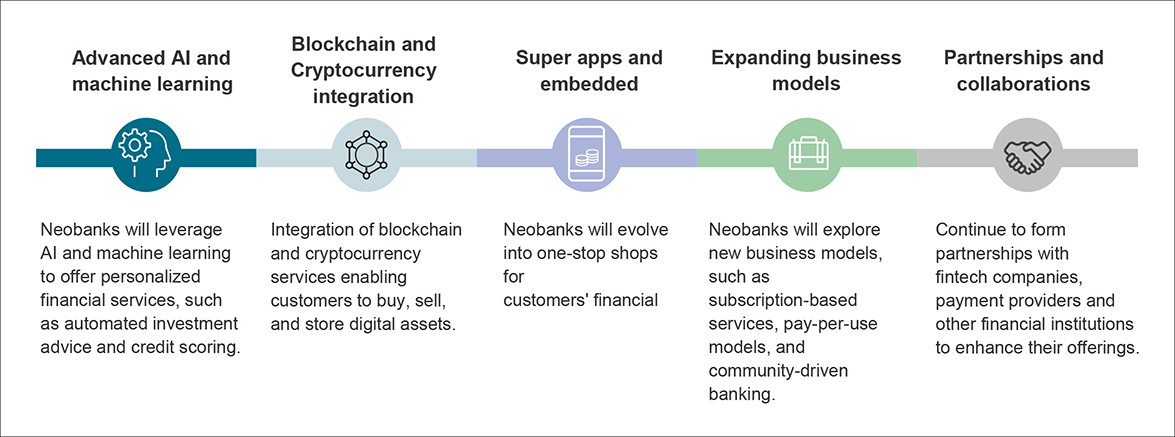
Future trends and milestones for neobanks