Explore Crisil, a company of S&P Global
Formerly known as Global Research & Risk Solutions
August 01, 2025
 Blog
Blog
Blog
 Share
Share




The approach to sustainability is undergoing a noticeable shift globally because of evolving regulations even as adoption levels have been varying.
Consequently, relevant, accurate and defensible sustainability data has never been more important.
While few asset managers are adjusting their strategies in response to the changing mandates, all of them continue to view sustainability as a core component of long-term value creation
But all are facing the growing challenge of managing large volumes of ESG data, including unstructured ones, from varied sources that may or may not be governed by differing taxonomies, definitions and methodologies.
Many asset managers still lack the internal systems and talent needed to ingest, reconcile and analyse complex ESG datasets as regulatory expectations evolve.
To navigate this landscape effectively, asset managers are increasingly investing in strong data management strategies, including data quality and governance frameworks, underpinned by advanced technologies and deep domain expertise.
Why management of ESG data is more critical now
With polarised sentiments and rigorous debates globally, sustainability remains resilient and adaptable. Investors, regulators and companies are embedding ESG data into their strategic decision-making processes, recognising that sustainable investments would be an important competitive advantage if not in the short term, then definitely in the long term.
Embedding ESG insights into investment processes requires more than just access to data-it demands robust data infrastructure, standardised approaches, and validation mechanisms to ensure quality and consistency across portfolios.
Mastering ESG data management
Firms must adopt tailored strategies that balance flexibility with standardisation to manage ESG data effectively. The illustration below highlights the key focus areas.
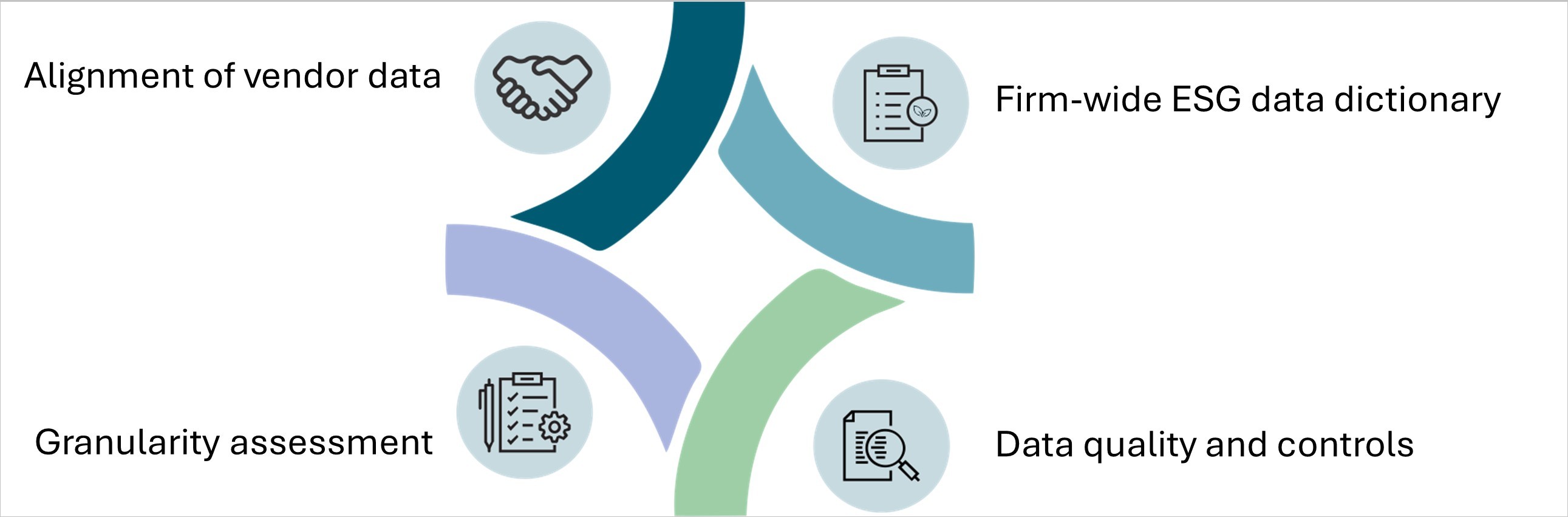
- Alignment of the vendor data: Customise ESG data from multiple vendors to align with firm-specific investment frameworks. For example, net-zero aligned portfolios may prioritise carbon intensity and temperature alignment metrics when selecting data providers
- Firm-wide ESG data dictionary: Establish a centralised reference for ESG definitions, benchmarks and methodologies to minimise interpretation risks and ensure consistency across internal and external reporting
- Granularity assessment: Not all ESG data hold equal value. The granularity and reliability of sustainability metrics can vary widely; some datasets are derived from audited corporate disclosures, while some are extracted from estimates or self-reported figures. Rigorous quality assessment frameworks, supported by regular audits and benchmark comparisons, help distinguish high-confidence data from potentially misleading information
- Data quality and controls: Robust data validation protocols are essential to maintain data integrity. Automated quality checks embedded in ESG data workflows help prevent inconsistencies and errors that could distort investment analysis. By integrating these validation rules directly into data ingestion systems, asset managers can uphold transparency and reinforce stakeholder trust in their sustainability metrics