Explore Crisil, a company of S&P Global
Formerly known as Global Research & Risk Solutions
July 11, 2025
 Blog
Blog
Blog
 Share
Share




Even as asset managers (AMs) see record assets under management ($128tn in 2024, +12% YoY 1), they continue to face a gradual structural shift that could bring significant operating challenges.
AMs are now forced to operate in a low-fee environment as passive funds and active ETFs continue to gain traction at the expense of traditional investment products. Besides, there is mounting pressure to reduce costs while meeting evolving client and regulatory demands.
Emerging trends in asset management
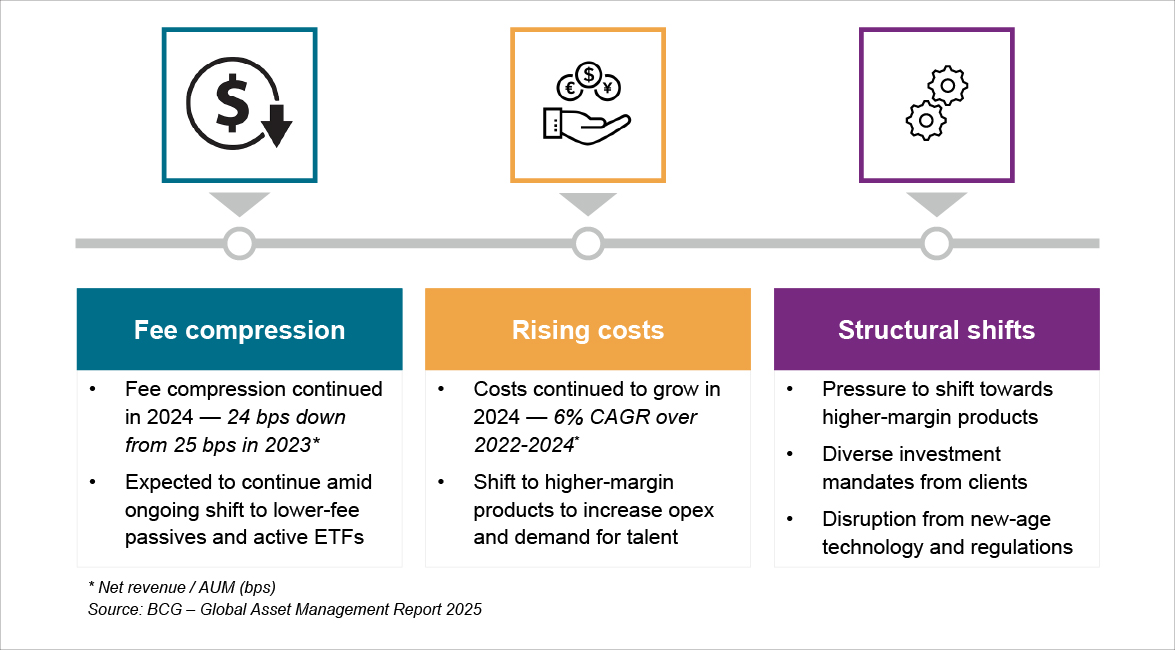
While strong market performance helped ease revenue pressures in 2024 (>70% revenue growth1), the industry remains increasingly vulnerable to external shifts (economic uncertainty, geopolitical risks, changing consumer preferences, technological innovation, and so on).
To keep up with the evolving landscape, AMs must revisit their operating models across front-, middle- and back-office functions.
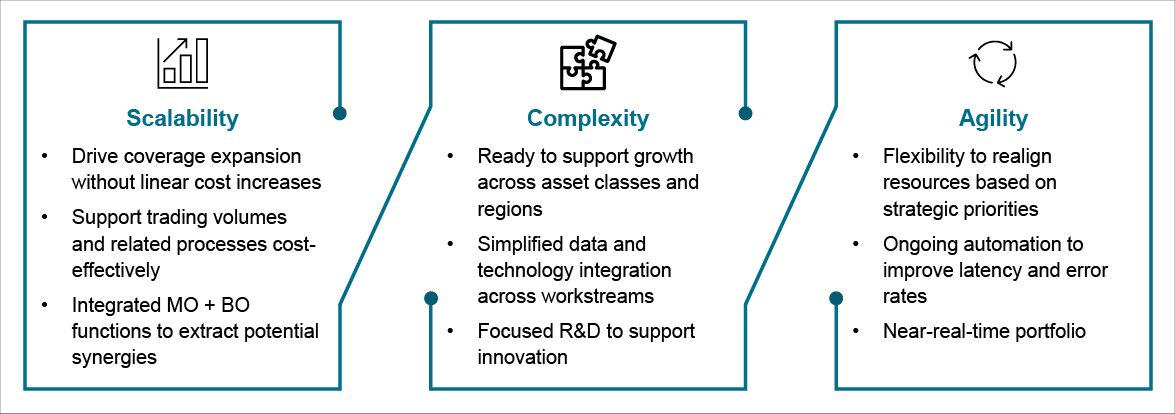
Key pillars of a future-ready model: Scalability, complexity and agility
Amid the ongoing structural shift, AMs are under growing pressure to reduce costs without hindering revenue growth.
According to Boston Consulting Group (BCG), to get back to historical profitable levels, managers will have to cut costs by 20% and increase the share of higher-margin products to ~30%2.
This will require AMs to shift to a robust operating model - one that supports a firm’s growth ambitions efficiently, while preserving its investment identity.
As managers embark on this transformation journey, they must factor in three core considerations when designing a future-ready model.
Scalability - grow efficiently
A future-ready operating model must support expansion in a cost-effective manner. Amid the growing push for passive investing, which is typically process-intensive, it is important that AMs design operating models that can handle high workflow volumes while ensuring adequate control and accuracy. Furthermore, scalability becomes critical as managers look to expand into newer markets and launch differentiated products. A scalable model enables managers to streamline workflows across functions, driving significant synergies and reducing operational bottlenecks and rising variable costs.
Complexity - navigate operational challenges
AMs are gradually entering new asset classes and markets as they seek higher-margin products. A future-proof model should have adequate resources to handle operational complexities, including access to relevant talent and a simplified data and technology platform to transform legacy processes and streamline disparate systems. An inability to navigate the operational nuances of new markets could hinder growth, increase reliance on manual processes and introduce redundancies.
Agility - respond to change without operational disruption
A future-ready model should offer AMs sufficient flexibility to quickly adapt to changing market dynamics. An agile model must ensure minimal operational disruption as managers navigate industry shifts, integrate new client mandates and respond to evolving regulations. Key features of such models include resource flexibility, a well-integrated technology that provides real-time data insights, and the ability to support customisation. An agile model is critical to retain competitive edge and drive an accelerated go-to-market strategy for new products.
Key pillars of a future-ready operating model
Since there is no one-size-fits-all approach, we explore how managers can assess their existing operating models to identify the ‘best-fit’ target model.
Reimagining the operating model through a strategic lens
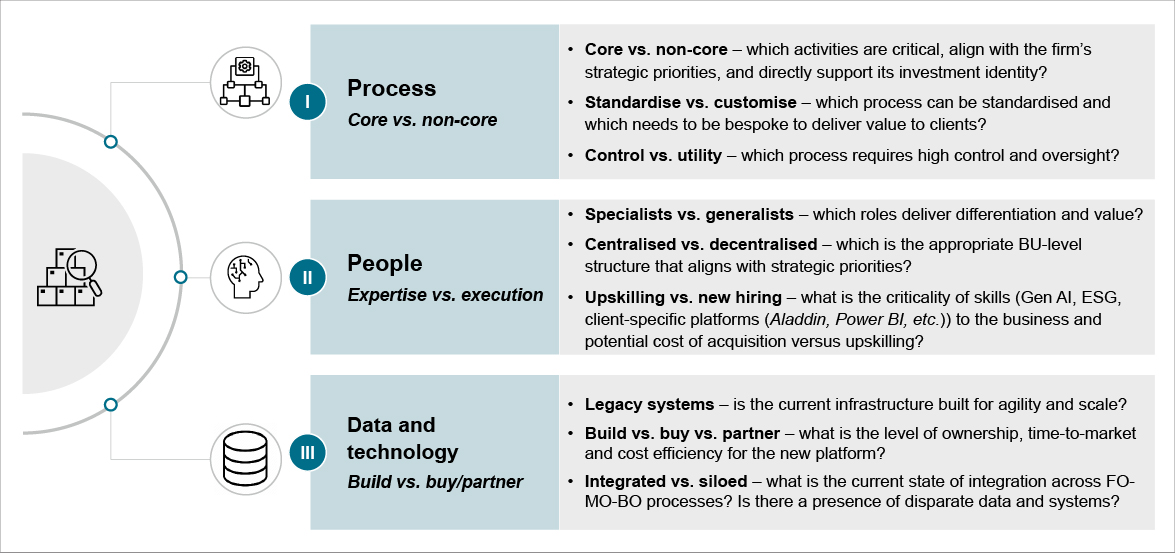
An effective target operating model should not only focus on costs and controls, but also align with a firm’s investment identity. Whether the firm adopts a traditional, quant, private or multi-asset strategy, the target operating model should help create value and provide a competitive edge. AMs should take a closer look at the operating model’s three core pillars - processes, people, and data and technology - to decide what to retain, redesign and partner on.
Key aspects to consider while assessing the existing operating model