Explore Crisil, a company of S&P Global
Formerly known as Global Research & Risk Solutions
November 03, 2025
 Blog
Blog
Blog
Credit monitoring 2.0 leveraging GenAI
November 03, 2025
Blog
Blog
Transforming from reactive reporting to proactive monitoring
 Share
Share






Credit risk 2.0: Why the old playbook no longer works
The world today is more connected — and more fragile — than ever before. A policy shift in the US can rattle currency markets in Asia overnight. A conflict in the Middle East can send shipping costs soaring, eroding margins for exporters half a world away. These disruptions don’t occur in isolation; they ripple through supply chains, industries, and borrower networks in ways traditional credit monitoring frameworks were never designed to detect. Credit risk has become multidimensional — interconnected, fast-moving, and often invisible until too late.
Yet, most monitoring processes remain anchored in an old rhythm — reactive reviews, manual covenant checks, and static financial triggers. These were effective when risks evolved linearly, disclosures arrived quarterly, and market shifts were predictable. That world no longer exists. In an era of instantaneous information and volatile macro conditions, the old playbook of waiting for lagging indicators is no longer sufficient.
In this environment, proactive and continuous credit monitoring isn’t just desirable — it’s indispensable. Institutions must detect early warning signals across thousands of counterparties, from subtle supply chain disruptions to sectoral shifts and sentiment changes in the media. The challenge lies not in the lack of data, but in the inability of traditional systems to interpret and connect it all in real time.
This is where Generative AI (GenAI) is rewriting the rules. By synthesizing unstructured data from disclosures, filings, news, and alternative data sources, GenAI can uncover patterns that human analysts or legacy systems might overlook. It transforms credit monitoring from a backward-looking, report-driven exercise into one that continuously monitors, connects dots across silos, and contextualizes risks at both borrower and portfolio levels.
The importance of adopting such transformation stems from four deep-rooted fault lines that plague traditional credit monitoring frameworks and demand a fundamental transformation.
Four fault lines in traditional portfolio monitoring
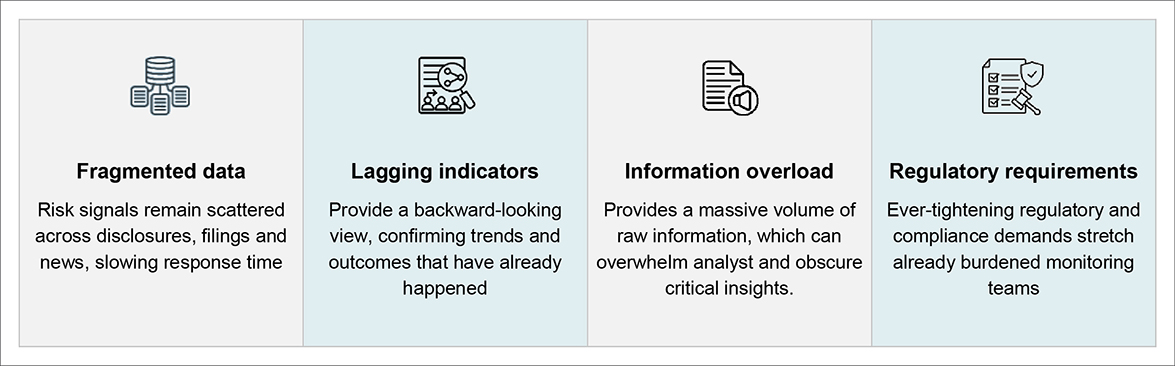
These limitations of traditional monitoring are no longer incremental gaps but structural weaknesses. Addressing them requires more than process enhancements; it demands a fundamental re-architecture of credit oversight. GenAI offers that shift, enabling institutions to move decisively from reactive to proactive monitoring at scale.
How GenAI rewrites the credit monitoring rulebook
Financial institutions are exploring the use of technology across the credit lifecycle, leveraging large language models (LLMs) to process unstructured data, summarise reports and even generate structured output for decision-making. The quest for productivity improvement is the top driver of GenAI implementation. Business need and regulatory/compliance pressure are also strong contributors.
Financial institutions are testing various GenAI use cases in credit, with super regionals leading the deployment. While institutions are experimenting with a wide range of use cases, the most prevalent ones are drafting memos, data assessment, portfolio monitoring and early warning signals.
Institutions are increasingly using GenAI to review and monitor their entire credit portfolio. This includes proactive covenant tracking and detecting early warning signals by scanning news releases and social media for market sentiment and financial distress indicators.
Four key areas redefining credit monitoring
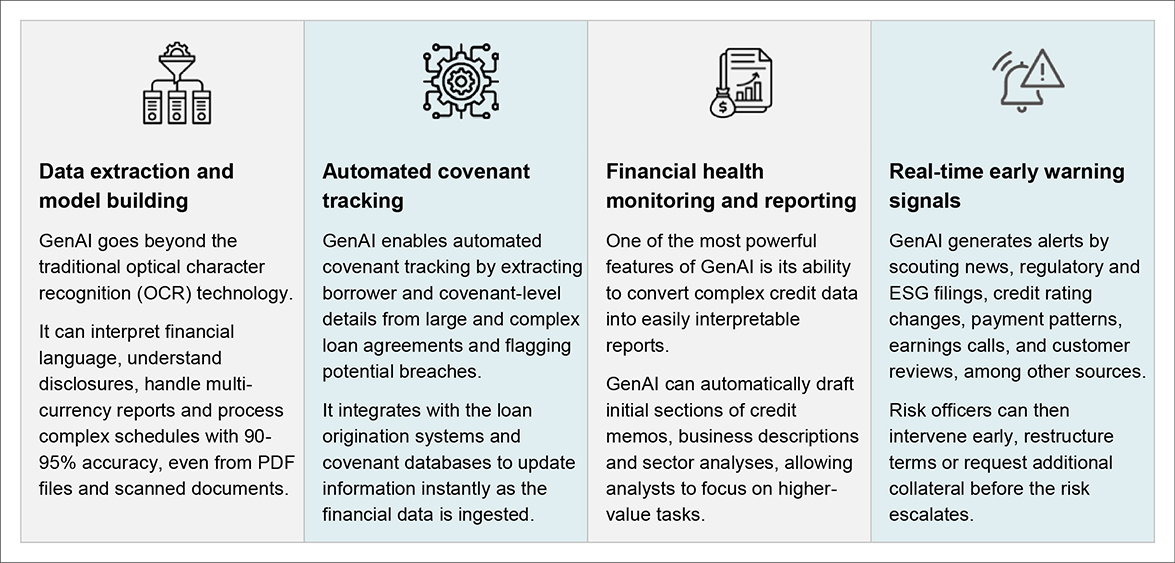
In essence, GenAI brings an “always-on” layer to credit monitoring — one that continuously learns from market signals, analyst feedback, and evolving borrower behaviour. Instead of relying on periodic reviews, institutions can now continuously monitor portfolio health, enabling earlier intervention.
Balancing potential with prudence: Guardrails for GenAI
While industry use cases highlight the transformative potential of GenAI in credit monitoring, its deployment is not without risk. Hallucinations, embedded biases, data leakage and compliance breaches can undermine trust if left unchecked.
Regulators, Boards and risk officers want assurance that new tools integrated with GenAI do not compromise transparency, data integrity or accountability. To capture the upside while mitigating the pitfalls, institutions need to embed a strong layer of guardrails and governance across GenAI initiatives:
- Validation and accuracy: Safety mechanisms can be built to ensure AI applications operate within acceptable boundaries. Carefully curated data, bias detection, optimization of retrieval/filtering algorithms, and regular review and updating of guardrails based on the latest research and stakeholder feedback can ensure integrity and security of GenAI models.
- Explainability and Traceability: Source attribution ensures every AI-generated number or statement is traceable to its origin. This allows users to verify, contextualize, and refine model outputs.
- Data privacy and security layers: Sensitive borrower and portfolio data must be protected. Financial Institutions can deploy GenAI within walled environments with encrypted data pipelines, and anonymized data sets for model training and fine tuning.
- Agentic AI for decision support: Agentic AI, which is capable of autonomous yet guided decisions, has quickly entered banking awareness, attracting resources and attention. In credit memo drafting as well, Agentic AI can generate confidence scores flag low-confidence sections for SME reviews.
- Human-in-the-loop review: Human expertise remains the cornerstone of trustworthy AI. SMEs actively supervise and validate GenAI-generated content, fine tuning insights, mitigating bias, and ensuring relevance. This also ensures that nuanced credit judgment remains with analysts.
Is implementation a challenge?
Large banks, backed by mature digital infrastructure and sizeable innovation budgets, are better positioned to independently develop and deploy GenAI-powered credit monitoring solutions.
In contrast, regional and community banks often face greater barriers, despite being equally exposed to emerging risks.
These institutions typically operate with leaner risk teams, limited data engineering capabilities, and legacy technology environments that are not ready for advanced AI integration.
Implementing GenAI solutions requires more than a model; it demands scalable data pipelines, workflow redesign and strong governance frameworks. For many mid-sized or community banks, building these capabilities in-house is difficult.
Furthermore, competition for skilled GenAI talent is intense. Banks located outside major fintech hubs frequently struggle to attract AI engineers, data scientists and model risk specialists. This can lead to long transformation timelines and higher operational strain on existing staff.
To overcome these hurdles, a collaborative approach is essential. Partnering with specialised vendors enables these banks to:
- Access proven GenAI solutions without large upfront investments
- Leverage credit domain expertise baked into technology
- Implement guardrails and compliance standards from Day 1
- Scale usage based on evolving regulatory and portfolio needs
- Have the option for build, operate and transfer (BOT)