Explore Crisil, a company of S&P Global
Formerly known as Global Research & Risk Solutions
November 10, 2025
 Blog
Blog
Blog
Stewarding transition investing
November 10, 2025
Blog
Blog
Enhancing analytical capabilities, tweaking research and investment processes imperative for sustainable investing
 Share
Share




Sustainable investing has long been viewed as a binary decision: channel capital exclusively into ‘green’ assets such as renewables or divest from unsustainable sectors.
While this approach has accelerated funding for green business models, it has neglected hard-to-abate sectors such as oil and gas, steel and utilities, which are vital to the global economy.
To bridge this gap, a more practical financing framework is needed, and this is where transition investing comes in.
Enabling a meaningful alignment with climate goals
Transition investing not only enables carbon-intensive sectors to reduce emissions and transition to net-zero pathways, but also ensures capital allocation balances environmental responsibility with economic reality.
This approach is no longer a niche theme, but a mainstream investment priority.
Global investments in the transition to low-carbon energy are surging high, demonstrating an increasing alignment of capital flows with climate goals and policy momentum.
For asset managers, supporting carbon-intensive industries means backing credible transition plans that replace high-carbon processes with low-carbon alternatives, driving transformation rather than maintaining status quo.
Although these sectors are significant contributors to global emissions, they remain crucial for economic growth and continue to generate competitive returns.
Moreover, they have substantial potential to deliver a meaningful reduction in emissions if capital is directed towards effective transition strategies.
By investing in these industries through a credible transition lens, asset managers can accelerate decarbonisation at the source, ensuring a broad-based and impactful progress towards net zero.
Challenges to transition strategies
- Defining ‘transition’ in practice: With evolving taxonomies and disclosure standards, the ambiguity in the definition of what constitutes a ‘transition’ activity makes it difficult for asset managers to set portfolio-level targets or report alignment with credible climate pathways.
- Inadequate disclosures and greenwashing risks: Transition investing relies on forward-looking data, such as emissions trajectories, capital expenditure (capex) alignment and technology adoption. However, corporate disclosures are often backward-looking or incomplete. Inconsistent reporting and a lack of standardised metrics make it challenging for asset managers to identify credible transition leaders and avoid exposure to greenwashing risks.
- Assessing transition credibility: Evaluating the feasibility and financing of companies’ net-zero strategies is a complex task. Asset managers struggle to benchmark corporate transition plans against sectoral pathways, such as the Science Based Targets initiative. As a result, distinguishing between ambition and execution remains a persistent challenge.
- Regulatory and policy fragmentation: In the case of transition investing, asset managers need to navigate diverse regional standards, such as the European Union Taxonomy, the International Sustainability Standards Board’s disclosure norms, and emerging national guidelines in the United Kingdom and Asia. Keeping pace with these evolving frameworks, as well as interpreting their implications for portfolio exposure and reporting, can be resource-intensive and operationally complex.
- Stewardship complexity: Transition investing requires active stewardship, including engaging with high-emitting companies to influence their decarbonisation pathways. However, defining what constitutes successful engagement, setting measurable goals and tracking tangible outcomes are ongoing challenges. Balancing the need to stay invested to drive change with the need to divest when progress stalls, adds nuance to the stewardship process
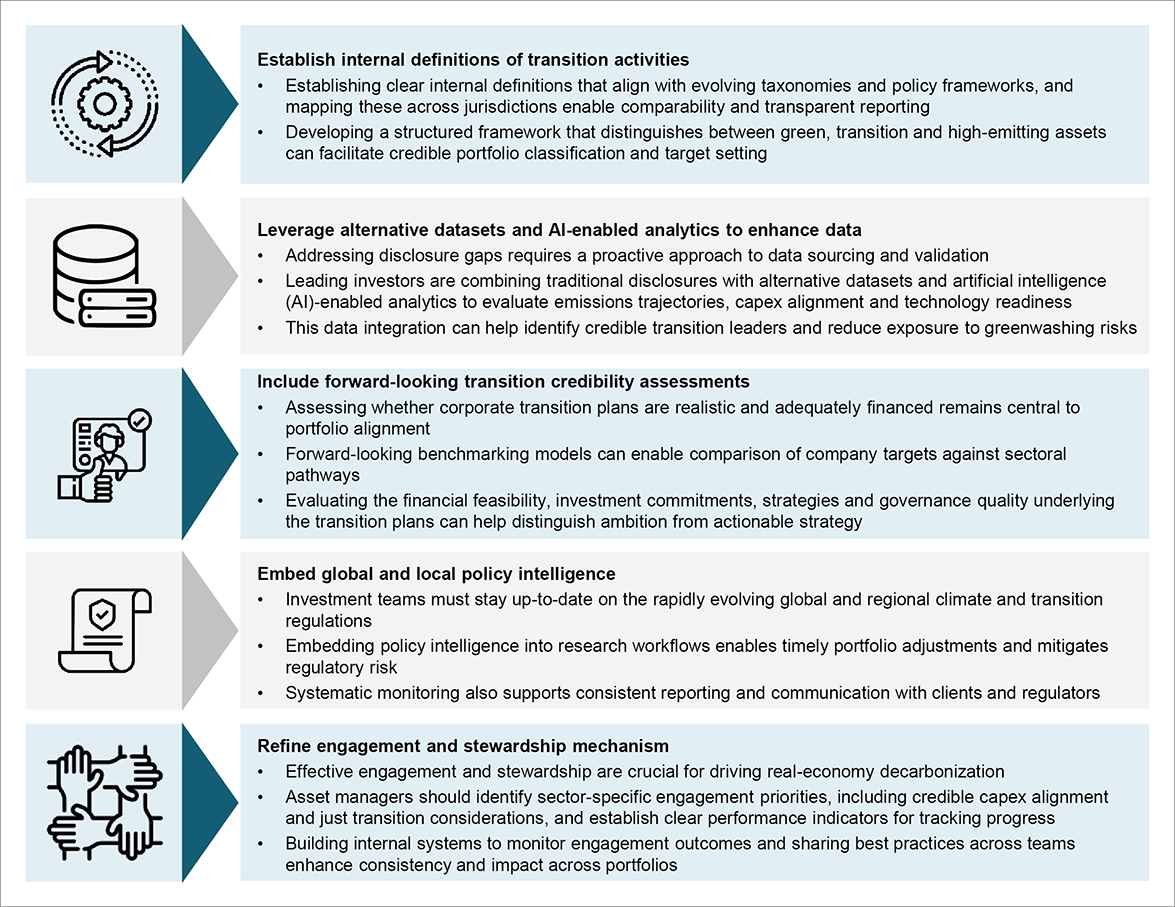
Turning insights into action
Despite its challenges, transition investing offers asset managers an opportunity to differentiate through robust research, data integration and targeted engagement.
To succeed, firms should enhance their analytical capabilities and integrate transition thinking into their research and investment processes.
We help asset managers build the analytical, research and stewardship capabilities needed to navigate transition investing with confidence.
Best practices