Explore Crisil, a company of S&P Global
Formerly known as Global Research & Risk Solutions
December 02, 2025
 Blog
Blog
Blog
 Share
Share





For over a decade now, asset managers have been traversing a tight margin environment stemming from fee compression, rising costs and evolving client mandates.
The advent of generative artificial intelligence (GenAI) could help change the script by offering a path to greater efficiencies.
To be sure, there is no data to support GenAI’s delivery of transformational results at scale across the industry at present, but early use cases and industry insights are showing promise.
Application of GenAI
Across the investment operations value chain, several domains have emerged as pragmatic starting points for the application of GenAI, driven by volume of unstructured data, repetitive tasks and rule-based manual processes that strain operational capacity.
The industry realises that the most credible and immediate value of GenAI lies in targeted application across specific workflows and not holistic.
Rather than approaching GenAI as a disruptive force, many firms are positioning it as a practical and incremental lever to reduce manual efforts, improve first-pass accuracy and accelerate turnaround times.
Within investment operations, certain areas are showing high potential for early GenAI exploration. These are not entire business functions that are being automated but a collection of workflows that consistently consume time and effort.
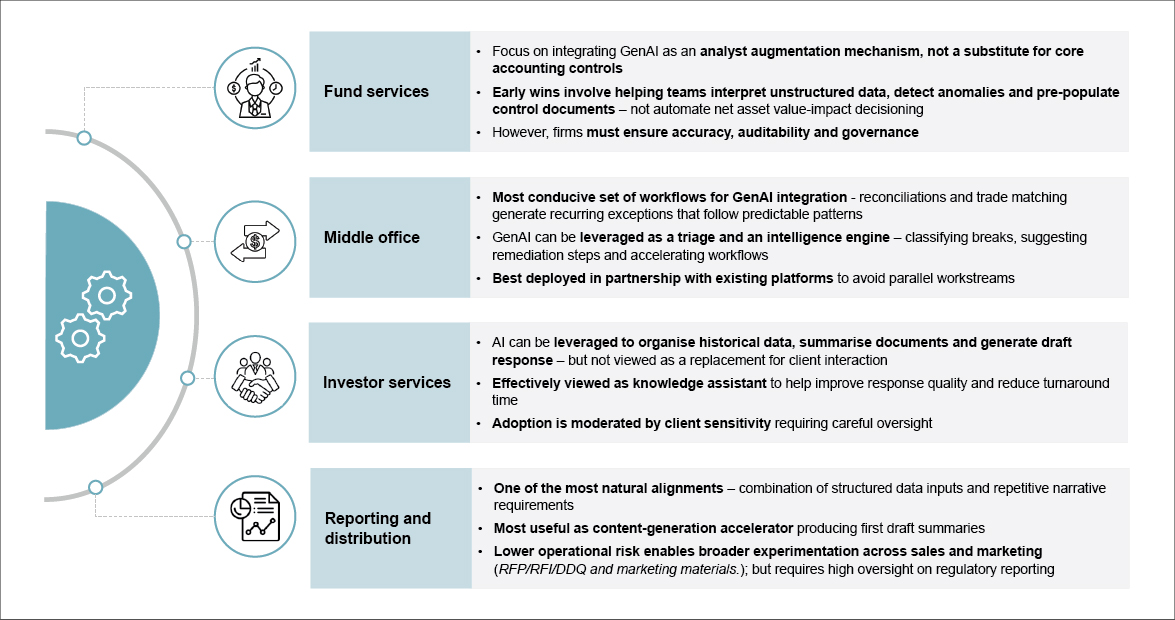
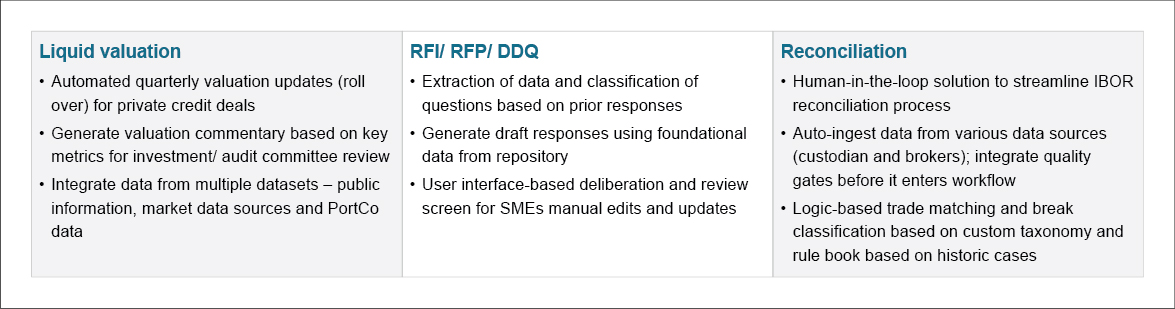
Over the past year, we partnered with several global asset managers to deliver practical, GenAI-embedded implementation across some of the above-mentioned workflows.
These solutions focused on leveraging GenAI as an intelligence layer, accelerating data interpretation, reducing exception workflows, improving turnaround time and unlocking capacity.
Practical challenges and solutions for GenAI implementation
While the opportunity for GenAI in investment operations is significant, most asset managers realise that its adoption involves challenges.
Investment operations is a highly controlled environment, governed by strict auditability standards, dependent on diverse data sources, intertwined with legacy systems and tightly sequenced daily processes. Hence, GenAI cannot be plugged in to existing workflows, but needs to be carefully aligned with in-house processes and systems.
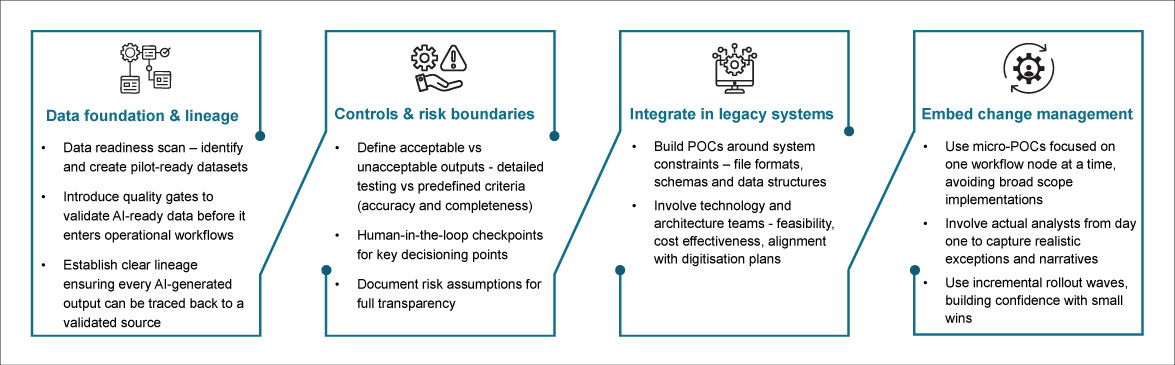
The following pillars highlight the most critical considerations for asset managers as they navigate the GenAI integration journey from experimentation to scaled production.