Explore Crisil, a company of S&P Global
Formerly known as Global Research & Risk Solutions
February 27, 2026
 Blog
Blog
Blog
From cyclical recovery to structural strengthening
February 27, 2026
Blog
Blog
The quiet transformation of US regional banks
 Share
Share




Recent earnings reports from top United States (US) regional banks indicate improving operating leverage and stable risk metrics. A study of about 30 regional banks shows compression in the average efficiency ratio to ~54.2% in fiscal 2025 from ~57.3% in the previous fiscal, and an increase in the average return on equity (RoE) to ~10.6% from ~9.7%. Net interest margins have stabilized (average of ~3.5%) and net charge-offs remain within the range of 0.35-0.45%.
This combination of cost discipline, margin resilience and controlled provisioning suggests that the performance of these banks is supported by more than just cyclical interest rate dynamics.
While public disclosure often centers on cyclical drivers such as rate movements, commercial real estate (CRE) exposure, or deposit competition, the data increasingly indicates structural strengthening in the operating model of US regional banks. Beneath headline performance, banks are quietly overhauling their operating architecture by channeling investments into analytics, automation, and granular risk visibility.
Three structural shifts redefining how regional banks operate, manage risk, and deploy capital
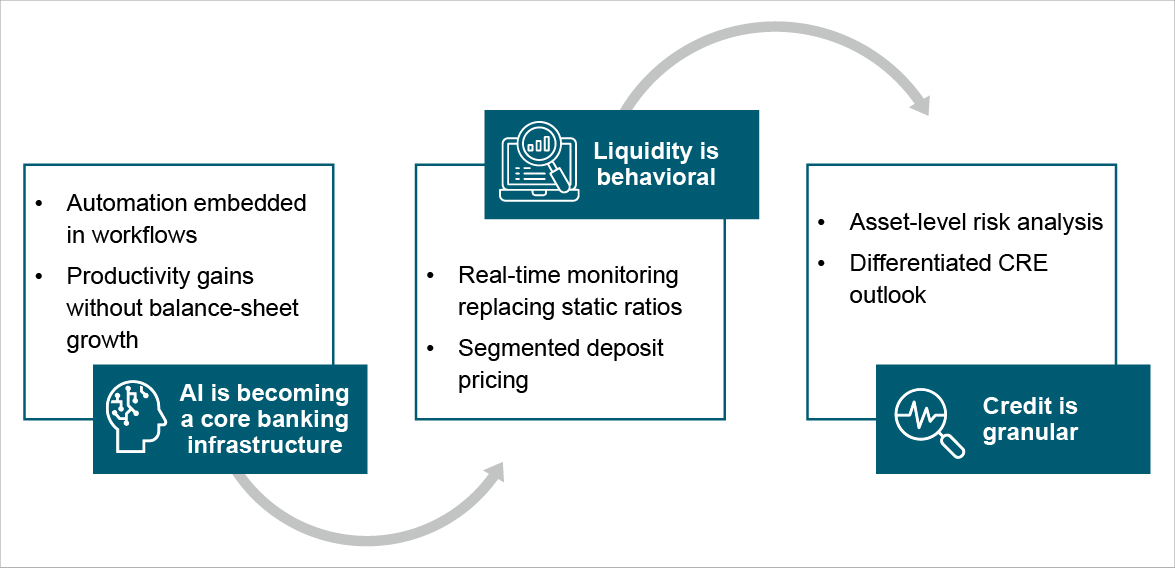
AI is becoming a core banking infrastructure
Across top US regional banks, artificial intelligence (AI) is no longer seen as a mere experiment—it’s increasingly regarded as integral infrastructure embedded into core operating processes. Management commentary in recent quarters has increasingly emphasized automation roadmaps linked to digital platform modernization, back-end automation, fraud detection, digital client acquisition, and cost discipline.
Regional banks typically operate with efficiency ratios of 55-65%. A modest gain in productivity related to non-interest expenses can translate into significant improvements in efficiency ratios, thereby enhancing RoE without expanding risk-weighted assets.
Earnings calls from institutions such as PNC Financial Services, US Bancorp, and Huntington Bancshares explicitly link automation and AI initiatives to forward productivity gains. PNC has identified 171 automation opportunities with an estimated $1.4 billion in addressable spending in its multi-year roadmap. The bank noted that between 2022 and 2025, it has already achieved substantial operating leverage through automation. It expects similar gains from AI-enabled processes over 2025-2030.
Meanwhile, with over 75% of US customers primarily using digital channels, AI-driven personalization is boosting fee income penetration. This not only reduces rate sensitivity but also stabilizes earnings, which could result in a meaningful implication for valuation. This reinforces the fact that AI adoption is more than just a technological fad—it’s a catalyst for capital efficiency.
Liquidity management is now behavioral, not static
Recent earnings calls across regional banks suggest liquidity is no longer just a balance-sheet ratio problem—it’s now a behavioral data challenge. In the current environment, where deposit betas have turned more rate-sensitive and funding competition remains elevated, institutions are explicitly investing in advanced monitoring and data capabilities through:
- Real-time analytics: Banks are ingesting transactional and balance movement data continuously, not just at the end of each quarter or month. This aids in detecting funding stress early on, allowing the treasury team to pre-position liquidity, activate contingent funding lines, and adjust pricing selectively
- Behavioral segmentation of depositors: Deposits are segmented into behavioral cohorts, such as insured retail customers, rate-sensitive corporate accounts, and high-balance uninsured depositors, using machine learning models. This allows banks to avoid blanket pricing actions and focus only on the rate-sensitive segments. Precision pricing directly protects margins and reduces earnings volatility through rate cycles
- Automation and early warning triggers: Automated systems flag withdrawal patterns, correlated movements among similar accounts, and unexpected spikes in digital transfer activity. This reduces the risk of rapid confidence erosion and limits contagion across depositor clusters
In the recent fourth-quarter earnings calls, Regions Financial explicitly linked investments in real-time analytics, depositor segmentation, and dynamic pricing to funding flow management. The bank highlighted its ongoing enhancements in real-time monitoring and data governance to manage risks and funding charges. Meanwhile, US Bancorp described how technology and data analytics help monitor funding flows more closely and respond dynamically to changes in behavior.
From aggregate to granular credit risk analysis
While CRE remains a central swing factor for regional banks, recent earnings reveal a clear shift from viewing CRE as a single risk bucket to analyzing it with asset-level precision. Regional banks have historically disclosed CRE exposure by property type, but recent reporting cycles show a marked increase in granularity, frequency, and investor-focused transparency. This analytical shift—consistent with our commentary in the PoV ‘Structural reset time in US regional banks’1 —is enabling targeted provisioning and informed restructuring decisions.
By disclosing staggered refinancing timelines and diversified tenant bases, banks are signaling that CRE risk is not synchronized across asset classes. Instead of a binary CRE crisis narrative, the emerging data supports a differentiated, asset-specific risk outlook, where losses, if any, are more likely to be distributed over time rather than hitting the entire portfolio at once. This shift from aggregated exposure metrics to granular portfolio analytics represents a meaningful evolution in credit risk management.
The evidence increasingly suggests that US regional banks are not simply benefiting from a cyclical reset—they are undergoing a meaningful evolution in their operating models. Automation embedded in core processes, behavioral liquidity management, and granular credit analytics are reshaping how earnings are generated and protected. These are not incremental upgrades; they represent durable shifts in cost discipline, funding agility, and risk visibility.
If sustained, this evolution could support more consistent earnings, stronger capital flexibility, and improved long-term valuation stability.
The question is no longer whether the cycle has turned. It is whether the market is fully recognizing the depth of the transformation.
1 Structural reset time for US regional banks