Explore Crisil, a company of S&P Global
Formerly known as Global Research & Risk Solutions
February 05, 2026
 Blog
Blog
Blog
GenAI-powered Covenant Guard
February 05, 2026
Blog
Blog
The future of intelligent covenant monitoring
 Share
Share





From manual oversight to machine intelligence: The GenAI edge
The financial landscape is transforming faster than ever before, inundating analysts and lenders with large volumes of data, including loan agreements and compliance reports that span multiple portfolios, geographies and sectors.
Yet, many financial institutions still rely on fragmented systems and use manual spreadsheets to track covenants—an approach that not only increases the risk of errors but also hinders timely, data-driven decision-making.
This is where Crisil Integral IQ’s Covenant Guard, powered by GenAI, helps.
Designed to bring intelligence and automation into covenant monitoring, Covenant Guard enables financial institutions/banks to shift from reactive management to proactive surveillance, making covenant tracking faster, easier and accurate.
Where conventional covenant tracking falls short
Traditionally, covenant monitoring has been a resource-intensive process, where analysts scan through loan documents and compliance packages, extract key ratios, verify financials for accuracy, and manually flag breaches. This approach often results in delays, errors and inconsistencies.
Here are some of the key challenges associated with traditional covenant monitoring:
- Manual and time-consuming: Traditional monitoring relies heavily on spreadsheets, emails and static documents such as financial statements and management reports, which increases operational workload and takes up substantial analyst time, which could otherwise be used for higher-value credit analysis
- Prone to errors: Since the process is largely manual, it is prone to data entry mistakes, incorrect formulas and misinterpretations of credit agreements
- Ineffective communication: Covenant breaches, waivers, headroom contractions, amendments and terminations are often tracked via emails, leading to delayed risk identification, escalations and inconsistent documentation of historical decisions
- Lack of standardisation: Covenants are checked though compliance certificates and financial statements that are stored in disparate locations, making it difficult to establish a centralised database, source data, or perform consistent analysis across a portfolio
- Lack of analytics: The lack of a centralised, structured system makes it challenging to conduct complex data analysis, visualise data, track historical trends, or generate real-time reports for internal stakeholders or regulatory bodies
Covenant Guard reimagines covenant monitoring, leveraging GenAI to:
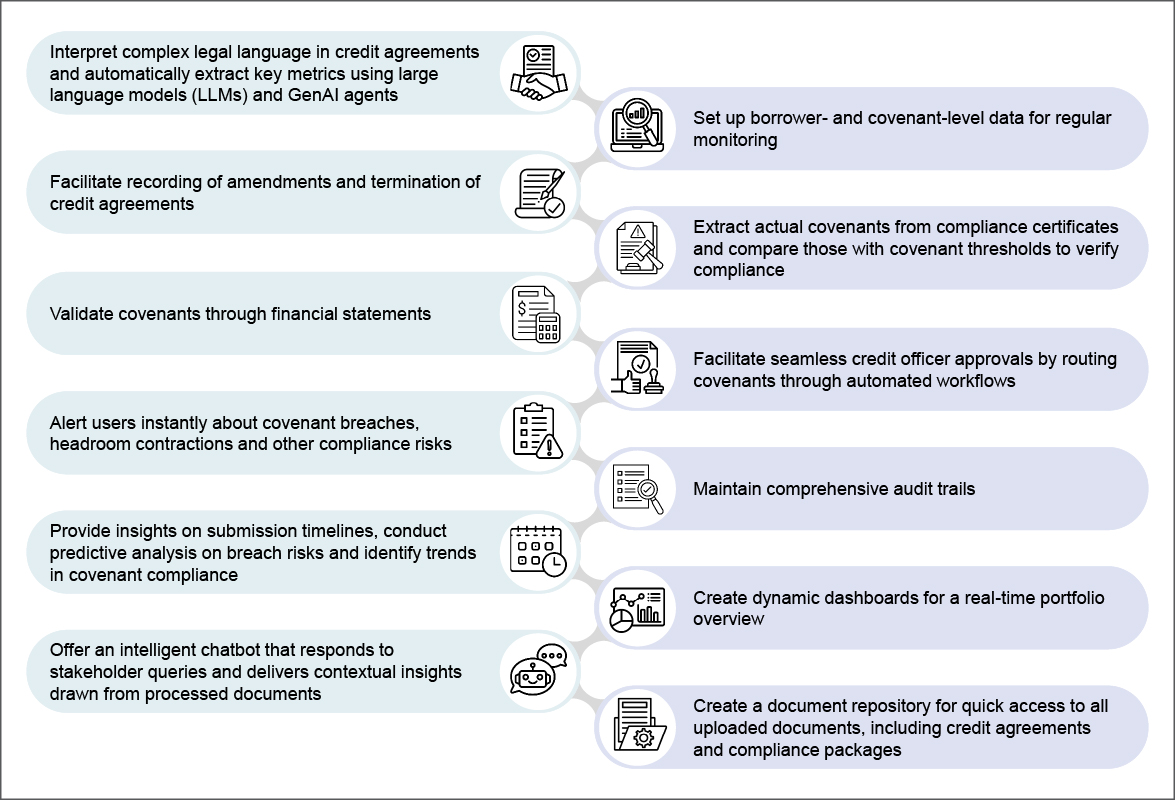
In short, Covenant Guard provides end-to-end covenant intelligence—from extracting clauses and affirmative and negative covenants to predicting breaches. This improves process efficiency by ~70% and transforms covenant management into a proactive, predictive capability.
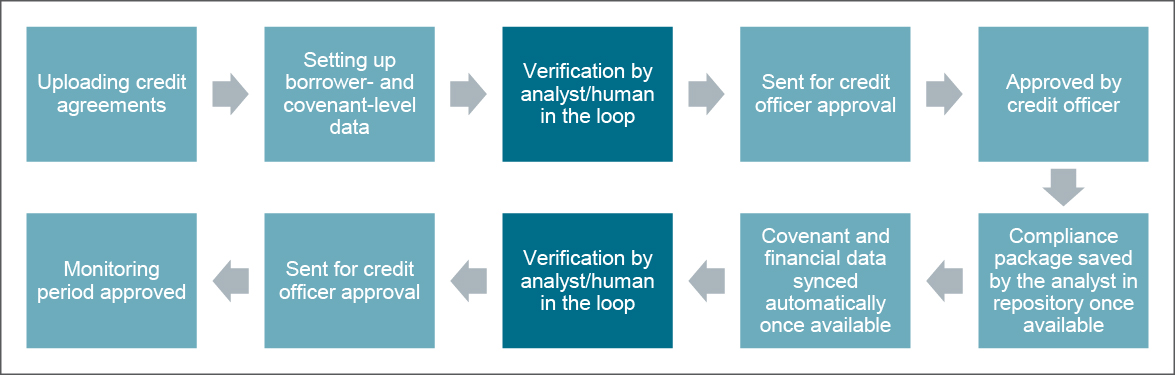
Process flow of covenant monitoring by Covenant Guard
Why it matters now
Post-pandemic credit cycles, rising interest rates and volatile market conditions have made it more critical for lenders to detect early warning signs.
Missed covenant breaches can lead to capital erosion, regulatory exposure and reputational damage. For instance, during 2017-2020, a top European bank relied on legacy, manual risk and covenant tracking processes across loan books and counterparties. Control breaches were, hence, not escalated on time, and covenant compliance documentation was inconsistent. As a result, the bank was fined over USD150 million by US regulators and publicly criticised for its weak internal control mechanism.
Integrating GenAI with Covenant Guard helps overcome such challenges. It delivers continuous, intelligent oversight, enabling quick decisioning and proactive actions before the risk materialises.
GenAI adoption: Challenges to overcome and guardrails to implement
While GenAI is being increasingly adopted across the credit value chain, it’s got its quirks. Sometimes it can misinterpret data or hallucinate results, which may lead to inaccurate extraction of covenants from complex credit agreements or overlooked covenant breaches, especially if we rely on it without a human in the loop. Plus, there are concerns regarding data privacy and regulatory expectations around explainability and auditability.
To unlock GenAI’s true potential, Crisil has implemented strong guardrails around Covenant Guard, including retrieval-augmented generation with approved contract sources, mandatory clause-level citations and human-in-the-loop reviews.
Additionally, deploying controlled LLM environments, enforcing rule-based access, maintaining audit trails and embedding rule-based validation for calculations could improve reliability and compliance.
Redefining covenant monitoring as a strategic advantage
The shift from manual monitoring to AI-driven insights represents a strategic advantage for organisations—it’s not just technological evolution.
Covenant Guard enables institutions to:
- Move from compliance tracking to risk anticipation
- Replace static reports with real-time dashboards that evolve with every data update
- Turn covenant management into a competitive differentiator, not a back-office task