Explore Crisil, a company of S&P Global
Formerly known as Global Research & Risk Solutions
March 25, 2026
 Blog
Blog
Blog
New NPR, a turning point for US capital rules
March 25, 2026
Blog
Blog
US banks get relief, the global level playing field gets a crack
 Share
Share




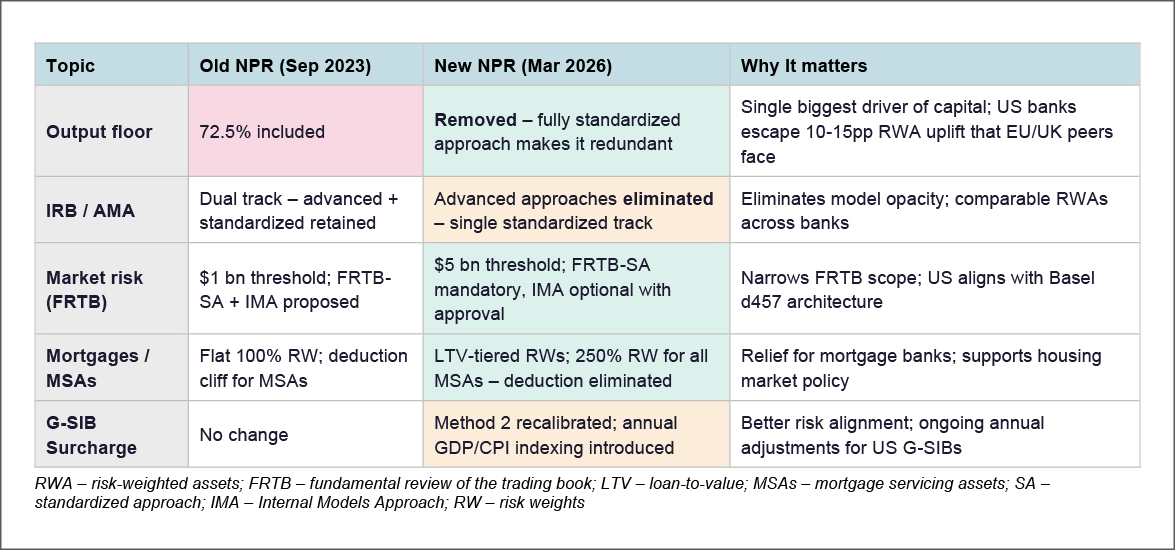
Three US federal banking agencies—the US Federal Reserve (Fed), the Office of the Comptroller of the Currency, and the Federal Deposit Insurance Corporation—issued a coordinated Notice of Proposed Rulemaking (NPR) on March 18, 2026, which removed the output floor of 72.5%.
This marks the most significant capital reform since the implementation of the Basel III regulations after the Global Financial Crisis of 2007-08.
The new NPR is not just a technical update but also marks a strategic retreat by US regulators.
By swinging from a projected 19% increase in Common Equity Tier 1 (CET1) to a 5% reduction, the Fed has effectively signalled that US bank competitiveness now outweighs the 'gold-plating' ambitions of 2023.
Five critical shifts
Impact on capital
The new NPR delivers a net 5% reduction in CET1 requirement for Category I and II holding companies when combined with NPR 2, NPR 3, and the Fed's October 2025 stress-testing changes—a roughly 24 percentage points swing vs the previous projected +19% increase.
Regional banks benefit even more. Category III and IV subsidiary depositories will see an estimated −7.8% CET1 reduction under NPR 2 alone, driven by loan-to-value-based mortgage risk weights and elimination of the mortgage servicing assets deduction cliff.
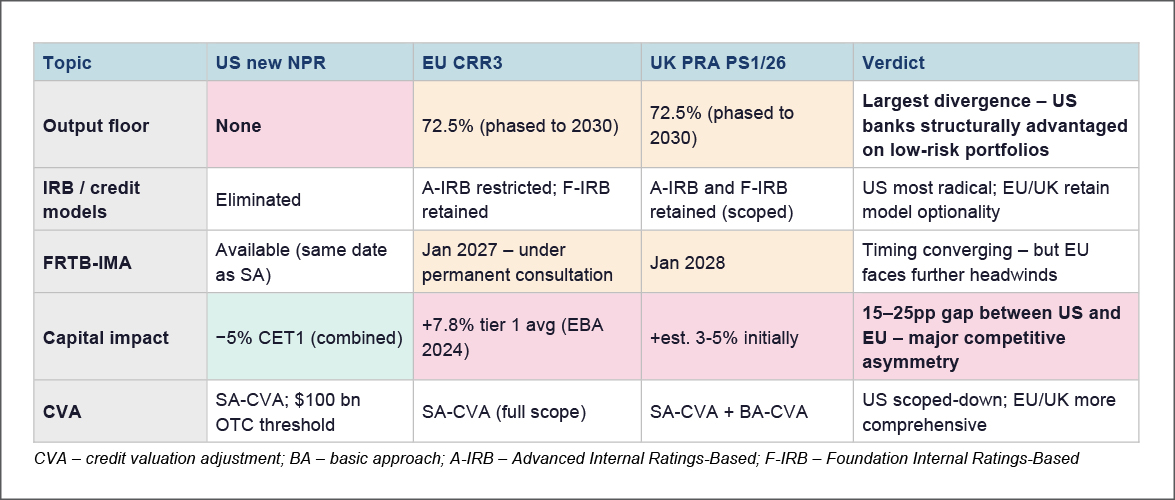
In contrast, EU banks face an average +7.8% tier 1 increase under Capital Requirements Regulation III (CRR3; European Banking Authority 2024 impact study), thereby translating into a 15-25 percentage point capital gap between US and EU peers on equivalent portfolios—the starkest transatlantic divergence since Basel III was finalized.
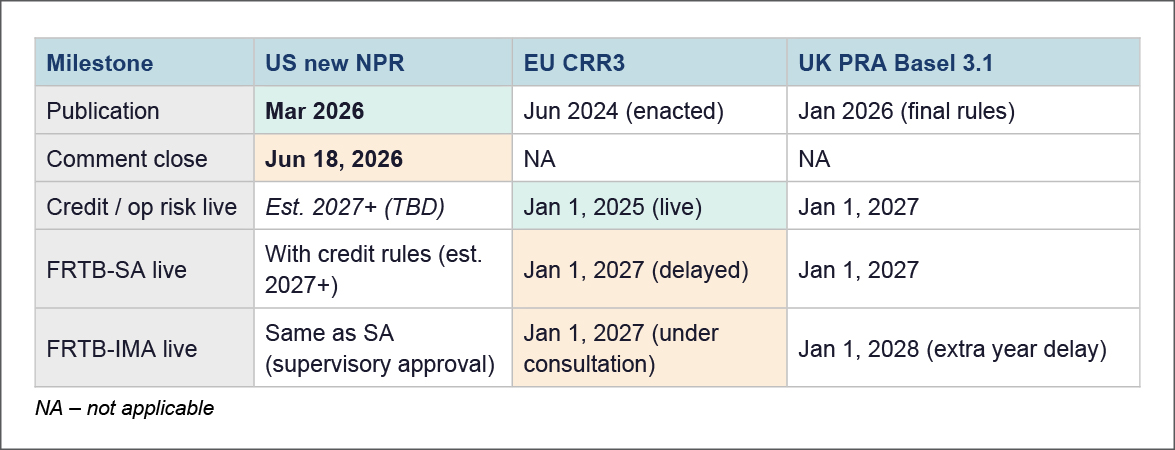
Timeline | New NPR vs peers
Critical divergences | US vs the EU and the UK
Our perspective
US banks should act now
- Run quantitative impact studies immediately: Model risk-weighted asset impact under the new expanded standardized approach across credit, market, and operational risks
- Re-scope the Fundamental Review of the Trading Book (FRTB): Banks need to determine if they fall in or out of the $5 billion trading threshold; those that are above must accelerate FRTB-SA build
- Model global systemically important banks (G-SIB) Method 2 trajectories: Annual GDP/CPI indexing changes the surcharge management dynamic permanently
- Engage the comment process before June 18, 2026: Credit valuation adjustment threshold, Basic Indicator Approach operational risk calibration, and FRTB scope questions all invite substantive input
- Plan internal ratings-based/ advanced measurement approach wind-down: Models shift from capital engines to risk management tools; governance frameworks need updating
Basel objectives weakened
The removal of the output floor is the most consequential deviation from Basel III compact since the standard was finalized. With EU banks facing a +7.8% average tier 1 increase and US banks a −5% combined reduction, the CET1 gap between similarly-rated US and EU institutions could exceed 15-25 percentage points on equivalent portfolios.
This undermines the Basel framework's core promise of a global minimum standard and creates real competitive distortions in traded markets, cross-border lending, and regulatory arbitrage of booking locations.
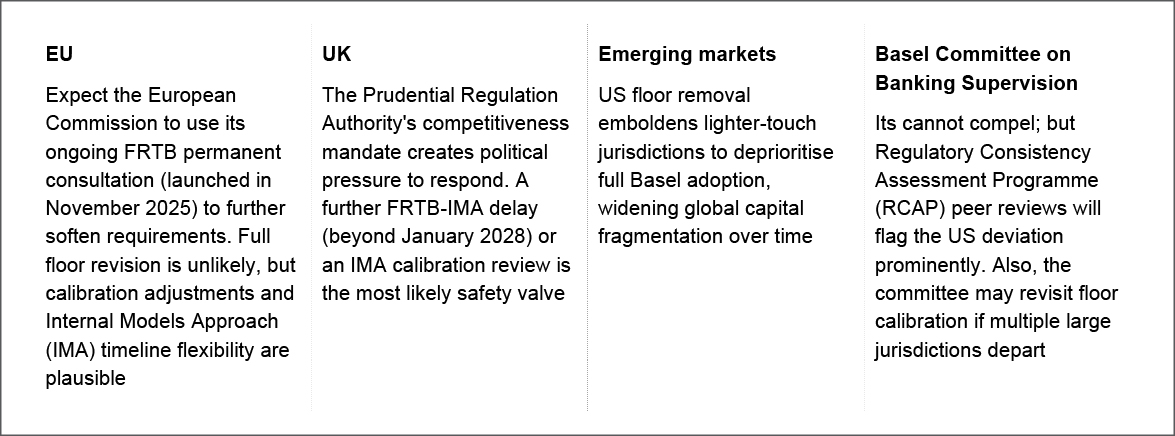
What other jurisdictions may do