1. IMA: Why the latest NPR is more adaptable
Earlier problem: The 2023 proposal made desk-level IMA expensive to implement and hard to sustain because of the need to pass desk-level back testing and PLAT, manage modellability continuously and accept fallback to standardized capital if approval could not be retained.
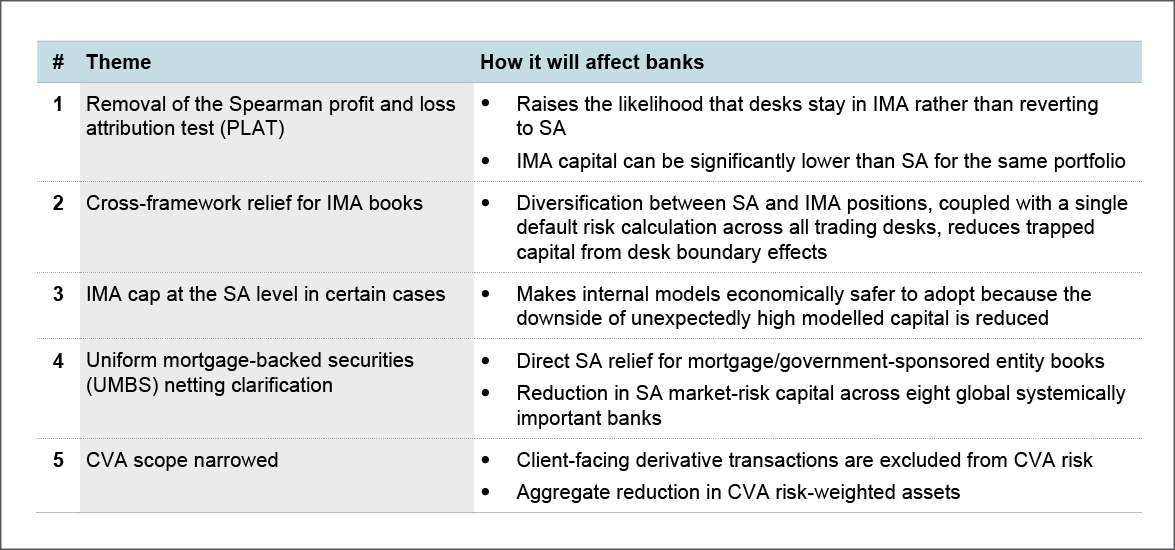
What changed: The latest NPR explicitly removes the Spearman correlation PLAT test, retains the Kolmogorov-Smirnov distributional test, allows diversification between SA and IMA positions, uses a single default risk calculation for all trading desks and contemplates capping IMA capital at the SA level in certain circumstances.
Why it matters: This shifts IMA from being theoretically attractive but operationally punitive to being a more credible capital option for large US trading books. Desks with liquid products, strong daily profit and loss (P&L) explain and stable front-office versus finance valuation alignment now have a clearer path to remain modeled.
Who benefits most: Rates, foreign exchange, liquid credit, listed equity and macro flow desks benefit the most because these desks generally have stronger transaction data, shorter liquidity horizons, better hedging evidence and cleaner daily hypothetical vs risk-theoretical P&L explain. Illiquid structured, bespoke, deep basis and correlation-heavy desks still face materially harder modellability and non-modellable risk factor (NMRF) outcomes.
Important nuance: The proposal does not make IMA easy. The bank still needs desk-level governance, independent validation, annual review, integrated daily risk use and supervisor approval. The relief is best read as a reduction in avoidable adoption friction, not as a weakening of model standards.
2. RFET, NMRF, liquidity horizons and floors: the real gating items
The risk factor eligibility test (RFET) remains demanding: A risk factor is modellable only if it passes both a qualitative data standard and the quantitative real-price test. The latest NPR uses a bucketed RFET design with at least 24 real prices in the prior 12 months for the most liquid risk factors and at least 16 for all others, with no more than one count per day and only limited timing flexibility for external data.
Type A vs B NMRFs still matter: Type A NMRFs pass the qualitative test but fail the quantitative one. They remain inside IMCC (internal models capital charge) and are also capitalized through stressed expected shortfall (SES). Type B NMRFs fail the broader data-quality standard and receive the harshest treatment because they are capitalized only through SES with more conservative assumptions.
Flooring does not follow the Basel story: The proposal does not adopt the Basel 72.5% output floor because the wider US framework is already mostly standardized. For market risk, the more relevant floor is that IMA is effectively constrained by model multipliers, PLAT add-ons where relevant, SES treatment for NMRFs, and in some cases a cap at the SA level. That is why IMA is still clearly preferable only for desks whose risks are observable, hedge-able and explainable.
Liquidity horizons still shape capital: The latest NPR retains longer liquidity horizons for less liquid risk factors and a minimum 20-day horizon in SES for NMRFs. So even where model approval is easier than under the 2023 proposal, capital will still stay elevated for volatility, spread and other less liquid risk factors.
3. Standardized market risk and CVA: Targeted relief, not architectural
 Explore Crisil, a company of S&P Global
 Blog
Blog
 Share
Share