Explore Crisil, a company of S&P Global
Formerly known as Global Research & Risk Solutions
April 14, 2026
 Blog
Blog
Blog
US private credit trends, 4Q25
April 14, 2026
Blog
Blog
Momentum on track, but resilience to be tested
 Share
Share




Snapshot
Private credit has become embedded as a core asset class over the past few years, and its popularity has continued into the fourth quarter of 2025. From a niche institutional strategy, it has evolved into a structural allocation for insurance, wealth and retail investors.
Private credit managers have accelerated efforts in the quarter to fund infrastructure in general, and digital infrastructure in particular, with asset-backed finance (ABF) strategies also becoming central to credit platforms.
In a bid to expand scale, diversify product offerings, and broaden the investor base, managers have continued to choose acquisitions as the preferred route, with several notable transactions in the quarter. Further, with mergers and acquisitions (M&As) and initial public offers (IPOs) still muted and market volatility rising, there has been a shift toward evergreen structures and private secondaries. European markets are also becoming a strategic focus for US managers.
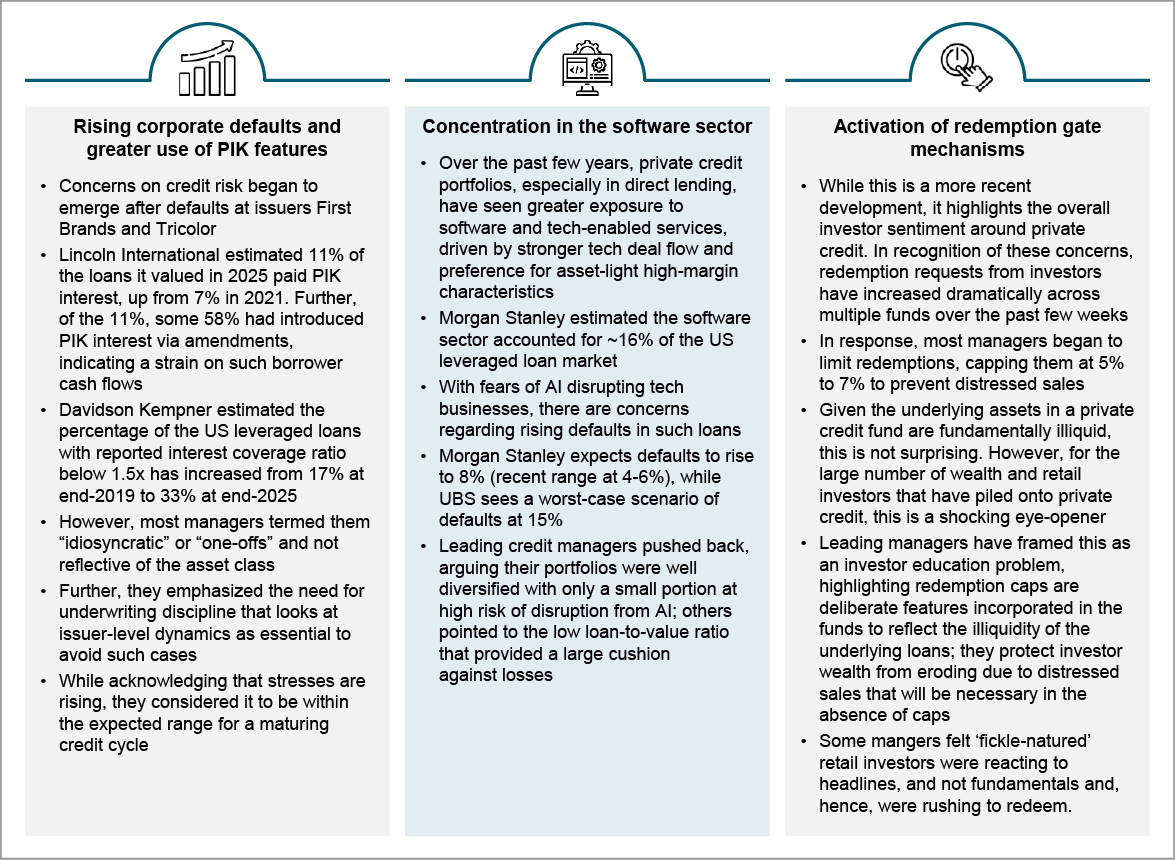
However, developments in late 2025 and early 2026 underscored the asset class is not immune to stress—corporate defaults at issuers such as First Brands and Tricolor, increased use of payment-in-kind (PIK) features, rising concerns around concentration in software sector that is exposed to artificial intelligence (AI)-driven disruption, and activation of redemption gate mechanisms that curtail liquidity. While leading asset managers have been refuting these perceptions, successfully navigating the heightened scrutiny is critical for private credit to evolve as an enduring asset class.
Infrastructure credit, especially digital, takes off
With the increased competition in traditional direct lending, credit managers have been increasingly deploying capital into the asset-heavy, cash-flow-stable infrastructure sector. They are attracted by long-duration contracted cash flows, inflation-linked revenue profile, relatively lower default rates and potential alignment with sustainability themes. Macro trends such as the replacement of aging infrastructure coupled with the tidal wave for renewable energy also ensure a large supply of attractive assets for deployment.
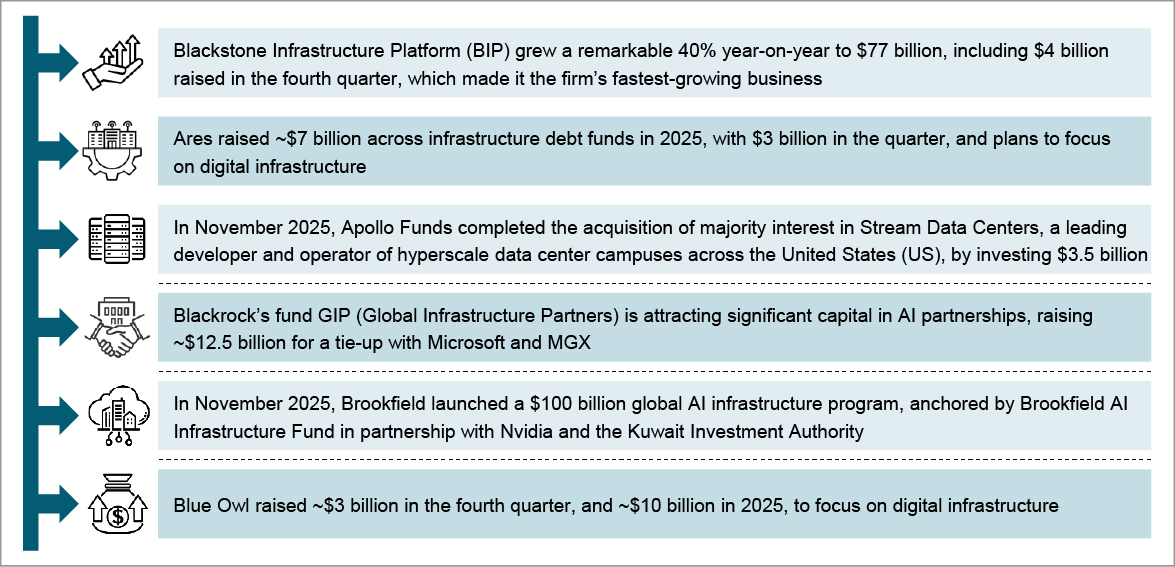
Digital infrastructure is a booming sub-domain in the space, with the rush for artificial intelligence (AI), cloud adoption and high-performance computing spawning financing demand for data centers and fiber networks, among other assets. Credit managers are adopting strategies such as direct investments in hyperscale facilities, partnerships with operators and focus on sustainability to meet high power (renewable energy) demands.
Developments in the fourth quarter underscored this trend.
ABF strategies becoming core to credit platforms
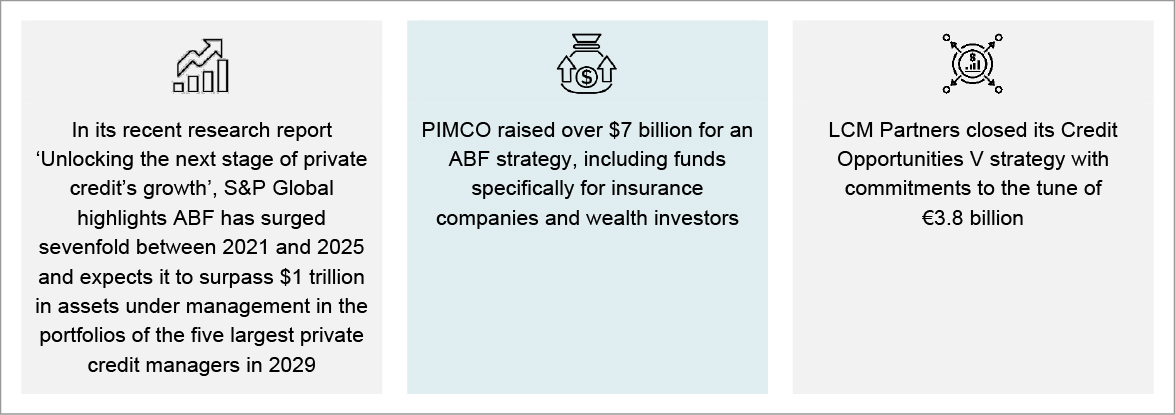
ABF strategies are moving on a similar trajectory to infrastructure—as traditional banks reduce their lending and investor appetite for collateralized credit increases, these are playing a pivotal role in the growth and diversification of private credit platforms. Offering strong collateral coverage, lower correlation with traditional corporate credit and robust downside protection, ABF strategies are now a key offering across major private credit managers.
Notable developments in the fourth quarter include:
Partnerships, joint ventures and mergers and acquisitions continue
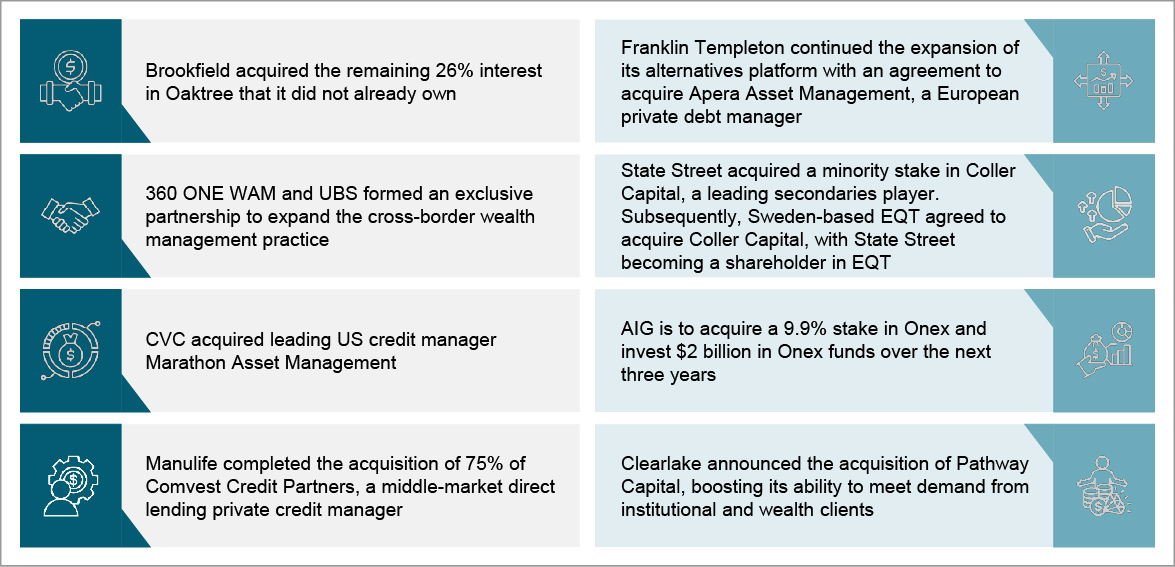
Managers seeking scale, product diversification and broader investor reach prefer to buy rather than build to rapidly gain expertise and market share. This trend continued in the fourth quarter of 2025, with robust M&A activity, partnerships and joint ventures with managers evolving to become full-spectrum credit providers.
Some notable actions in the quarter include:
Surge in private credit secondaries to enhance liquidity
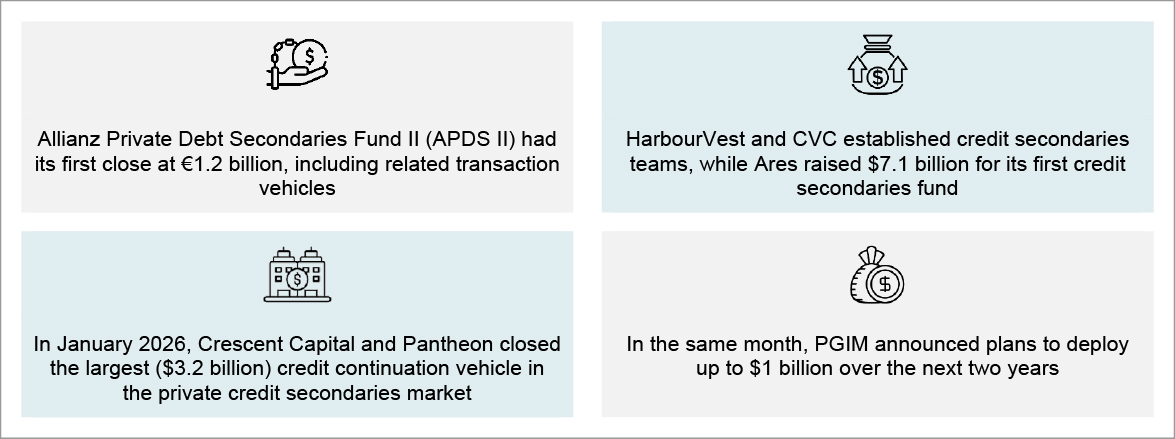
Private secondaries have emerged as a crucial source of liquidity for limited partners (LPs). They are increasingly viewed as an essential tool for portfolio management amid the slower exit environment for LPs to rebalance exposure and access liquidity. They encompass LP-led transactions, general partner-led continuation vehicles and asset-level sales.
Key developments in the fourth quarter:
Evergreen funds grow at rapid clip
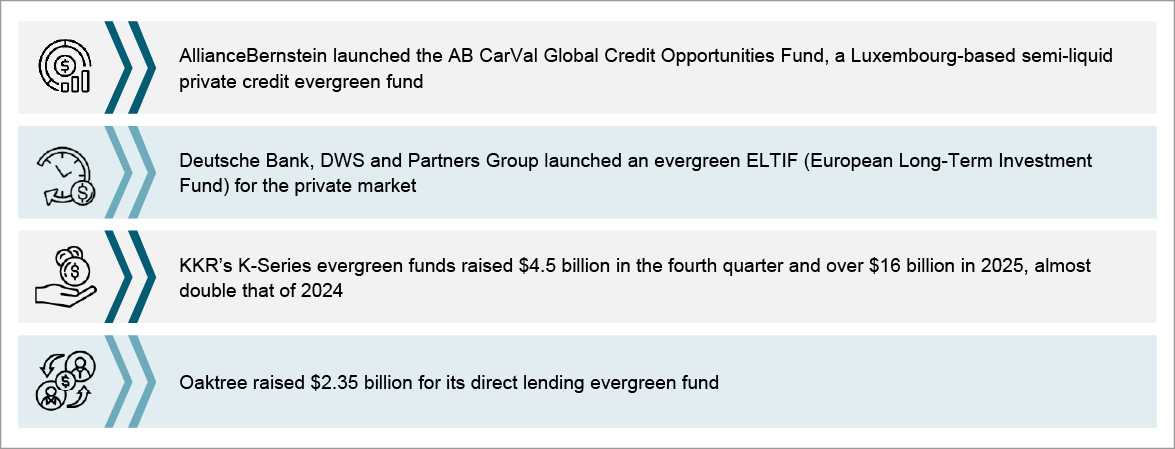
The surge in private evergreen funds is being fueled by growing interest from retail and wealth investors, alongside recent regulatory changes in the United Kingdom (UK) and the US that encourage the inclusion of private market assets in retirement accounts. Assets under management (AUM) in evergreen credit funds have grown significantly in recent years, with PitchBook and Morningstar estimating end-2025 direct lending evergreen AUM tripling to $236.7 billion in three years.
Developments in the last quarter of 2025 include the following:
European markets are becoming a larger strategic focus
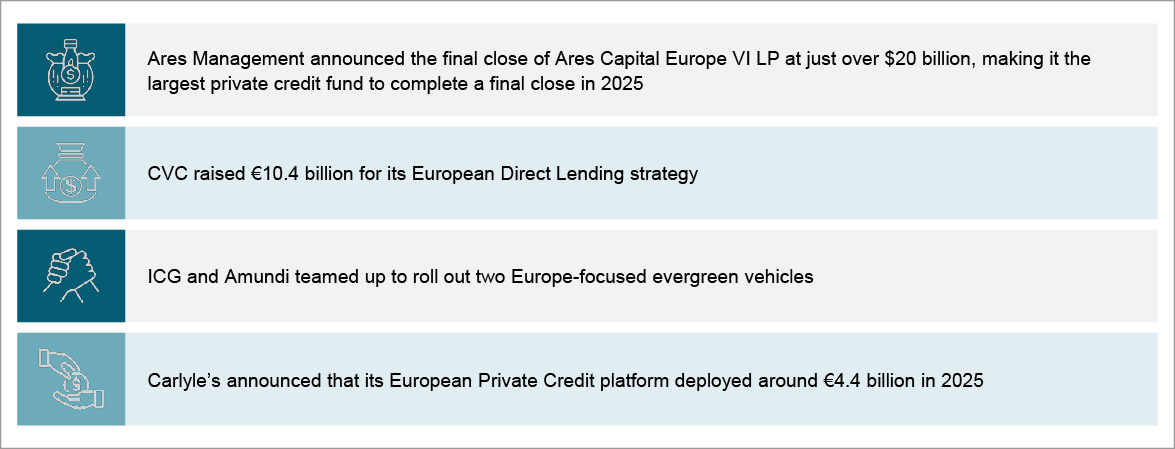
Growth initiatives are increasingly expanding beyond the US into Europe, where firms are establishing regional platforms and launching localized products. Europe's private credit markets are characterized by diverse legal, regulatory and cultural dynamics across jurisdictions. In 2025, private credit fundraising in the UK and continental Europe rose 40%, as reported by Preqin, reflecting significant momentum.
Key developments in the fourth quarter
Highlights from major listed US private managers
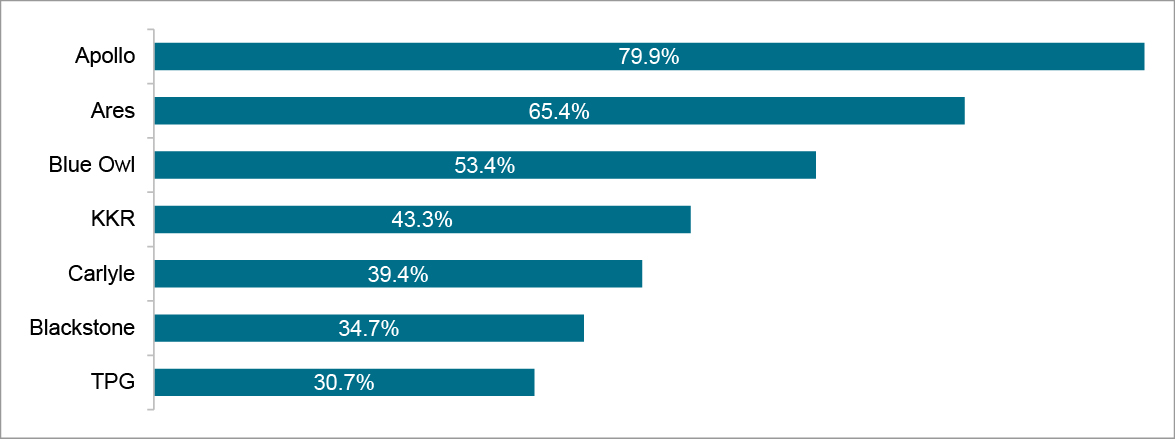
In its research report, US Public PE and GP Deal Roundup’, PitchBook estimates that the big seven listed private manager (Apollo, Ares, Blackstone, Blue Owl, Carlyle, KKR and TPG) have, on average, 51.2% of their AUM concentrated in credit.
Share of credit strategies in total AUM by manager (as of December 2025)
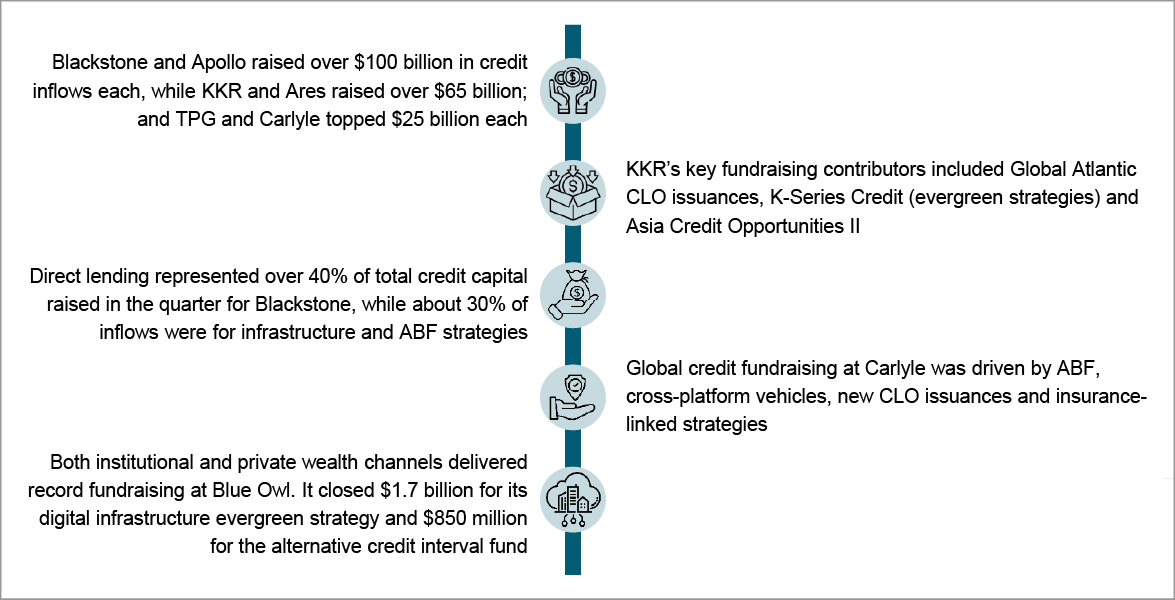
Fundraising: Credit strategies for these seven firms led fundraising, accounting for $92 billion in inflows in the fourth quarter and $451 billion over 2025, representing 52.8% of total 2025 inflows. These substantial credit inflows were more than double those of private equity, the next highest strategy, and surpassed inflows from all other strategies combined for the full year.
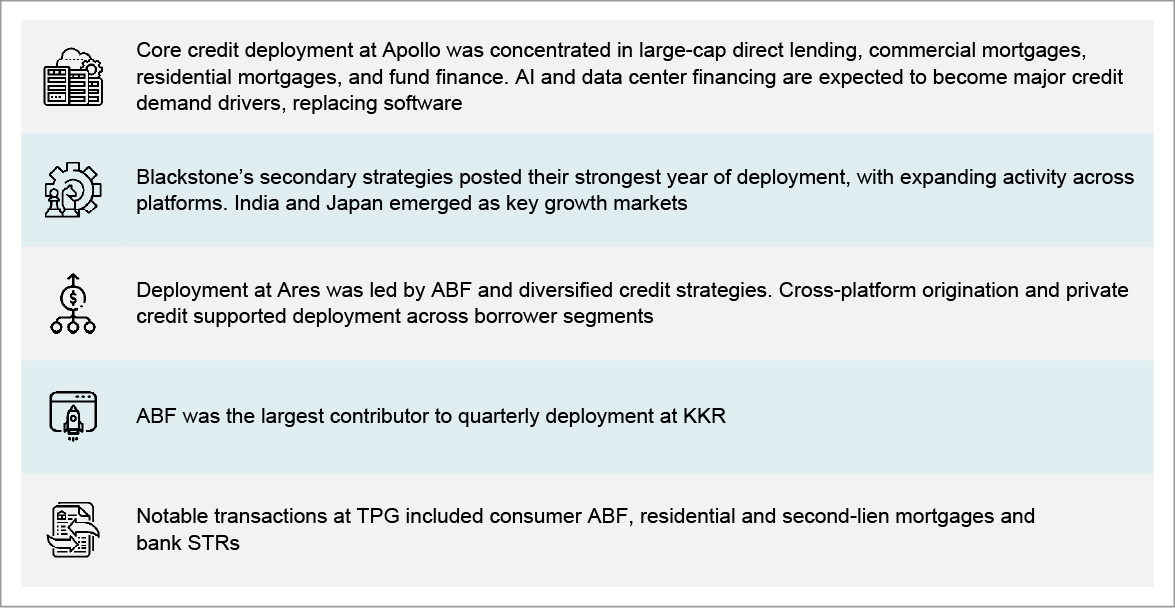
Deployment: Private credit deployment remained robust throughout the year. These seven firms deployed $605 billion over the year, up 21.9% compared to the previous year. In the fourth quarter, they deployed over $160 billion, up 38.4% year-over-year.
Rising concerns about private credit being refuted by leading managers
While the growth of private credit as an asset class has been robust, there is growing scrutiny around the underlying risks. Several concerns have been emerging as the market matures and the macro environment turns.
While acknowledging these concerns, private credit managers have been quick to argue that while there are issues in pockets, the asset class remains sound with outcomes diverging based on the manager quality and underwriting discipline.