Explore Crisil, a company of S&P Global
Formerly known as Global Research & Risk Solutions
May 19, 2026
 Blog
Blog
Blog
 Share
Share



US regional banks are steadily expanding their private banking capabilities, making deliberate, expensive bets on the segment as the next engine of profitable growth. And at the heart of that bet lies a critical capability: to underwrite complex, bespoke credit for high and ultra-high net worth (HNW/UHNW) clients whose financial profiles look nothing like that of a standard borrower.
Private banking underwriting requires a fundamentally different risk assessment framework from conventional commercial or corporate lending. This is because traditional models quickly reach their limits when a client’s balance sheet includes concentrated equity positions, private investments, complex trust structures and multi-jurisdictional assets.
Spotlight: Citizens Bank’s regional private banking bet
While Citizens Bank, U.S. Bank and many of their peers are expanding into private banking, few stories illustrate the opportunity better than Citizens’ aggressive expansion since 2023. Born out of the disruption caused by the failures of Silicon Valley Bank and First Republic Bank, Citizens Private Bank was launched in mid-2023 and has since undergone rapid expansion.
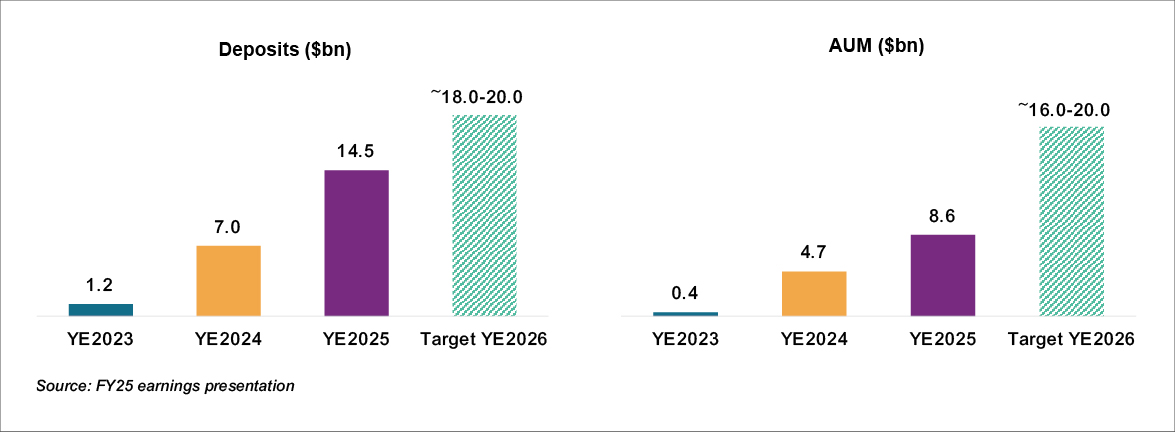
The broader trend reflects a growing industry focus on stable deposit gathering, fee-based revenue diversification and a deeper client wallet share following the liquidity stresses in the regional banking sector in 2023.
A different paradigm
Corporate underwriting is grounded in audited financials, EBITDA (earnings before interest, tax, depreciation and amortization) multiples and covenant structures. Private banking, however, follows an entirely different approach, highly bespoke and tailored to individual client needs rather than standardized financial metrics.
HNW clients have substantial yet often highly illiquid wealth, locked in private businesses, real estate portfolios, concentrated equity positions, hedge funds or family trusts. Reported taxable income may not fully reflect underlying wealth generation capacity due to complex entity structures and tax-planning strategies. Their balance sheets span multiple jurisdictions, legal entities and asset classes.
Standard underwriting models fail these clients. And yet, the credit risk is real. Overleveraging a client against an illiquid or concentrated position is one of the most consequential mistakes a private bank can make, as First Republic Bank’s collapse in 2023 starkly illustrated. The collapse reinforced the importance of disciplined concentration management, collateral monitoring and liquidity stress testing within private banking portfolios.
The pillars of private banking underwriting
While every private bank develops its own framework, the strongest underwriting practices in the segment are built on the interlocking pillars below.
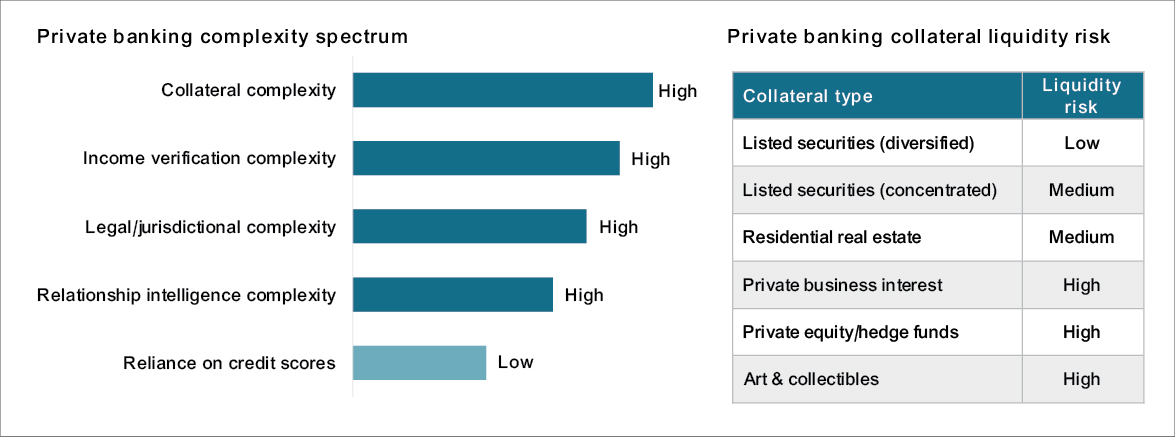
Balance sheet assessment: Private banking requires mapping of liquid assets, such as cash and marketable securities, alongside illiquid ones like private equity stakes and real estate. Liabilities must be captured in full, including contingent ones such as personal guarantees. The goal is a consolidated net worth picture that reflects economic reality. This highly specialized analysis requires close collaboration with the client’s accountants, tax advisors and family office.
Collateral assessment: Private banking collateral is frequently non-standard. Securities-based lending is perhaps the most common instrument, but regional banks are increasingly encountering real estate held in limited liability companies, art collections, private equity fund interests and life insurance cash surrender values. Each requires specialist valuation, careful haircut methodology and rigorous analysis of liquidity risk under stress conditions. A securities portfolio can be liquidated in days, while a private equity stake may be illiquid for years. This creates heightened importance around collateral haircuts, advance rates and continued portfolio monitoring.
Regulatory perspective and concentration: The collapse of First Republic Bank underscored concentration risk as a critical vulnerability in private banking. Regulators now demand rigorous stress testing, enhanced transparency and stricter exposure limits to mitigate systemic risks. At the portfolio level, banks must enforce rigorous concentration limits, real-time monitoring and consistent margin call protocols to prevent rapid collateral erosion, even for high-fee-generating wealth clients. These proactive risk management frameworks are essential to balance customized credit structuring with robust oversight.
Legal and jurisdictional complexity: Many UHNW clients hold assets through trusts, limited partnerships, offshore holding companies or family limited partnerships in multiple states or countries. Enforcing security interests across these structures requires legal analysis that goes well beyond standard loan documentation. Which entity owns the asset? Is trust revocable? What are the governing laws of the jurisdiction? These questions, if insufficiently answered, become extremely costly in a workout scenario.
The relationship layer, underwriting’s invisible pillar
There is a dimension of private banking underwriting that does not appear in any credit policy manual: relationship intelligence. A private banker who has worked with a client for five years knows if this client has always met commitments, if there is a family succession dispute brewing or whether the client may be approaching a liquidity event or broader transition in their business holdings. This intelligence does not replace quantitative analysis, but sharpens it.
It also creates a governance challenge. The relationship manager, whose compensation may be tied to the client relationship, must not be the final voice in a credit decision. Hence, the relationship team and the credit function must be independent, with relationship intelligence feeding into, but not determining, the underwriting outcome.