Explore Crisil, a company of S&P Global
Formerly known as Global Research & Risk Solutions
June 02, 2026
 Blog
Blog
Blog
 Share
Share




The adoption of artificial intelligence (AI) in banking and finance has reached scale, with 58%1 of finance functions actively using the technology and around two-thirds of banks advancing their generative AI initiatives.
While confidence in technology is rising, the pace of adoption is beginning to plateau owing to data, talent and integration challenges.
As many as 61%2 of banks surveyed have reported a tangible impact from GenAI. Meanwhile, other institutions are still in the early stages of their journeys, with limited end-to-end deployment and continued reliance on fragmented use cases rather than fully integrated decision workflows.
The first line of defence (1LoD) at banks, comprising client coverage, credit analysis, underwriting and risk rating, is poised for a similar transformation.
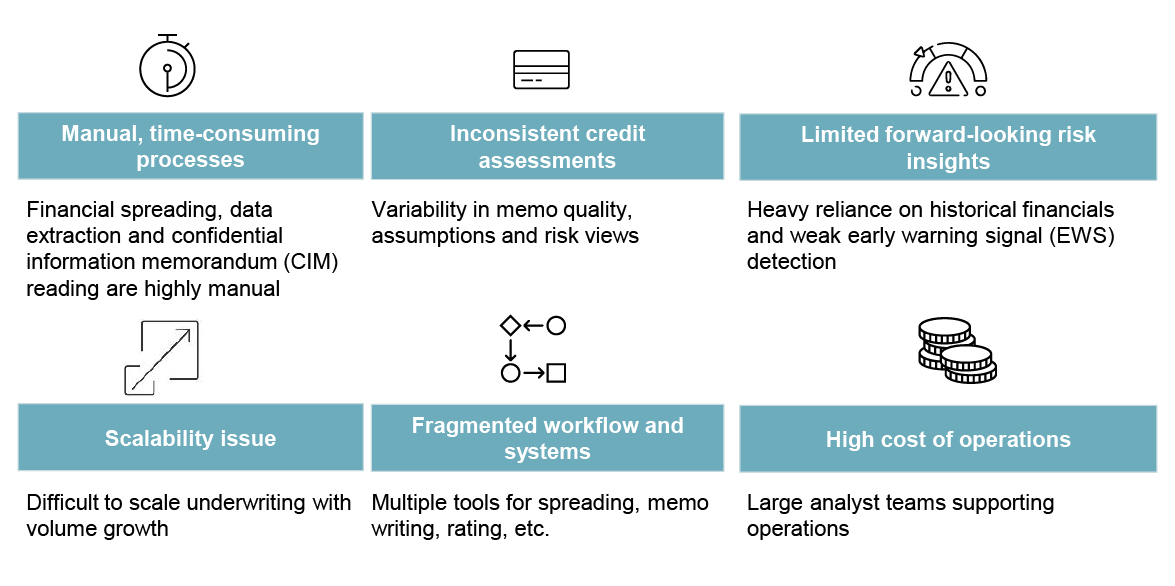
Traditionally, the function has been characterised by manual workflows, fragmented systems and processes dependent on individual judgement, but AI-led augmentation is now transforming this space, aiding a more streamlined and efficient approach.
The goal of this transformation is not to replace bankers but harness AI’s capabilities to accelerate cycles, enhance consistency and facilitate early identification of potential risks.
Typical bottlenecks observed in 1LoD
Where AI fits
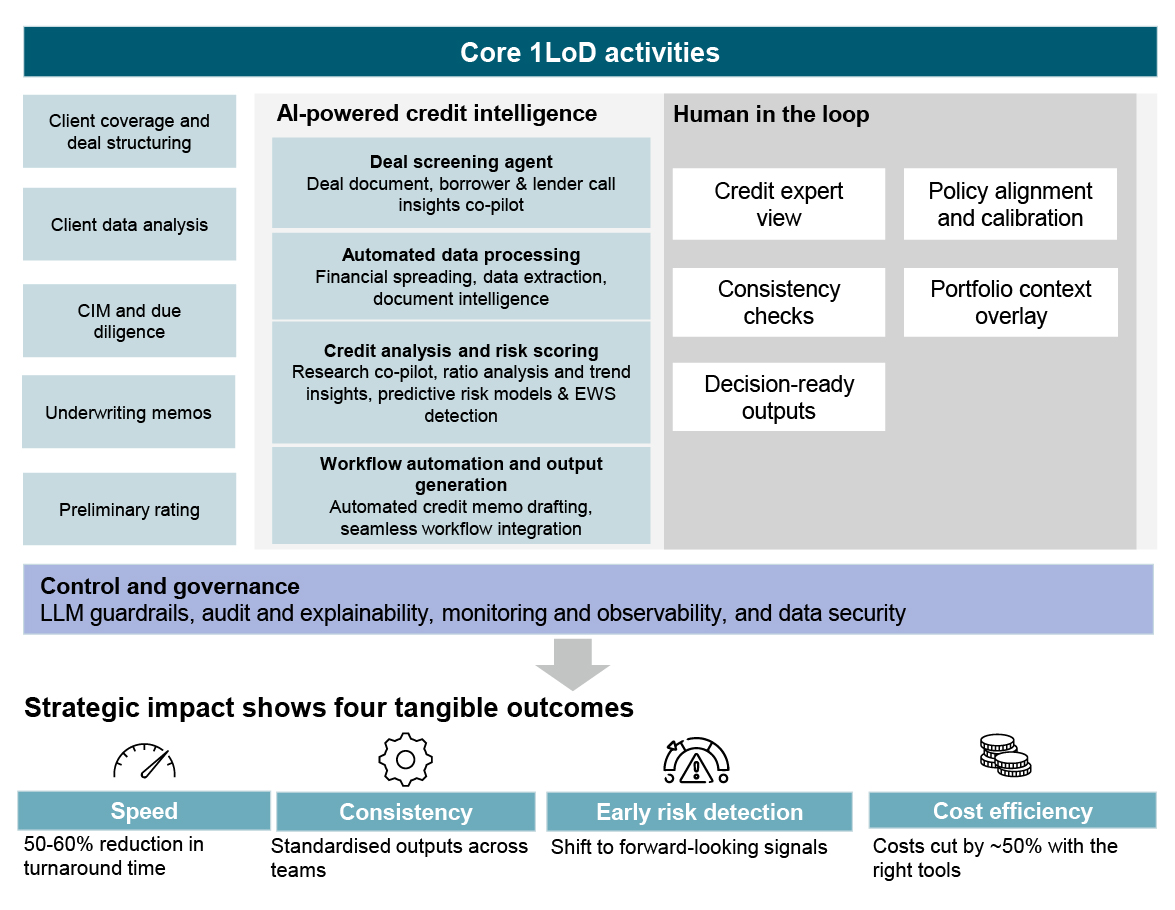
AI deployment in 1LoD is most effective when embedded across five core workflows:
- Client coverage and deal structuring: AI-powered copilots integrated into customer relationship management platforms can convert conversations into structured outputs, including summaries, action items and risk signals. When guided by domain-specific templates and review layers, these outputs become decision-ready.
- Client data analysis: AI-driven platforms, such as S&P Capital IQ and Ratings360, offer a range of benefits:
• Automated borrower profiling
• Predictive analytics and scenario modelling
• Peer benchmarking and early risk indicators
However, to leverage these insights, expert calibration is necessary to align them with portfolio strategy and credit frameworks.
- CIM, due diligence and screening: AI accelerates diligence through structured extraction, entity matching and adverse media screening. The true value of AI lies in contextualising outputs with credit narratives and risk interpretation.
- Underwriting and credit memo creation: GenAI enables automated drafting of credit memos, policy checks and consistency validation. To warrant accuracy, a human-in-the-loop approach is essential, which ensures:
• Consistency with internal rating frameworks
• Clear articulation of risks and mitigants
• Decision-grade outputs, not just drafts
- Preliminary risk rating: AI-powered platforms, such as Finbots, support real-time scoring, automated credit evaluation and continuous risk monitoring. When combined with expert overlays, these platforms enable forward-looking, portfolio-aware risk assessments.
Why human still matters
Banks are increasingly adopting AI tools to streamline their workflows, but a significant gap remains. Most implementations struggle with five key challenges:
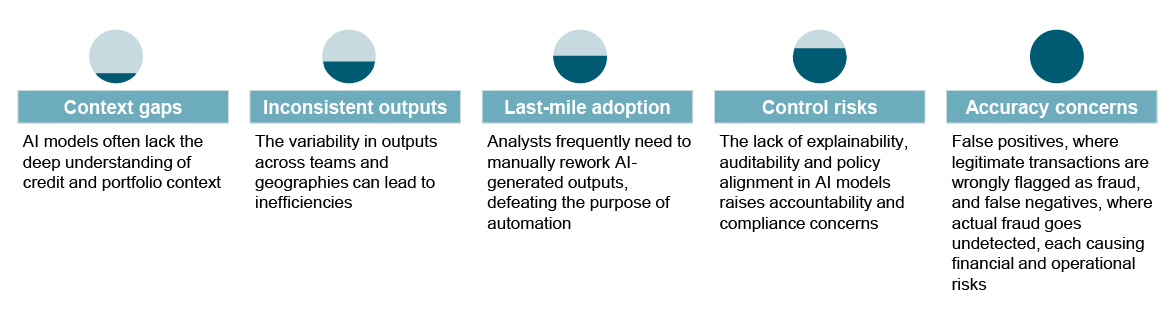
A critical evolution in the "human-in-the-loop" model at US commercial banks is the migration of QC/QA functions out of traditional Operations or 3LOD units and directly into the First Line of Defense (1LOD). Because AI models frequently encounter context gaps and require nuanced oversight to prevent false positives and ensure policy alignment, post-deployment auditing is no longer sufficient. By building out QA capabilities within the 1LOD—often empowered by emerging AI governance and continuous testing platforms—banks are ensuring that human oversight is applied in real-time, bridging the gap between AI-generated outputs and final, client-ready execution.
Consequently, AI often only achieves ‘first draft’ efficiency, without truly transforming decision-making processes.
What is emerging instead is a more pragmatic model, AI augmented by domain expertise, where human judgement is embedded into the workflow, not layered on after.
What banks need
AI stacks for scalable 1LoD
To achieve scalable AI-enabled 1LoD, banks must move beyond point solutions. Leading banks are building integrated AI stacks with four layers—data, AI/machine learning (ML), application, and control layers.
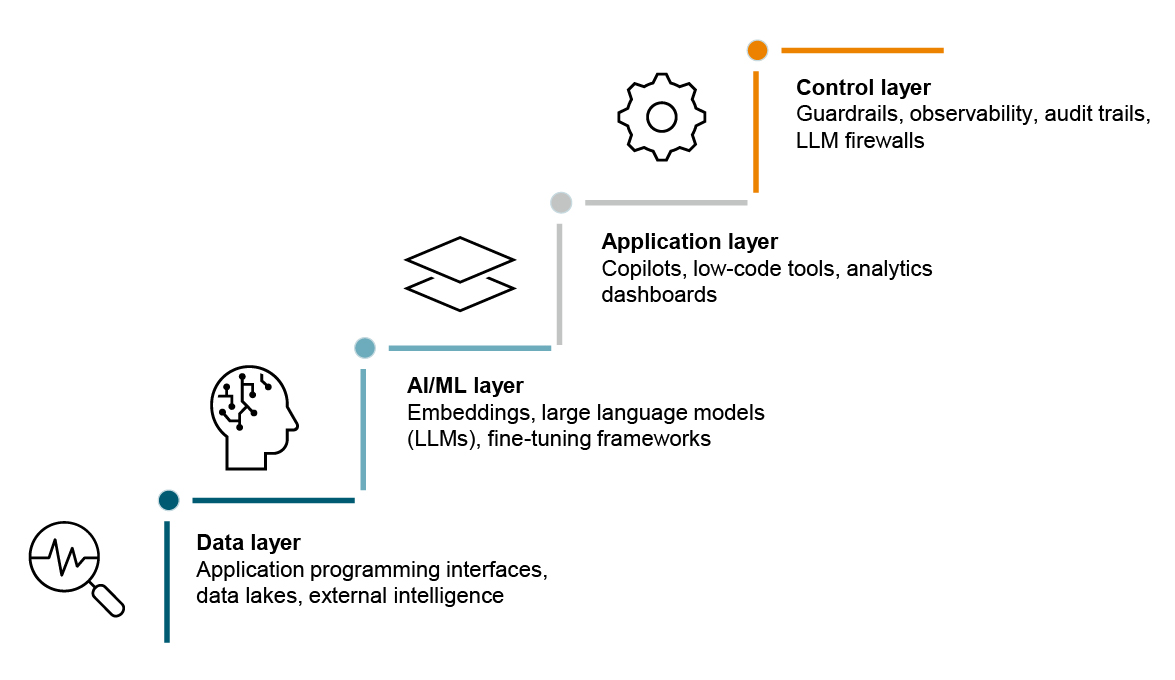
This ensures that AI is not just powerful but also secure, explainable and regulator-ready. While AI adoption in 1LOD is not governed by a single dedicated regulation yet, banks must navigate a complex, evolving regulatory landscape that applies existing prudential regulations, supervisory guidance, and emerging AI-specific frameworks. The emphasis is on safe, transparent, and compliant AI adoption with robust governance, risk management, and human oversight embedded within 1LOD operations.
AI-augmented 1LoD operating model