Explore Crisil, a company of S&P Global

Formerly known as Market Intelligence & Analytics

Risk Consulting

We help financial institutions develop and validate risk models, design scorecards and calculate risk parameters.


Risk Models and Framework Services
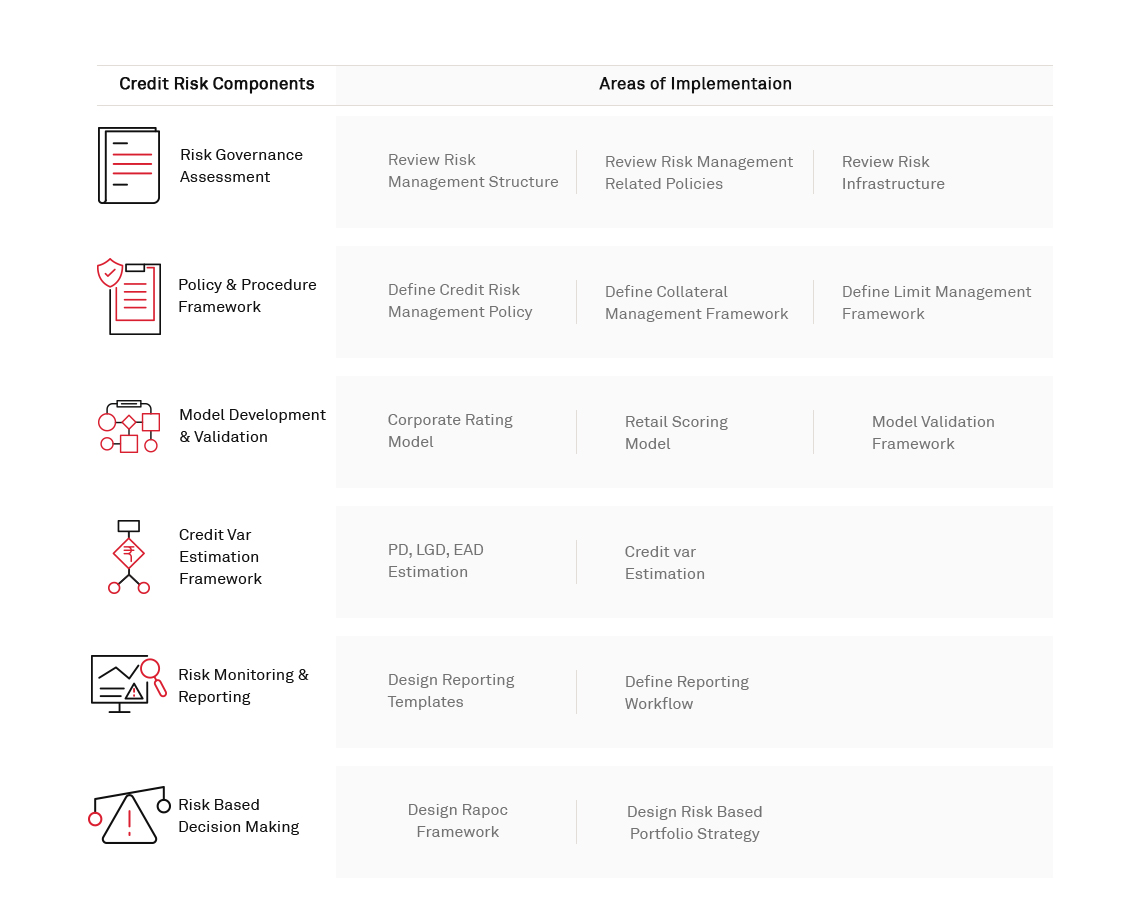


  • Design and implementation of a best practices-based credit risk management framework
  • Reengineering of credit and credit risk management processes
  • Preparation of credit risk management policy
  • Design of collateral management framework
  • Design of RAROC estimation and risk-based pricing framework

  • Diagnostic review of credit risk management practices compared with industry best practices and regulatory guidelines.

  • Development and validation of internal credit rating models for different categories of borrowers

  • Development of appropriate corporate and retail risk models for portfolio credit risk management, including an estimate of asset correlations

  • Installation of data management processes and analytical methodologies for deriving default probabilities, transition matrix and loss given default statistics

  • Development of framework to estimate portfolio credit VaR based on underlying parameters, as well as inter-sector correlations


Credit Risk Consultancy Services


  • Diagnostic review of credit risk management practices compared with industry best practices and regulatory guidelines.

  • Design and implementation of a best practices-based credit risk management framework
  • Reengineering of credit and credit risk management processes
  • Preparation of credit risk management policy
  • Design of collateral management framework
  • Design of RAROC estimation and risk-based pricing framework

  • Development of appropriate corporate and retail risk models for portfolio credit risk management, including an estimate of asset correlations

  • Development and validation of internal credit rating models for different categories of borrowers

  • Installation of data management processes and analytical methodologies for deriving default probabilities, transition matrix and loss given default statistics

  • Development of framework to estimate portfolio credit VaR based on underlying parameters, as well as inter-sector correlations


Market Risk Consultancy Services

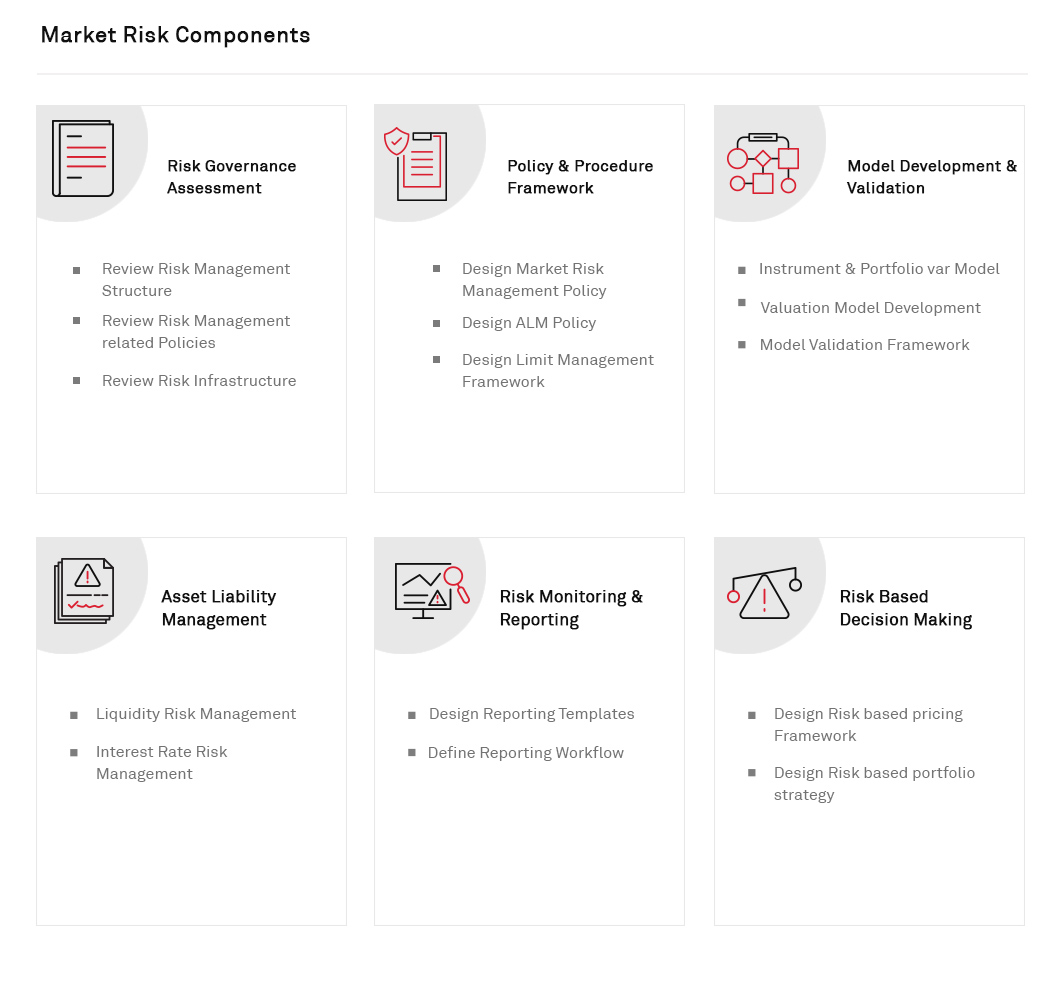
Market risk management consulting includes development and validation of risk measurement models, development of asset-liability management (ALM) framework, as well as the development of related policies and procedures.


Market Risk Consultancy

  • Diagnostic review of operational risk management practices as compared to industry best practices and regulatory guidelines

  • Design and implement best-practices-based market risk management framework
  • Treasury process reviews and process reengineering
  • Preparation of market risk management and ALM policies

  • Validation of bank's internal models and other qualitative requirements

  • Development of value-at-risk methodology

  • ALM monitoring and reporting framework        
  • Liquidity and interest rate risk measurement and management framework
  • Framework for stress testing and funds transfer pricing


Asset-liability management (ALM) consulting covers:

 
  • Diagnostic review - Review of organisation’s ALM-related processes, including risk management structure, underlying policies and procedures, and risk measurement and reporting frameworks.
    • Risk assessment & measurement - Assessing extent of liquidity risk, taking into account gap reports, liquidity coverage ratio, net stable funding ratio and funding portfolio mix.     
    • Stress testing - Includes scenario analysis and sensitivity testing to assess impact of macro-economic and institution-specific stress scenarios on liquidity and interest rate.
      • Risk control & monitoring - A limit management framework is designed, taking into account risk appetite and tolerance levels, as well as underlying and prospective portfolio mix.
        • Risk-based decision-making - Mainly is in the form of funds-transfer-pricing-related consulting, including methodology. In addition, the plan for capital allocation, taking into account the liquidity and interest rate risk impact, is defined.

        • Valuation of derivatives
        • Valuation of other market instruments
        • Treasury performance assessment and monitoring framework

        MarketRisk Rating Value at Risk Model Development

        • Assessment of internal and external data (including proxy data elements) used in the model to ensure completeness
        • Analysis of model assumptions
        • Analysis of mathematical calculations and underlying risk factors
        • Back-testing of data (past one year) at varying confidence intervals and sub-portfolios
        • Conducting tests on VaR model, based on hypothetical portfolios
        • Validation of model vis-à-vis benchmark/industry standard models


        Operational Risk Consultancy

        Crisil Risk Solutions reviews, recommends and designs operational risk management frameworks.
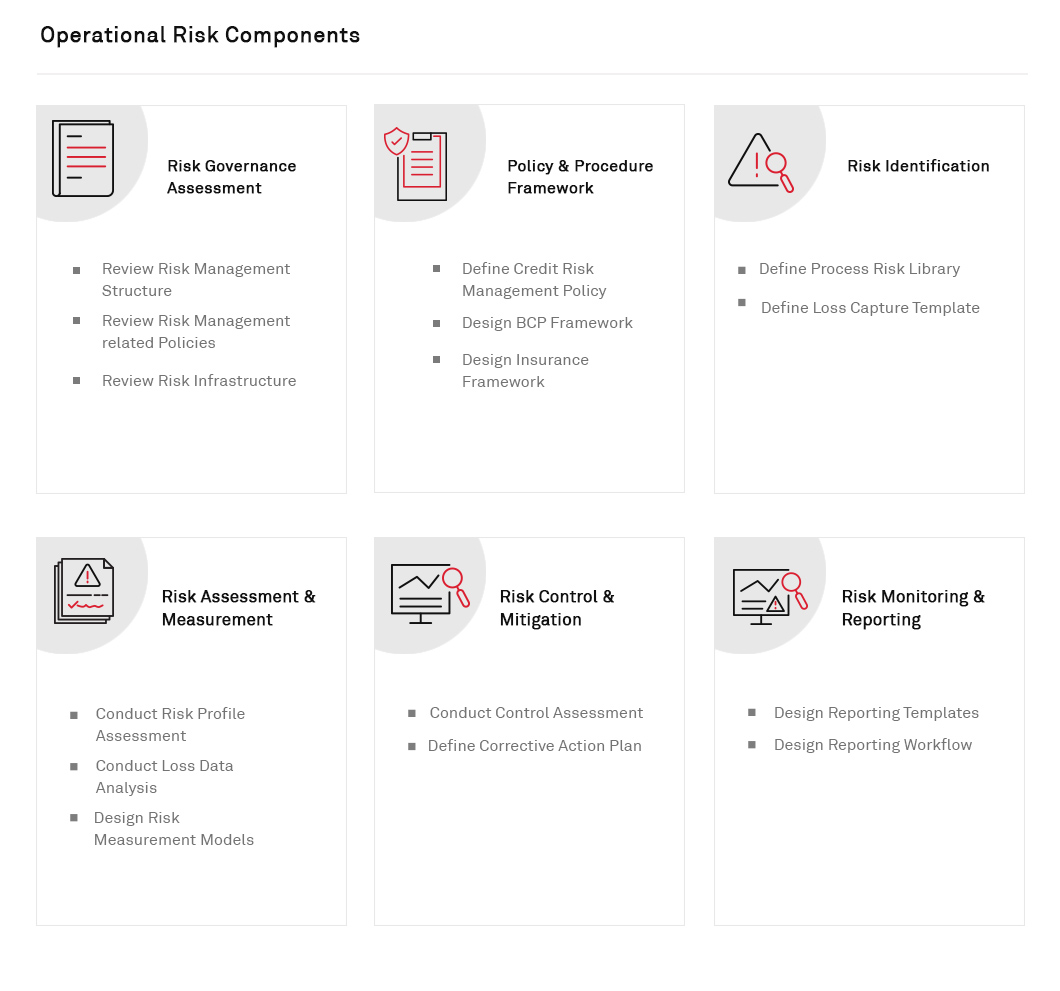


        • Diagnostic review of operational risk management practices as compared to industry best practices and regulatory guidelines.

        • Analysis of key business processes, development of workflow charts, identification/grading of possible operational risk areas
        • Assess and mitigate operational risk 
        • Design control processes to assist in risk mitigation/minimisation

        • Design process-risk-control library to assist risk control self-assessment (RCSA)
        • Design framework and template for RCSA

        • Design process flow and library for key risk indicators (KRI)
        • Design KRI monitoring framework

        • Design framework to measure operational risk
        • Design processes to analyse operational loss databases
        • Design framework for loss data management

        • Validate bank's internal models, etc to ensure compliance with advanced measurement approach

        Operational Risk Consulting develops value-at-risk (VaR) models for operational risk measurement. It entails:

        • Loss data collection across Basel business lines and loss event categories
        • Loss data modeling
        • Conduct "goodness of fit" test to assess strength of distribution
        • Conduct simulation analysis
        • Estimate operational loss VaR
        • Back-testing to assess operational loss of VaR as against actual loss
        • Operational risk capital charge estimation
        • Estimate unexpected loss
        • Scale-up factor, based on results of RCSA and KRI
        • Value-at-risk model validation process includes:
          • Assessment of internal and external data (including proxy data elements) used in the model to ensure completeness
          • Analysis of model assumptions
          • Analysis of mathematical calculation and underlying risk factors
          • Back-testing of existing data
          • Testing VaR model based on hypothetical portfolios
          • Validation of model vis-a-vis benchmark/industry standard
          • Assessment of reporting to senior management as regards