Explore Crisil, a company of S&P Global
Formerly known as Market Intelligence & Analytics
April 09, 2026
 Report
Report
Regional aviation gains altitude on UDAN 2.0
April 09, 2026
Report
Report
Impact note | April 2026

 Share
Share


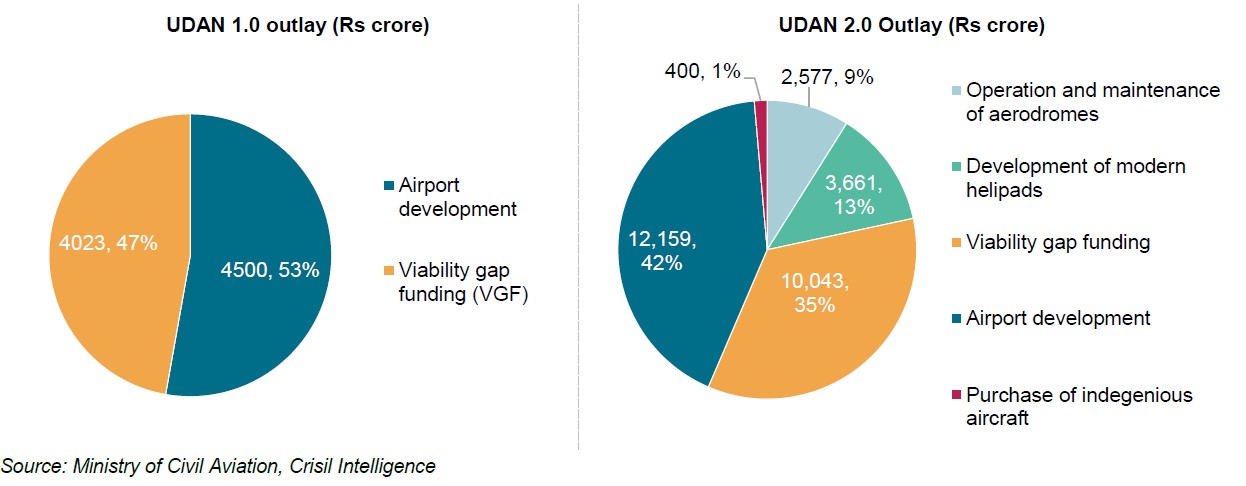
The Government of India announced UDAN 2.0 (Ude Desh ka Aam Nagrik) on March 25, 2026, earmarking a capital of Rs 28,840 crore to develop 100 new airports and 200 helipads over fiscals 2027-2036. The latest regional connectivity scheme considerably builds on UDAN 1.0, which had an outlay of Rs 8,523 crore and was implemented over fiscals 2017-2026.
Also, as compared with UDAN 1.0’s primary focus on enhancing regional connectivity by incentivising airlines through route-based viability gap funding (VGF), fare caps and revival of unserved/underserved airports, and strong emphasis on expanding network reach, UDAN 2.0 adopts a more holistic approach, such as dedicated allocations towards airport operations and maintenance (9%) to ensure continued operations on UDAN airports, development of helipads (13%) for serving underserved and far off regions, extended VGF support (35%) for sustaining thinner routes, and acquisition of indigenously manufactured aircraft (1%) to strengthen domestic aircraft manufacturing capabilities, apart from the core initiative of developing airports (42%).
Hence, UDAN 2.0 represents a step-up in both scale and scope, shifting from a connectivity initiative to a structural aviation infrastructure programme.
Since its launch, UDAN has played a role in enhancing last-mile connectivity, particularly across underserved and unserved regions. Under 1.0, 79 new airports have been operationalised, significantly increasing the overall airport base in the country to 163 in fiscal 2026 from 77 in fiscal 2016. Consequently, the share of UDAN airports in total airports have increased to 58% from 21% over the period.
Subscribe to our reports