Explore Crisil, a company of S&P Global
The Future of Digital Content in Institutional Investing
 Report

 Share
Share



Executive Summary
In this report, we examine the role that investment research/content plays in the institutional investment landscape and how that role has changed in the past five years. In today’s new normal, providing personalized or tailored investment research is more important than ever. With less face-to-face contact, asset managers must make a conscious effort to provide the personal touch that many institutional investors have come to expect.
Brand reputation remains a top factor in the decision-making process of institutional investors, but how asset managers build their brand presence has evolved over the last five years. With institutional investors spending more time on social media, asset managers that are savvy adopters of these trends have a unique opportunity to grow mind share as well as market share.
Looking forward, content creation and distribution by asset managers will become evermore fluid, with customized research distributed across multiple channels to ensure clients and asset managers meet where they are. Yet despite all this progress toward a more digital world, relationships matter. The source of the content, both the firm and the individual, and the ability of that content provider to follow up will still, over time, act as the tipping point between the haves and the have nots.
METHODOLOGY
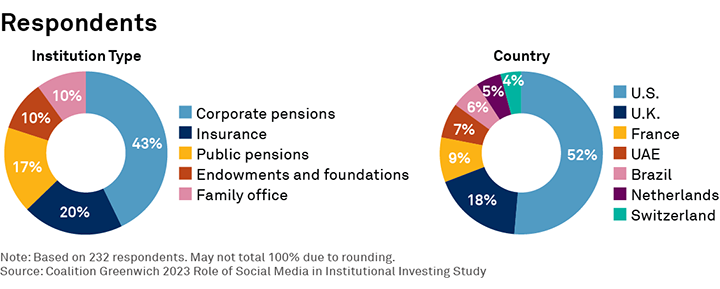
In Q4 2022 and Q1 2023, Coalition Greenwich interviewed 232 institutional investors located in the United States, EMEA and Latin America. The study asked senior investment professionals at corporate pensions, insurance companies, endowments and foundations, and family offices about their habits and views regarding the consumption of digital media in the investment process and its impact on investment decisions. This report was commissioned by LinkedIn.
Executive Summary
In this report, we examine the role that investment research/content plays in the institutional investment landscape and how that role has changed in the past five years. In today’s new normal, providing personalized or tailored investment research is more important than ever. With less face-to-face contact, asset managers must make a conscious effort to provide the personal touch that many institutional investors have come to expect.
Brand reputation remains a top factor in the decision-making process of institutional investors, but how asset managers build their brand presence has evolved over the last five years. With institutional investors spending more time on social media, asset managers that are savvy adopters of these trends have a unique opportunity to grow mind share as well as market share.
Looking forward, content creation and distribution by asset managers will become evermore fluid, with customized research distributed across multiple channels to ensure clients and asset managers meet where they are. Yet despite all this progress toward a more digital world, relationships matter. The source of the content, both the firm and the individual, and the ability of that content provider to follow up will still, over time, act as the tipping point between the haves and the have nots.
Introduction
The past three years have changed the nature of work for millions of professionals around the world. Financial markets firms in particular were forced to adapt to a new reality in which investment professionals, who had been effectively chained to their desks in the past, were now working remotely. Institutional investors still needed access to sophisticated information tools while remaining under the watchful eye of compliance professionals aiming to ensure the firm and its people remained aware of and complied with regulations.
And while many financial professionals have now returned to the office, new habits have become permanent, including how they consume content, what content they consume and how that content is put to work as part of the investment process.
Ultimately, the increasingly diverse asset manager ecosystem and the wide range of investment products available allow investors to better achieve their objectives of higher returns and reduced risk, often at a lower cost. But for marketers looking to promote their asset management solutions in this very crowded field, understanding the role that digital media plays, whether traditional news or social media, how institutional investors sift through the sea of research at their disposal and how those habits have changed over time is more critical than ever.
In this report, we examine the role that investment research/content plays in the institutional investment landscape and how that role has changed in the past five years.1 In this new normal, for instance, providing personalized or tailored investment research is more important than ever. With less face-to-face contact, asset managers must make a conscious effort to provide the personal touch that many institutional investors have come to expect.
Further, it should be no surprise that brand reputation still plays a critical role in the decision-making process of institutional investors, but the best way for asset managers to build their brand presence has changed over the last five years. With institutional investors spending more time on social media, asset managers that are able to adapt to these new trends have a unique opportunity to grow mind share as well as market share.
Impact of Changing Working Models
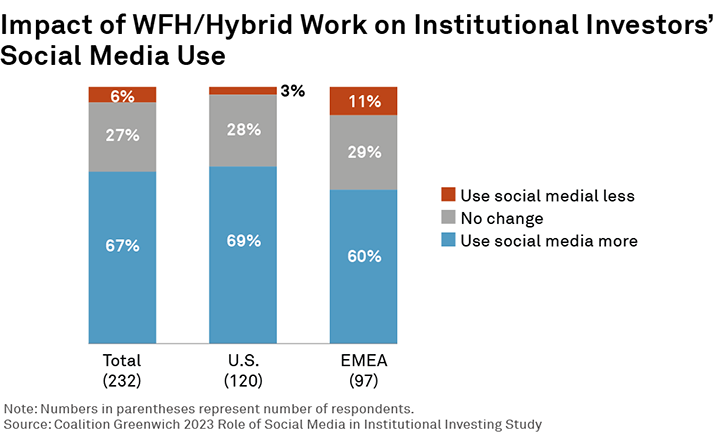
Sixty-seven percent of institutional investors told us that hybrid working has driven them to use social media more than they had pre-pandemic. This shift is even more pronounced in the U.S., with 69% using social media more often, compared to only 3% that have decreased usage of social media in their professional role. Social media has also had an impressive jump in usage in EMEA (60% use social media more often).
There has been no shortage of scandals arising from social media trends and their impact on financial markets (there was a congressional hearing on the role that Reddit played in the meme stock craze), but for institutional investors, there’s less concern. Especially when content is shared by someone that the investor knows and trusts, social media gives institutional investors access to a wider variety of investment-related content than a traditional media publisher.
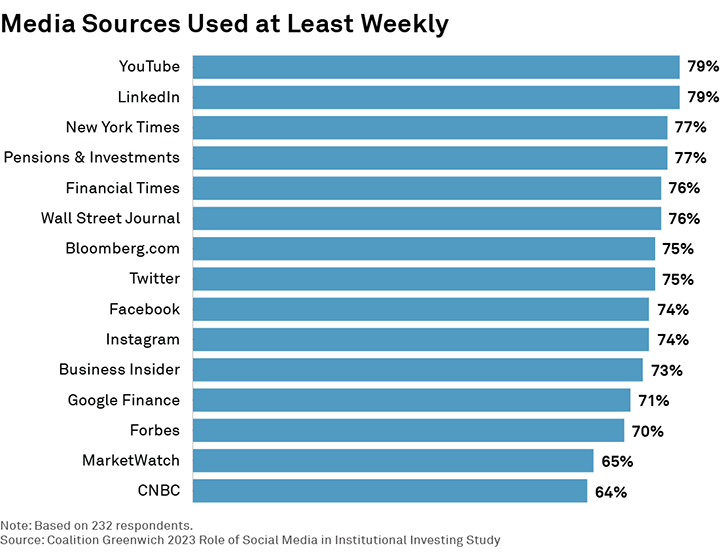
This is reflected in the frequency of use of different media sources. Notably, LinkedIn and YouTube are the media sources that the most institutional investors (both in the U.S. and EMEA) use at least weekly. Major traditional media sources, such as the FT and Wall Street Journal, are also heavily relied on. This is a marked change from even just 10 years ago, and all signs indicate the trend will continue.
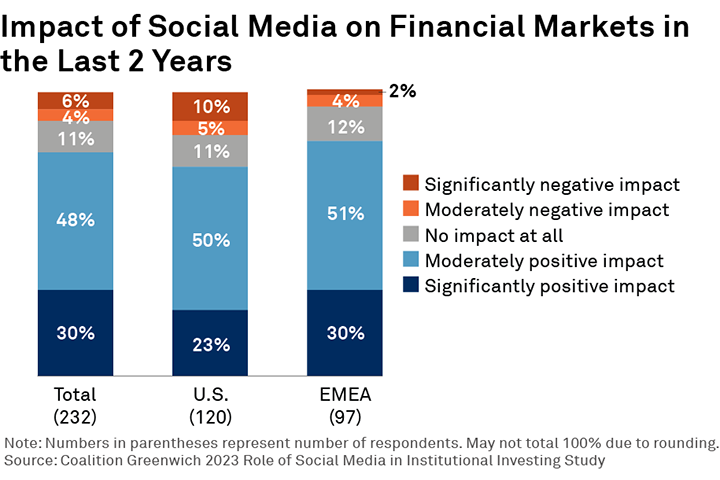
Overwhelmingly, investors in the U.S. and EMEA agree that this trend toward more social media usage has had a positive impact on financial markets over the last two years. This tells us that meme stocks and the use of Reddit to fuel retail trading was nothing more than a distraction, with the benefits of professionally focused platforms liked LinkedIn far outweighing those negatives.
Content Preferences of Institutional Investors
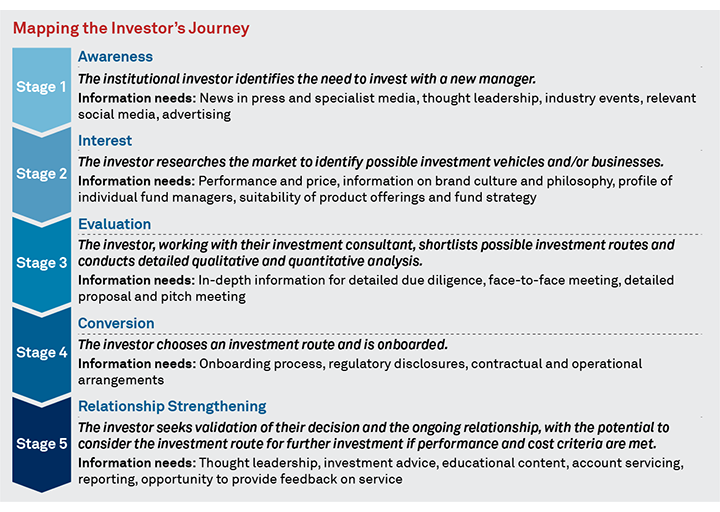
For asset management firms, a successful marketing campaign requires providing institutional investors with the right content at the right time. In order to maximize the impact of a marketing campaign that will ultimately lead to asset inflows, marketers must understand the content that institutional investors are seeking.
Since the pandemic, investors are more often going directly to financial institutions’ websites or blogs to find the content they need. In 2018, 64% of investors globally said that they used a financial firm’s website to find relevant content. Five years on, nearly 80% of investors seek out content from asset managers directly—on par with usage of news media. While the fervor surrounding “fake news” has abated, traditional news sites are still grappling with the loss of confidence in the impartial and unbiased nature of their content.
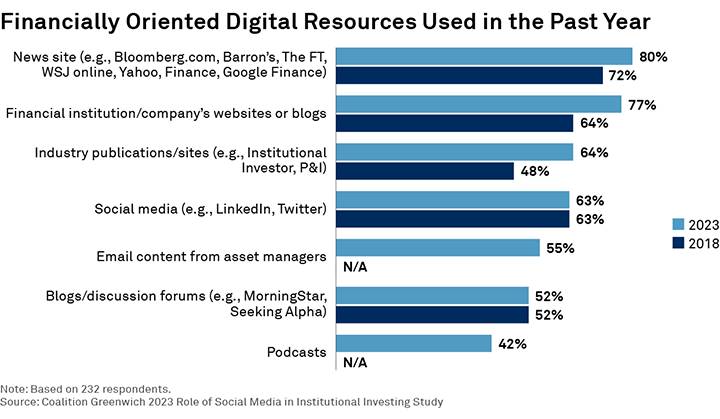
Institutional investors are also relying more on industry-specific publications in 2023 (64% compared to 48% in 2018). It’s also notable that there isn’t a digital resource that has seen less usage since 2018. Institutional investors are consuming more research and information than ever before. These trends hold true across regions.
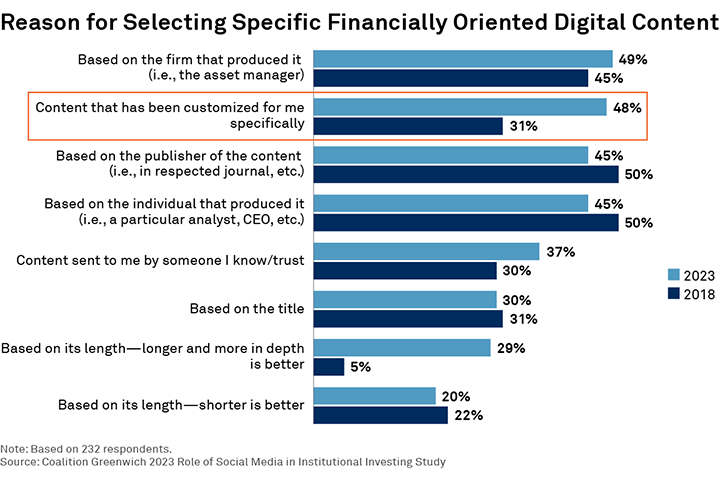
Capturing the attention of investors is not simply about where the content is consumed, but the nature of the content itself. Overall, the top characteristics that institutional investors value are the asset manager that produced the content (49%) and the degree to which the content is tailored or customized to the specific investor (48%). The specific author (45%) and publisher of the content (e.g., a respected industry journal) (45%) are also very important, although less so than five years ago.
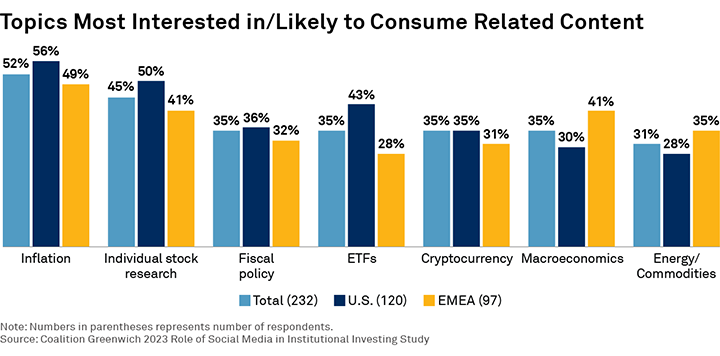
And while research topics are often cyclical, a few trends stand out in 2023. Inflation, unsurprisingly, was the most interesting topic for the investors we spoke with. If and when inflation slows, so too will the demand for inflation research. In contrast, the demand for individual stock research (45%) is an evergreen topic for institutional investors.
There are some notable differences by region, however. U.S. institutional investors are more interested in ETF-related content than their European peers, given the much larger ETF market in the U.S. On the other hand, macroeconomic content appeals more to European institutional investors, whose onshore investments are often more sensitive to gyrations in the global economy.
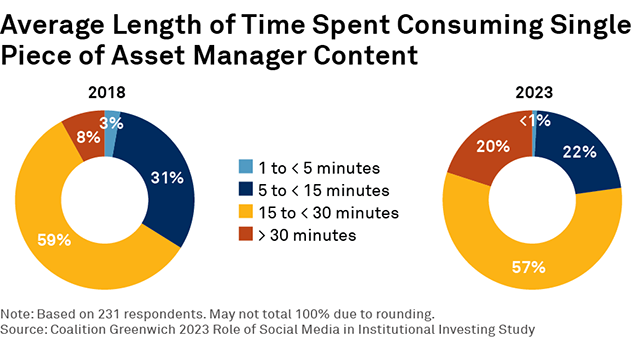
Another significant shift in institutional investor behavior in the past five years is the amount of time investors will spend reading/consuming content, especially asset manager content. Despite the general trend toward brevity, institutional investors are more willing to spend longer periods consuming content today than they were pre-pandemic. In 2018, only 8% of respondents were willing to spend more than 30 minutes on a piece of assetmanager- provided content; that figure jumped up to 20% in 2023, with significant increases in both the U.S. (23%) and EMEA (18%).
Content as a Differentiator
Institutional investors rank historical performance and brand as the main two criteria used to select an asset manager—neither particularly surprising. Strong performance from a strong brand is always a reasonable choice. It is notable, however, that quality research/content came in as a close third—a reminder that dedicating time, money and resources to producing quality content does, in fact, drive revenue for asset managers.

Investors are looking for several content types from their asset managers. Investment perspectives from senior leadership or other executives are sought after. Nearly one-quarter of investors (24%) rank senior-level insights as the single most valuable type of asset-manager-provided content. Specific investment advice and individual market analysis are also valued forms of content. Ultimately, investors aren’t simply paying for their portfolio to be managed, but also to be able to tap the expertise of the firm to help generate investment ideas via the best insights available.

Offering quality content is important, but increasingly, the buck doesn’t stop there. Sixty-two percent of institutional investors expect the asset manager to follow up directly and offer to go deeper, if helpful. These conversations provide invaluable opportunities to foster stronger client relationships and can provide additional cross-selling opportunities. Asset managers fiercely compete to accumulate more assets and new mandates. Effectively utilizing the perspectives from senior leadership will not only improve general brand awareness/reputation, but also give asset managers the leg up in strengthening relationships.

Conclusion
Digital media use for institutional investors is largely about access to information. The move to hybrid work and the accompanying expectation to be “always-on” means that the content investment professionals consume must meet them where they are. This has made the job of the asset management marketing professional all the more complex. Gone are the days of creating glossy monthly research reports, replaced today by digital content distributed via social and traditional media alike. Furthermore, clients expect their asset managers to tailor that content to them directly—“Only show me what I care about or I might start to ignore your research all together.”
Today’s institutional investor is willing to spend more time consuming content than they were pre-pandemic. They’re also more likely to find their financial content via social media than they were five years ago. Perhaps most interesting, quality content is now a big criterion for selecting an asset manager, behind only historical performance and brand.
Looking forward, content creation and distribution by asset managers will become evermore fluid, with customized research distributed across multiple channels to ensure easy accessibility for clients. Yet, despite all of this progress toward a more digital world, relationships matter. The source of the content, both the firm and the individual, and the ability of that content provider to follow up, will still, over time, act as the tipping point between the haves and the have nots.
Dan Connell, Kevin McPartland and Brad Tingley advise on market structure and technology globally.
1https://www.greenwich.com/market-structure-technology/investing-digital-age
Methodology
In Q4 2022 and Q1 2023, Coalition Greenwich interviewed 232 institutional investors located in the United States, EMEA and Latin America. The study asked senior investment professionals at corporate pensions, insurance companies, endowments and foundations, and family offices about their habits and views regarding the consumption of digital media in the investment process and its impact on investment decisions. This report was commissioned by LinkedIn.