Explore Crisil, a company of S&P Global
Top Trends in Institutional Asset Management for 2023
 Report

 Share
Share



Executive Summary
Institutional investors and asset managers in 2023 are facing a host of challenges and changes in a market that is evolving rapidly. In this report, Coalition Greenwich examines the top trends impacting institutional asset management in 2023.Among the influential trends covered in the report are:
- Enhancing the Client Experience—Elevating engagement tobuild strategic partnerships
- Customization and Personalization—Meeting client demands; building an advantage
- Projecting Purpose in Branding—Beyond the money
- Separating the Wheat from the Chaff in OCIO—A trend at an inflection point
- ESG Evolution—Opportunities and headwinds
Coalition Greenwich analyzed data from its research with over 2,000 asset owners in North America, Europe and Asia, and insights from conversations with our asset manager clients around the world to identify these and the additional Top Trends in Institutional Asset Management for 2023.
Executive Summary
Institutional investors and asset managers in 2023 are facing a host of challenges and changes in a market that is evolving rapidly. In this report, Coalition Greenwich examines the top trends impacting institutional asset management in 2023.
Among the influential trends covered in the report are:
Enhancing the Client Experience—Elevating engagement to build strategic partnership
Customization and Personalization—Meeting client demands; building an advantage
Projecting Purpose in Branding—Beyond the money
Separating the Wheat from the Chaff in OCIO—A trend at an inflection point
ESG Evolution—Opportunities and headwind
Coalition Greenwich analyzed data from its research with over 2,000 asset owners in North America, Europe and Asia, and insights from conversations with our asset manager clients around the world to identify these and the additional Top Trends in Institutional Asset Management for 2023.
Enhancing the Client Experience
In 2023, client facing staff at asset managers will have to work harder than ever to adapt and deliver a client experience that meets asset owners’ rising expectations. As fee compression has led to squeezed budgets, relationship management teams have had to retool their service capabilities, invest more in digital technology which in turn has revolutionized client service capabilities. Asset owners have become familiarized with support tools which have come to the fore over the past few years that can provide unparalleled reporting in almost real time. Asset management firms that elevate the client experience to a top priority by investing in relationship management teams and supporting marketing efforts will reap benefits in terms of higher asset and client retention rates.
One way for managers to elevate the client experience is to utilize client segmentation techniques that enable them to embrace technology and analysis to personalize their offerings and service. When it comes to manager selection, a manager’s ability to customize its offerings now carries more weight than fee levels among institutional investors in Europe and Asia.
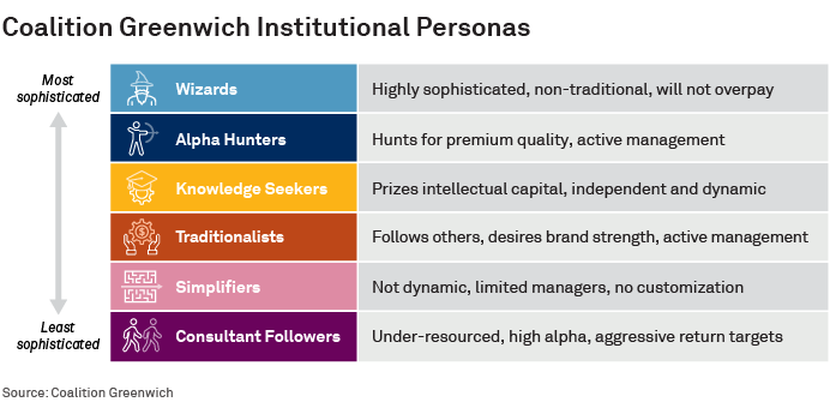
Segmentation strategies can sort prospects and clients into well-defined groups with similar traits and demands including behavioral factors relating to their level of sophistication, funding/financial status, investment practices, asset allocations, product usage, manager selection, and other characteristics.
The following graphic provides an example of the type of “personas” asset managers can create to organize prospects and clients in a “best-fit” manner to align services/solutions they provide with unique client needs.
The combination of challenging market conditions, increasing speed and complexity, and internal resource constraints is prompting asset owners to seek much deeper, holistic relationships with their managers beyond the historic transactional parameters of an investment mandate.
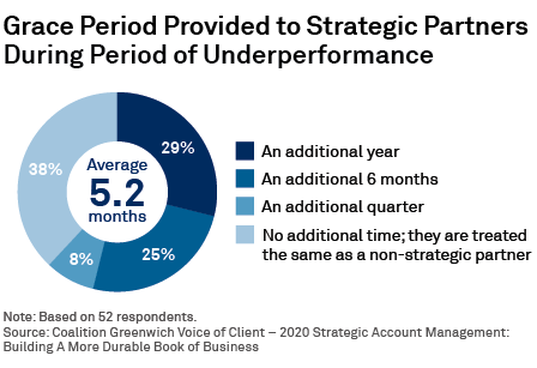
Research by Coalition Greenwich has repeatedly shown that asset managers viewed as strategic partners are given significantly more leeway during periods of underperformance, leading to decreased rates of client attrition and higher levels of asset retention. Strategic partners also have higher win rates on cross-sales, meaning more opportunities to expand the relationship with institutions and develop favorable relationships with pension fund consultants.
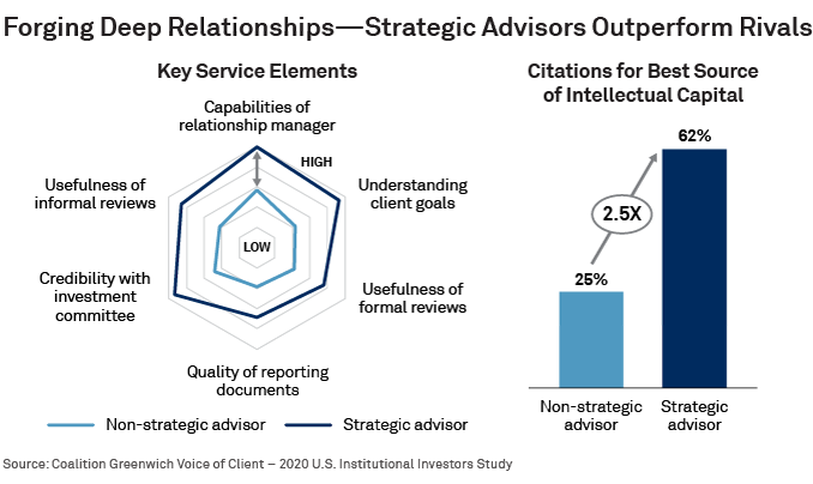
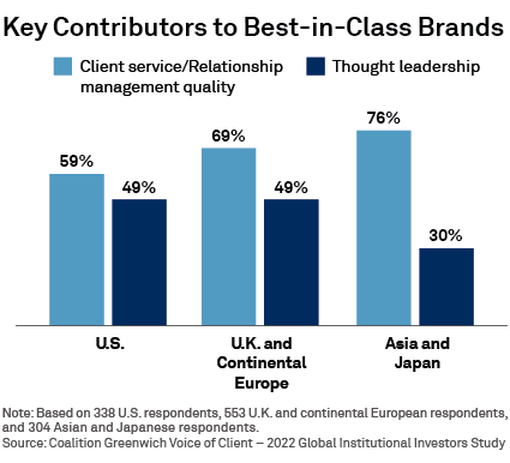
In 2023, asset managers will have to be imaginative in their development of thought leadership. Thought leadership has become a primary means for asset managers to demonstrate value to prospects and clients. In fact, thought leadership is now one of the most powerful drivers of brand strength, with a majority of asset owners saying a manager’s ability and willingness to transfer knowledge is an important factor in their manager selection process.
Projecting Purpose in Branding
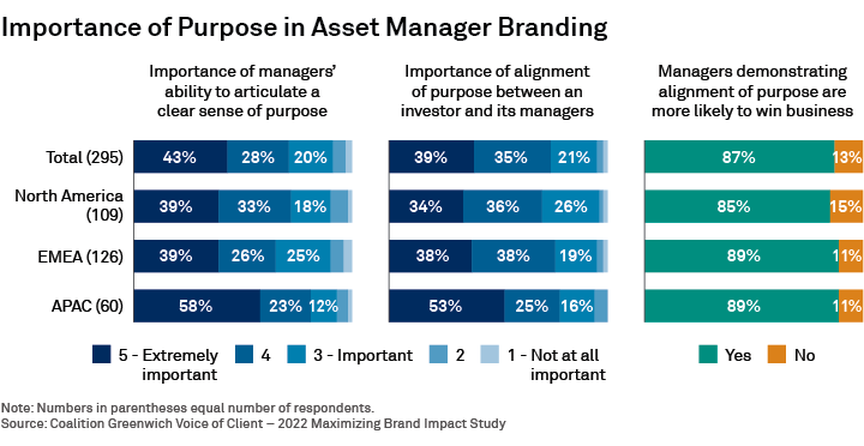
Asset managers are striving to show that they have a mission that goes beyond merely making or managing money. Demographic and behavioral changes are leading investors to pay increased attention to the principles conveyed by managers with whom they do business and a shift to align with those managers they share values in common. That desire is evident in institutional investing where more than 70% of global institutions cite a manager’s ability to articulate a clear sense of purpose that aligns with their own beliefs as a critical factor in manager selection. For that reason, asset managers this year will be doing some hard thinking about what they stand for, and how to communicate a compelling organizational purpose to the marketplace.
Separating the Wheat from the Chaff in OCIO
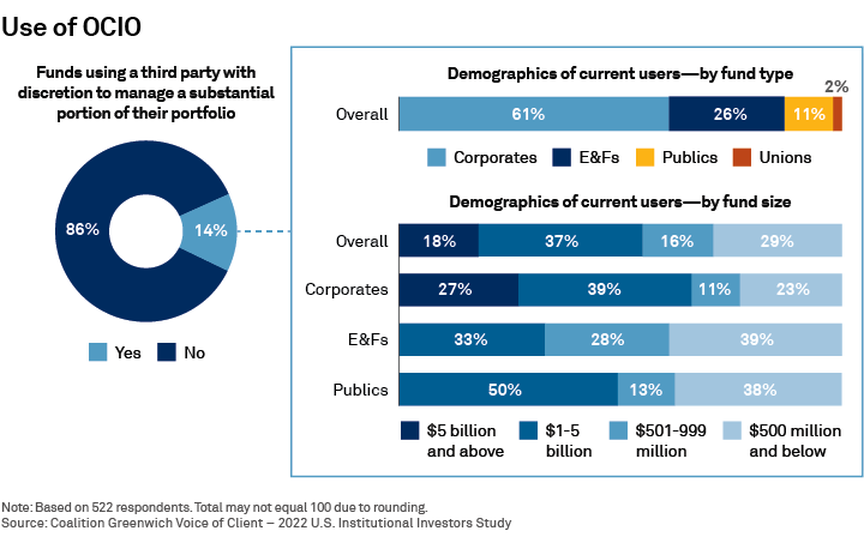
2023 could be an inflection point for OCIO providers. Over recent years, the OCIO industry has been growing at a double-digit pace in markets like the U.S. and U.K., and has an established track record that can be evaluated across market cycles. Firms that fall short in terms of either investment performance or overall client satisfaction will find that the days of rapid growth are over. OCIO’s that benefit are those that demonstrate the ability to construct complex, highly customized portfolios for their clients at a transparent and reasonable cost. This in turn will require investment in human and technological capital to scale the business to accommodate bespoke client needs.
The diversity of asset classes and benchmarks are also giving asset owners invaluable new insights into decisions about what type of OCIO provider to select, a development that could help tip the scales in the ongoing battle among asset managers, investment consultants and independent OCIO firms. This trend will continue to play out over the short to medium term.
ESG Evolution
Responding to demands from clients, regulators and other constituencies, asset managers around the world—led by those in Europe—have worked to integrate ESG and sustainable investing practices into their investment processes, albeit with mixed results. In Continental Europe and the U.K., at least 90% of asset owners now consider ESG in manager selection, and most say ESG will become even more important in 2023.
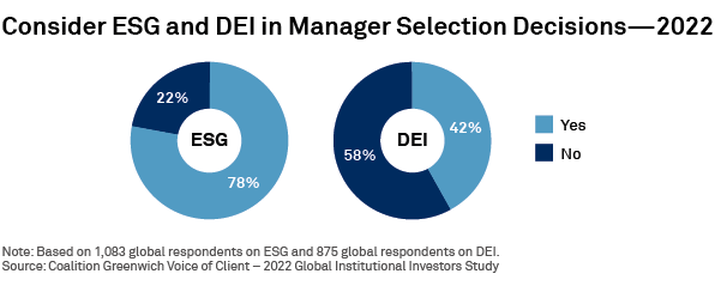
Although uptake is lower than in other markets, more than half of U.S. asset owners now consider ESG when selecting managers, and a third expect ESG to carry even more weight in the year ahead. Around the world, more than half of asset owners now expect to receive information on diversity equity and inclusion (DEI) from manager candidates, including written explanations of policies, strategies and values, and detailed breakdowns of staff data.
Despite this growth, the year ahead might include the need to pause and review the ESG and DEI strategies managers are putting in place. In Europe, regulators are developing tighter standards on ESG to weed out “greenwashing”, which will pressure managers to implement more comprehensive ESG strategies, and in the U.S. managers are facing increased local and governmental regulatory scrutiny.
Mark Buckley, Todd Glickson, Parijat Banerjee, Seiji Ishii, Sophie Emler, Susan Gould, Alasdair Philip, Arifur Rahman, Joseph Mattesi, and Erin Dunne advise on investment management globally.