


- Risk
- Model Risk Management
- Blog
- Investing
- Banking
- Global Research and Risk Solutions
Making the grade
How banks could pass the PRA muster on model risk management expectations
by Rachna Maheshwari, Associate Director - Model Risk Management
CRISIL Global Research and Risk Solutions


Overview of the CP 6/22 model risk management principles
Recently, the British Prudential Regulation Authority (PRA) came out with a consultation paper (CP) which aims to get banks to prepare ahead for managing model risks. It lays out expectations from banks, based on its five guiding principles for effective MRM.
Based on the consultation paper, we think that most major banks will need to revise some policies and procedures to fall in line with the new guidance, even if they have well-established MRM frameworks.
The Supervisory Statement (SS), which sets out the expectations for regulated United Kingdom (UK)-incorporated banks, building societies, and PRA-designated investment firms around MRM practices, has the following major objectives:
Build robust MRM practices around artificial intelligence (AI)/machine learning (ML): Given the dynamic financial services landscape and rapid adoption of AI/ML and other innovations such as digitization, robotics and automation, the SS encourages firms to have robust practices around identification, management, reporting, monitoring and mitigation of model risks arising from the adoption of these technologies.
Involve the board and senior management: Active senior management and board involvement in firms’ MRM governance processes are key to robust and effective MRM practices. Therefore, the PRA wants firms to identify and assign responsibilities for overall MRM to the relevant senior management function (SMF) as well as to ensure board oversight over MRM.
Proportionate implementation: This refers to the guiding principle that application of MRM practices and governance should be proportionate to the number, complexity, and materiality of models. Typically, smaller and ‘simpler-regime’ firms would have fewer and less complex models. While they too should establish the model definition, keep an inventory, and classify models, they need only to focus on the limited and basic elements of model governance.
Self-assess the MRM function: The SS expects firms to set up a recurring process of self-assessment and evaluation of MRM frameworks, policies, and processes. It requires them to remediate and report on identified gaps, thereby enhancing and consistently maintaining high MRM standards.
PRA’s guidance on firms’ self-assessment
|
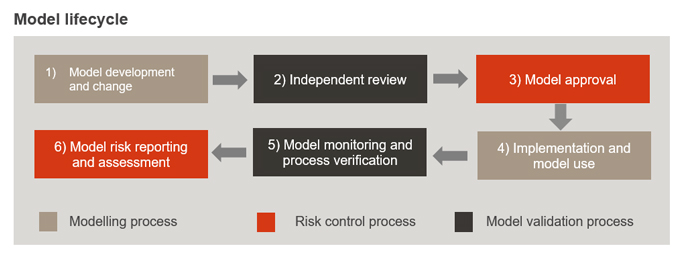
A strategic and holistic view of MRM: The SS encourages PRA-regulated entities to establish MRM frameworks, procedures, and practices, comprehensively covering all model types used to inform business decision-making, including in-house and vendor models, and all aspects of model life-cycle management. It aims at establishing greater coherence and consistency in MRM across UK firms with comparable MRM practices and measurable outcomes, especially regarding the practices around key aspects of MRM.
Key aspects of a holistic MRM strategy
|
Bridging the expectations
In our view, most major banks and regulated entities in the UK already have well-specified MRM practices. However, they would still need to focus on the following areas to meet the expectations of the new guidance in full:
- Judiciously define the ‘proportionate implementation’ scope of the MRM function, based on the size and organisational complexity of the regulated entity, the magnitude, variety (in terms of geography, instruments etc.) and materiality of portfolio exposures to be quantified by risk models, and the number and complexity of models.
- Improve business leadership oversight over MRM practices by specifying requirements and procedures for board oversight over the MRM function and SMF involvement in MRM.
- Update, standardise and enhance existing MRM policies and procedures around model identification, risk rating, inventory management, effective model governance, model development and implementation, model validation, ongoing model monitoring and model risk mitigants.
- Upgrade policy to specifically incorporate identification and mitigation of imminent risks from application of innovations such as AI/ML as well as the dynamically evolving and ever-changing environment in financial services.
- Ensure higher efficacy, review and reporting transparency of the audit function (third line of defense), as it applies to MRM.
- Set up an effective and recurring MRM self-assessment process along with a procedure for remediation and reporting of identified gaps.
In our view, a well-established, recurring process for self-assessment of MRM practices proposed by the PRA will ensure that banks are evaluating and updating their MRM frameworks, policies, and operating processes on an ongoing basis to meet the new challenges that arise from innovations and unanticipated shocks in a ceaselessly evolving risk landscape.
With application of AI/ML, specific attention will have to be given to widely discussed issues, which exacerbate model risk of applying such methods, such as bias, interpretability, explainability of algorithms and data adequacy and quality, which have not been covered explicitly in the SS.
Similarly, firms will have to identify model risks that are specific to new technological developments such as digitisation, robotics and process automation and develop well-defined policies, standards and practices around managing such risks.
Subscribe to our blogs