

- Crisil
- Blog
- Leveraged Lending
- Refinance Risk
- CRISIL outlook on near term interest rates
- Interest Rates
Navigating leveraged lending crossroads
Refinance risk builds as wall of maturity looms



Mamta Khandelwal
Lead Analyst
Credit and Lending Solutions
CRISIL Global Research & Risk Solutions

Toshita Mukherjee
Lead Analyst
Credit and Lending Solutions
CRISIL Global Research & Risk Solutions

Ankur Kohli
Sector Lead
Credit and Lending Solutions
CRISIL Global Research & Risk Solutions
High inflation, interest rates obstacles impacting leveraged debt issuance
The global leveraged finance market has been roiled over the past couple of years as the pandemic, geopolitical uncertainty, inflation and rising interest rates dried up liquidity and led to increased concerns over rising defaults among lenders. In the US, inflation1 peaked to 9.1% in June 2022, while in the Eurozone, it touched 10.6% in October 2022. The gauges have remained high for most of 2023, warranting a constant increase in interest rates globally. In July, the US Federal Reserve raised its key borrowing rate by 0.3% to a range of 5.3-5.5% - the highest level in 22 years. The European Central Bank raised its main refinancing rate to 4.5%2 in September 2023 and the Bank of England increased its base rate for the 14th consecutive time to 5.25%3.
Banking turmoil slows leveraged debt issuance4
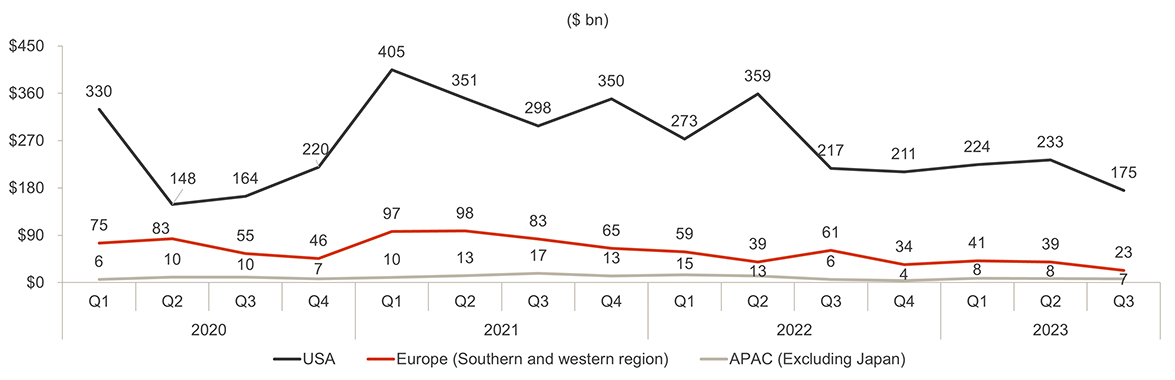
Debt issuance has been hampered by this constant increase in interest rates globally, on account of inflation. According to Debtwire Par data, leveraged loan issuances in the US slid 34.2% from $849.5bn in 9M22 to $632.8bn in 9M23, while in Eurozone, it fell from $159.5bn to $104.0bn and in Asia-Pacific (APAC) ex-Japan, from $33.4bn to $23.3bn.
As private equity managers contended with both a slowdown in fundraising and widening gap in vendor and buyer pricing expectations (largely due to increasing borrowing costs), demand for buyout financing plummeted 79% in the US and 64% in Europe in the first half of 20235.
In addition to the challenging pricing environment and a decline in issuance for buyout deals, overall loan issuance in the US and Europe has been impacted by the banking turmoil due to the collapse of Signature Bank and First Republic Bank in the US.
In APAC, the decline in issuance in 2023 can be largely attributed to China’s sluggish economic growth, primarily led by the crisis in the real estate sector, which accounts for ~20% of the country’s gross domestic product.
Defaults rising on-year, driven by media and consumer products
Default insights6
|
Regions
|
2022*
|
2023*
|
y-o-y change
|
Sectors most impacted
|
US
|
27
|
77
|
1.9x
|
Media and entertainment
|
Europe
|
11 |
21
|
0.9x
|
Consumer products
|
Emerging markets
|
21
|
15
|
-0.3x
|
Utilities and transportation
|
Other developed regions
|
3 |
5
|
0.7x
|
Healthcare, metal, mining and steel
|
Note: Data as of September 30, 2023. Other developed regions include Australia, Canada, Japan and New Zealand. |
The number of global corporate defaults almost doubled to 118 as of September 30, 2023, and spanned several industries, with media and entertainment, consumer goods, capital goods and automobiles accounting for a lion’s share. The media and entertainment industry was hit hard, given softening of revenue from advertisements, increasing competition, ongoing secular pressures that disrupted its operations and cash flows. The US and Europe accounted for majority of the defaults, primarily led by interest rate hikes, which constrained cash flows of counterparties.
As much as 55% of the defaults were a result of distressed exchanges. With six additional instances, the total count of distressed exchanges reached 52, marking the highest year-to-date tally since 2009.
Distressed exchange count at the highest since the Global Financial Crisis7
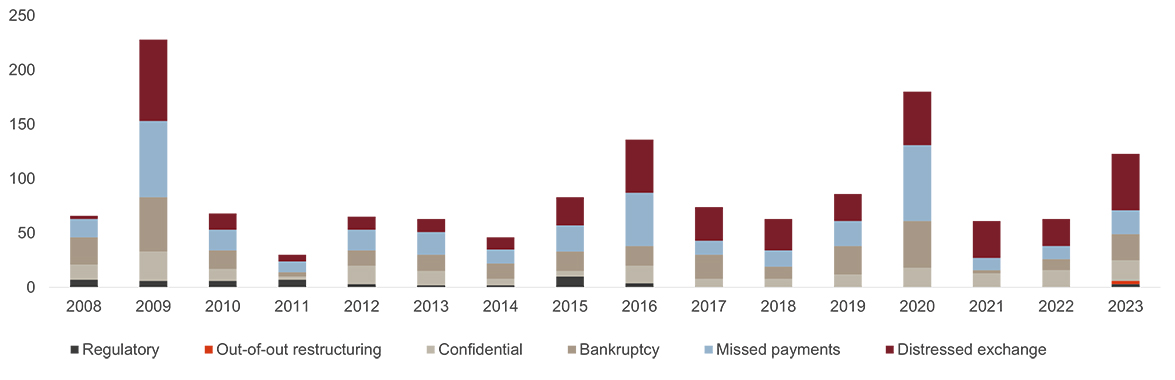
Credit quality has deteriorated and speculative-grade default rates increased to 3.0% in the US in July 2023 vs 1.0% in mid-2022 and 2.9% in Europe in August 2023 vs 2.4% in July 2022.
High near-term maturities of debt likely to pose refinancing challenge
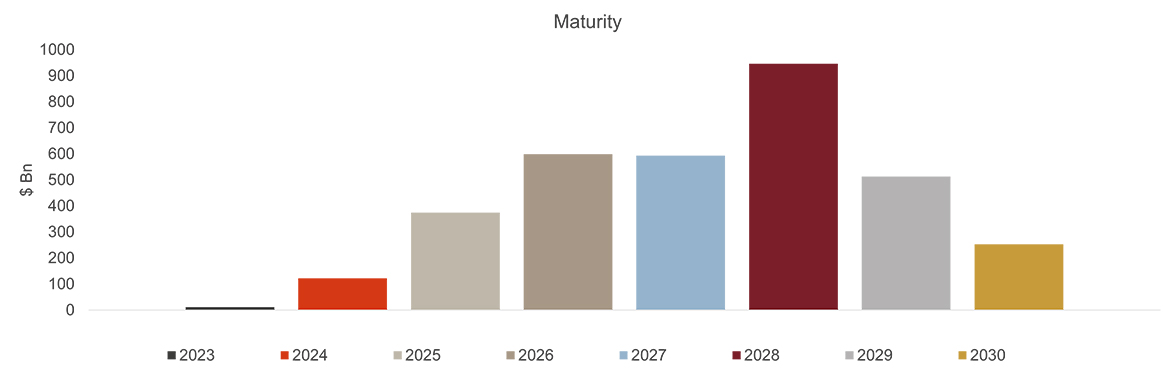
Cash flow deficit is a significant concern for lower-rated credits, given high interest rates are likely to continue despite talks of rate cuts in 2024 by central banks across the globe. Although inflation has cooled to some extent (3.7% and 4.3% in the US and the Eurozone, respectively, in September 2023), borrowers may hardly get any respite given mounting debt maturities in the near term. Borrowers will face refinancing risk given ballooning maturities of speculative-grade debt. Further, higher refinancing costs, demand for better collateral protection and more equity injection from the sponsors will aggravate the challenges for leveraged borrowers.
Corrective measures adopted by banks to deal with challenges in leverage lending
Worsening asset quality of borrowers and the recent banking turmoil have prompted banks to reassess their risk models, strengthen their underwriting standards and adopt a more cautious approach towards lending. Banks are aiming to strengthen their early warning systems and leveraging negative news analytics to safeguard their portfolio from rising defaults.
Given high refinancing costs, coupled with weakening credit metrics, precautionary measures such as amend-and-extend arrangements, covenant waivers or suspensions, increasing current expected credit loss reserves and rolling amortisation payments into bullet maturities will be crucial to enable leveraged borrowers to meet their near-term debt obligations.
1Statista.com
2Key ECB interest rates
3bankofengland.co.uk
4usinflationcalculator.com
5debtexplorer.whitecase.com
6spglobal.com
7S&P Global Ratings Credit Research and Insights; data as of Sep 30, 2023