
Market Risk Consultancy
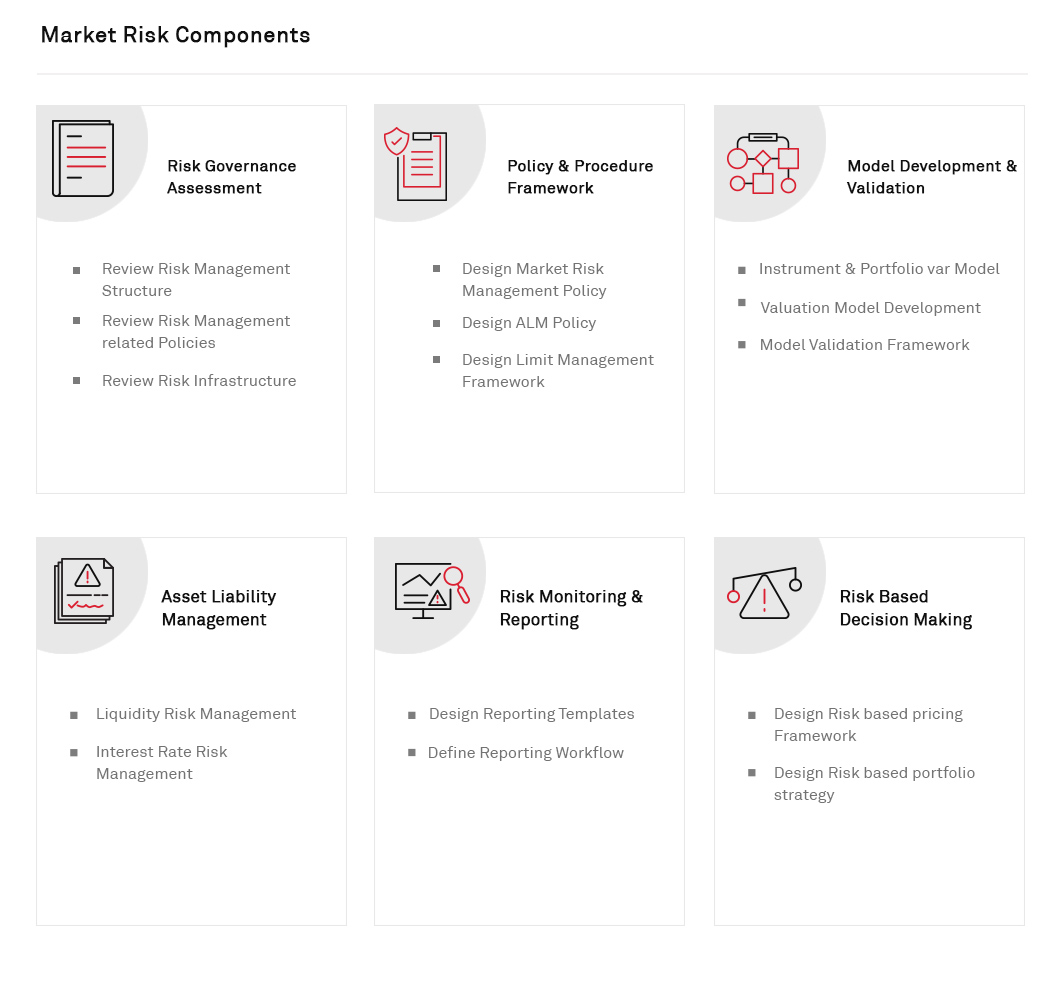
Market risk management consulting includes development and validation of risk measurement models, development of asset-liability management (ALM) framework, as well as the development of related policies and procedures.
Gap Analysis
Diagnostic review of operational risk management practices as compared to industry best practices and regulatory guidelines
Policy & Procedure
- Design and implement best-practices-based market risk management framework
- Treasury process reviews and process reengineering
- Preparation of market risk management and ALM policies
Model Validation
Validation of bank's internal models and other qualitative requirements
Measurement
Development of value-at-risk methodology
Asset Liability Management
- ALM monitoring and reporting framework
- Liquidity and interest rate risk measurement and management framework
- Framework for stress testing and funds transfer pricing
Asset-liability management (ALM) consulting covers:
- Diagnostic review
Review of organisation’s ALM-related processes, including risk management structure, underlying policies and procedures, and risk measurement and reporting frameworks.
- Risk assessment & measurement
Assessing extent of liquidity risk, taking into account gap reports, liquidity coverage ratio, net stable funding ratio and funding portfolio mix.
- Stress testing
Includes scenario analysis and sensitivity testing to assess impact of macro-economic and institution-specific stress scenarios on liquidity and interest rate.
- Risk control & monitoring
A limit management framework is designed, taking into account risk appetite and tolerance levels, as well as underlying and prospective portfolio mix.
- Risk-based decision-making
Mainly is in the form of funds-transfer-pricing-related consulting, including methodology. In addition, the plan for capital allocation, taking into account the liquidity and interest rate risk impact, is defined.
Valuation
- Valuation of derivatives
- Valuation of other market instruments
- Treasury performance assessment and monitoring framework
MarketRisk Rating Value at Risk Model Development
- Assessment of internal and external data (including proxy data elements) used in the model to ensure completeness
- Analysis of model assumptions
- Analysis of mathematical calculations and underlying risk factors
- Back-testing of data (past one year) at varying confidence intervals and sub-portfolios
- Conducting tests on VaR model, based on hypothetical portfolios
- Validation of model vis-à-vis benchmark/industry standard models