
Operational Risk Consultancy
Crisil Risk Solutions reviews, recommends and designs operational risk management frameworks.
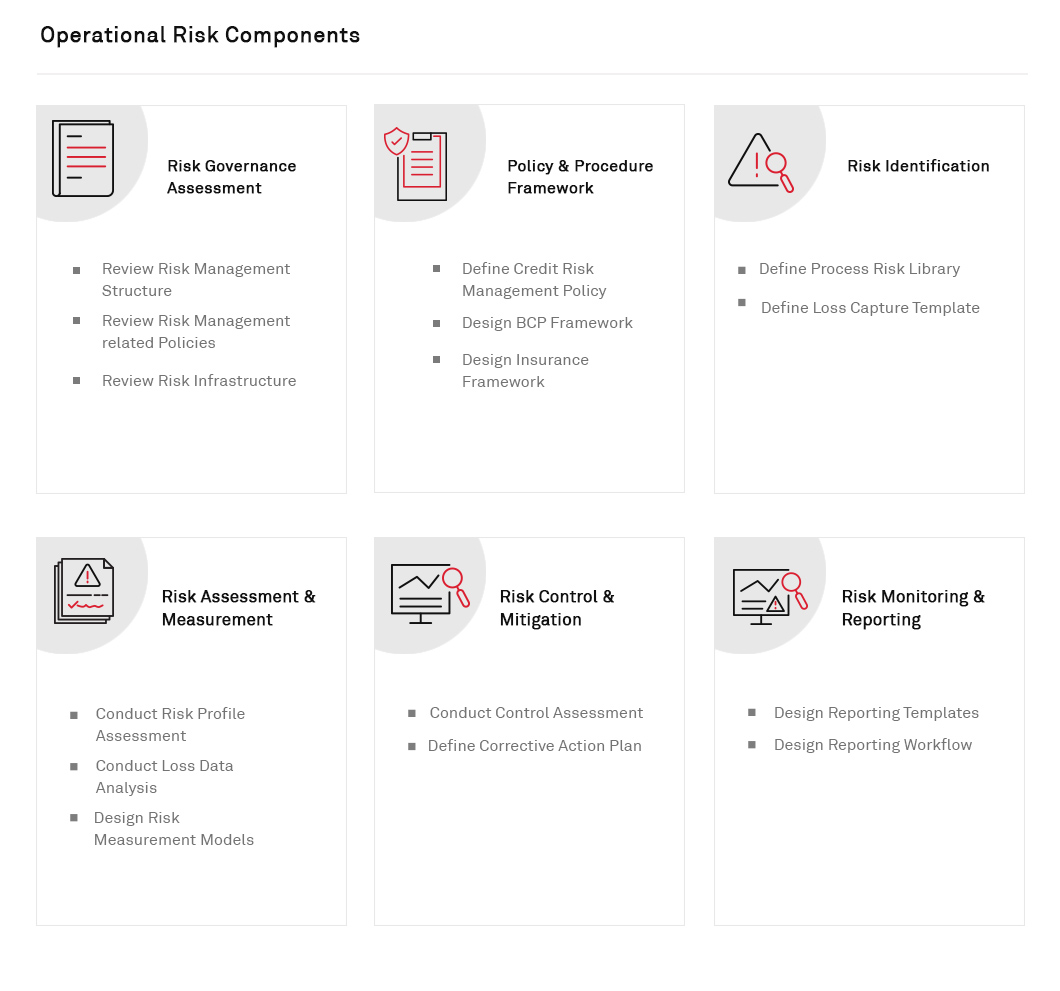
Gap Analysis
- Diagnostic review of operational risk management practices as compared to industry best practices and regulatory guidelines.
Policy & Procedure
- Analysis of key business processes, development of workflow charts, identification/grading of possible operational risk areas
- Assess and mitigate operational risk
- Design control processes to assist in risk mitigation/minimisation
Risk Control Self-Assessment (RCSA)
- Design process-risk-control library to assist risk control self-assessment (RCSA)
- Design framework and template for RCSA
Key Risk Indicators (KRI)
- Design process flow and library for key risk indicators (KRI)
- Design KRI monitoring framework
Loss Data Management (LDM)
- Design framework to measure operational risk
- Design processes to analyse operational loss databases
- Design framework for loss data management
Model Validation
- Validate bank's internal models, etc to ensure compliance with advanced measurement approach
Operational Risk Consulting develops value-at-risk (VaR) models for operational risk measurement. It entails:
- Loss data collection across Basel business lines and loss event categories
- Loss data modeling
- Conduct "goodness of fit" test to assess strength of distribution
- Conduct simulation analysis
- Estimate operational loss VaR
- Back-testing to assess operational loss of VaR as against actual loss
- Operational risk capital charge estimation
- Estimate unexpected loss
- Scale-up factor, based on results of RCSA and KRI
- Value-at-risk model validation process includes:
- Assessment of internal and external data (including proxy data elements) used in the model to ensure completeness
- Analysis of model assumptions
- Analysis of mathematical calculation and underlying risk factors
- Back-testing of existing data
- Testing VaR model based on hypothetical portfolios
- Validation of model vis-a-vis benchmark/industry standard
- Assessment of reporting to senior management as regards
- Assessment of internal and external data (including proxy data elements) used in the model to ensure completeness
- Analysis of model assumptions
- Analysis of mathematical calculation and underlying risk factors
- Back-testing of existing data
- Testing VaR model based on hypothetical portfolios
- Validation of model vis-a-vis benchmark/industry standard
- Assessment of reporting to senior management as regards