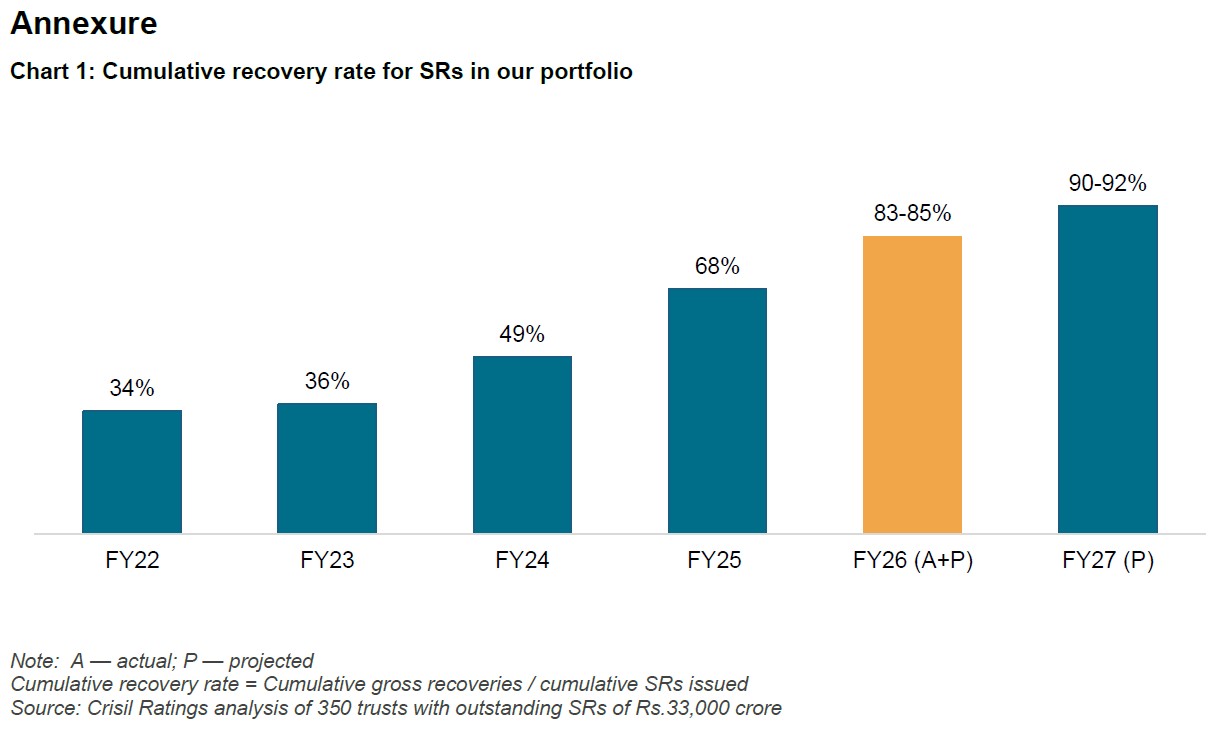
Asset reconstruction companies (ARCs) are expected to see the cumulative recovery rate1 of security receipts (SRs) go up by ~700 basis points in the upcoming fiscal, taking the total to ~90%. Healthy performance and resolution of chunkier stressed assets in key infrastructure sectors such as real estate, roads and power will be the primary drivers for higher recoveries.
Further, slowdown in new acquisitions due to limited supply of fresh distressed assets from banks and non-banking financial companies (NBFCs), resulting in slower increase in cumulative SRs issued, will also contribute towards improving the recovery ratio.
In fact, assets under management (AUM) of private ARCs have declined by ~4% since fiscal 2024 as redemption of SRs have outpaced acquisitions and this trend is expected to continue in the medium term.
At this juncture, what can potentially arrest the declining AUM trend is a broad-basing of the addressable stressed asset pool for ARCs by measures such as enabling acquisitions from alternative financiers.
Recoveries continue to be led by corporate assets (~92% of expected recoveries in fiscal 2027), with the cumulative recovery rate expected to reach 90-95% next fiscal (from ~85% estimated this fiscal). Recovery in retail asset pools (~8% of expected recoveries) is expected to inch up to 80-85% next fiscal (from ~78% estimated this fiscal).
An analysis of ~350 trusts with outstanding SRs of ~Rs 33,000 crore across our rated corporate and retail pools indicates as much.
Says Mohit Makhija, Senior Director, Crisil Ratings, “Of the estimated ~Rs. 11,000 crore recovery next fiscal, real estate segment is expected to contribute 40-45%, owing to stable milestone linked payouts as construction progress remains on track. The roads segment2 will contribute 10-15%, aided by expected arbitration payouts in terminated road projects, while the balance 30-35% will be spread across diversified sectors3 primarily through IBC4 mode and settlements owing to healthy security coverage. Further, retail pools will contribute ~10% of recoveries driven by secured mortgage pools of lower vintage and low Loan-To-Value (LTV). However, with chunkier infrastructure assets nearing resolution, headroom for further acceleration in recoveries may reduce beyond fiscal 2027”.
Healthy SR redemptions coupled with a declining supply of fresh stressed asset pools, are expected to keep growth subdued for ARCs. Supply of new stressed assets will likely be lower as the overall gross non-performing assets in the banking system (banks and NBFCs) is expected to remain low next fiscal at 2.3-2.5%. This is likely to pose growth challenges for ARCs.
In this context, implementation of Sudarshan Sen Committee’s proposal to allow ARCs to tap into stressed asset pools of debt alternative investment funds (AIFs), debt mutual funds and other financiers can aid diversification in sourcing of stressed assets.
Says Shounak Chakravarty, Director, Crisil Ratings, “Allowing ARCs to acquire stressed assets from alternative financiers can create a win-win proposition for both ARCs and AIFs. While ARCs can bring in their expertise in resolution and recoveries of stressed investments, AIFs can remain focused on their core objective of generating returns on standard assets. With debt AUM of approximately ~Rs 1.40 lakh crore as of December 31, 2025, AIFs have seen past instances of their assets defaulting and could offer select avenues for ARCs to diversify their portfolio by acquiring stressed assets of AIFs.”
In the road ahead, any negative impact on the performance of stressed infrastructure assets due to a slowdown in overall economic activity, larger than expected delays in IBC resolutions and any hinderances in implementation/ adoption of the proposed reforms in the ARC space will bear watching.
1 ARCs acquire stressed loans from financial institutions at a haircut and issue SRs against them; the cumulative recovery rate is the ratio of cumulative gross recoveries to cumulative SRs issued. Cumulative SR issued includes Crisil rated trusts originated since fiscal 2016
2 Our rated portfolio of stressed assets includes ~1,500 km of stressed road projects
3 Diversified sectors such as power, EPC (engineering, procurement and construction), education services, etc.
4 Resolutions using the provisions of the Insolvency and Bankruptcy Code (IBC)