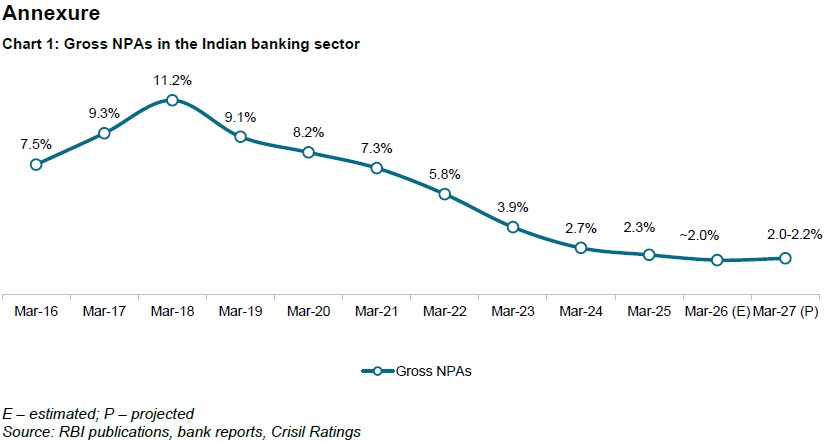
Banks are expected to keep their gross non-performing assets (NPAs) in check at 2.0-2.2% by the end of March 2027, compared with a historical low of an estimated ~2.0% as of March 2026 (refer to Chart 1 in Annexure).
Amid the conflict in West Asia, the corporate segment’s healthy balance sheets will support resilience in their credit quality.
However, loans to the micro, small and medium enterprise (MSME) segment will be impacted more on account of two key factors - firstly, the West Asia conflict affecting underlying borrowers and secondly, seasoning of the portfolio in a period of high growth. That said, government measures are expected to contain the stress on MSMEs, and in turn, the cascading effect on bank NPAs.
Asset quality in the retail loan segment should remain manageable with performance of the unsecured book stabilising compared to trends seen in the recent past.
The projections assume the West Asia conflict-related disruptions and subsequent stabilisation to extend to a 3-4 month period in the current fiscal, leading to a moderation in gross domestic product (GDP) growth to 7.1%1 this fiscal in the base case from 7.6% last fiscal, with risks tilted to the downside.
The corporate loan segment, which accounted for ~36% of bank credit2 in March 2026, is expected to see stable gross NPAs of 1.2-1.3% by March 2027, in line with an estimated 1.2% as of March 2026, despite multiple sectors facing an impact on their revenues and operating profit from the gas supply shock, crude oil-linked price increases, direct trade exposure and rupee depreciation. This is because of the healthy balance sheets of India Inc as reflected in an estimated low gearing of ~0.53 time as on March 31, 2026 and an interest coverage ratio of ~5.2 times in fiscal 2026 – a substantial improvement from the levels of ~1.1 times and ~2.9 times respectively, a decade ago.
This is also borne out by a recent Crisil Ratings’ stress test of 30 sectors (accounting for 65% of rated corporate debt4) exposed to the West Asia conflict either directly or indirectly. The stress test indicates that companies in 23 of these 30 sectors will see limited impact on credit profiles. Six sectors could see a moderately negative impact and only one sector, i.e. ceramics will see an adverse impact; together, these 7 sectors account for < 7% of rated corporate debt5.
The MSME segment, which accounted for ~19% of bank credit in March 2026, could, however, witness a higher impact from the West Asia conflict.
Says Subha Sri Narayanan, Director, Crisil Ratings, “Our base case indicates a modest increase in reported gross NPAs in the MSME segment, to 3.4-3.6% this fiscal from ~3.2% last fiscal. MSMEs typically have limited financial muscle to absorb higher input costs, supply-chain disruptions and working capital elongation resulting from the ongoing West Asia conflict”.
However, government and regulatory relief measures, including the recently announced RELIEF6, will support MSMEs. The likely introduction of additional support measures, such as a credit guarantee scheme for affected sectors, as seen in the past during periods of exogenous stress such as the Covid-19 pandemic, will support asset quality of banks.
As a result, the uptick in gross NPAs in the MSME segment will be primarily on account of seasoning of the portfolio, which logged a compound annual growth rate (CAGR) of ~20%7 over the past three fiscals.
Earlier, NPAs in the MSME segment had been declining sequentially, driven by banks’ improved underwriting and monitoring capabilities, supported by increasing formalisation and data availability in the sector, healthier bank balance sheets that allowed for higher write-offs, and various government and regulatory support measures for MSMEs.
The retail loan book of Indian banks has exhibited steady performance in recent years, especially in the secured segment, and that trend is expected to continue.
Says Vani Ojasvi, Associate Director, Crisil Ratings, “In the retail portfolio, which accounted for ~33% of bank credit in March 2026, gross NPAs are expected to be stable at 1.1-1.3% this fiscal, benefitting from steady asset quality in most of the secured segments and some stabilisation in unsecured asset classes.”
Housing loans, which form over 45% of the retail book, have exhibited healthy asset quality through economic cycles, with gross NPAs remaining ~1% for last few years.
In the unsecured loan segment, which accounts for over a quarter of retail advances and where some volatility in asset quality was witnessed in the recent past, banks have taken corrective actions, resulting in better performance from newer vintages. As these newer vintages constitute an increasing share of the book, gross NPAs in this segment should not rise materially above the current ~1.8%.
However, the unsecured loan segment overall has witnessed higher slippages8 and reported NPAs have remained low only due to accelerated write-offs 9.
Against a backdrop of increased borrower indebtedness—both in terms of average household debt and average borrower leverage—the trend in early-bucket delinquencies in the unsecured portfolio of banks does warrant attention, but it should not materially impact the overall asset quality levels.
Asset quality in the agriculture segment remains sensitive to the extent and distribution of rainfall. With monsoons expected to be below normal for the first time in 11 years, this portfolio remains monitorable.
All in all, asset quality metrics for the banking sector will be range-bound as per our base case estimates.
The duration and intensity of the West Asia conflict, as well as government and regulatory measures to manage its impact, will bear watching.
1 Refer to Crisil Limited publication ‘Economic impact of West Asia shock’, dated April 10, 2026
2 Total domestic bank credit
3 Refers to median number for the corporate static pool in Crisil Ratings’ portfolio (excluding financial sector)
4 Includes both bank loans and capital market debt
5 Refer to Crisil Ratings report “Strain in the Strait”
6 Resilience & Logistics Intervention for Export Facilitation under the Export Promotion Mission. The intervention is aimed at supporting Indian exporters affected by extraordinary freight escalation, heightened insurance premia and conflict-related export risks arising from disruptions in the Gulf and wider West Asia maritime corridor
7 Part of the growth last fiscal was on account of reclassification of MSMEs
8 The slippage ratio in unsecured retail loans is estimated to have been around double that of overall retail loans last fiscal
9 Write-offs to gross NPAs (annualised) stood at 144% in the first half of last fiscal