• Bank Credit Growth
  • Bank Credit
  • MSME
  • Deposit Growth
  • Micro, Small and Medium Enterprises
  • Retail Sector
April 07, 2026

Bank credit to grow ~13% this fiscal, a smidgen slower on-year

MSME, retail drivers; geopolitical uncertainties, deposit growth bear watching

Bank credit1 is poised to grow ~13% this fiscal, driven by healthy growth in the micro, small and medium enterprise (MSME) and retail sectors, as well as the continued preference of corporates for bank credit rather than issuance of bonds amid the prevailing interest rate differential.

Support will also come from increased working capital intensity of India Inc, even as a revival in capital expenditure (capex) of the private sector could be delayed.

Overall, credit growth will be a tad slower than the estimate of ~14% for fiscal 2026 (refer to the chart in the annexure). While tailwinds from the regulatory and government measures announced in fiscal 2026 should sustain and support growth, the extent of benefit will taper over time and the impact will be seen across sub-segments: corporate, MSME and retail.

The duration and intensity of the West Asia conflict and its effect on the macroeconomic landscape can also impact the credit growth calculus. Further, a pick-up in deposit growth will be crucial, given the recent widening of its gap with credit growth.

Says Subha Sri Narayanan, Director, Crisil Ratings, “Credit growth in the corporate sector (~36% of domestic bank credit) is seen growing 9-10%, in line with ~10% in fiscal 2026. After a subdued start, corporate credit growth accelerated in the second half of fiscal 2026, supported by lower interest rates on bank loans relative to corporate bonds.”

While corporate bond yields2 began dropping in January 2025, the trend reversed after July and by March 2026, yields rose past the January 2025 level. Meanwhile, the weighted average lending rate (WALR3) of banks dropped almost 90 basis points (bps) between January 2025 and March 2026.

This resulted in corporates, especially in large sub-segments such as non-banking financial companies (NBFCs), preferring bank credit. The trend of corporate bond interest rates being higher than bank WALRs should continue in fiscal 2027 as well, which will aid demand for bank credit.

Newer avenues such as acquisition financing, now permitted for banks by the regulator, should also support credit growth.

The ongoing West Asia conflict would have a dual impact on wholesale4 credit growth. On the one hand, the associated uncertainties could weigh on a broad-based revival in private sector capex. On the other hand, supply-chain disruptions and higher input prices would increase demand for working capital debt in the short term.

The latter would especially play out in the MSME segment (~19% of domestic bank credit). This segment has been, and will remain, the fastest growing portfolio for the banking sector, though growth will moderate from the 24-25% level seen in fiscal 2026 as the country’s economic growth tempers.

Growth in fiscal 2027 should still be upwards of 22% in the base case for two reasons. One, government initiatives such as the three-tier stimulus for MSMEs announced in the Union Budget5 and doubling of collateral-free loan limits should enhance funding access, liquidity, and transaction settlement for MSMEs. Further, strengthening of the operational infrastructure and digital ecosystem associated with MSMEs is enabling better data access, which, in turn, enhances the ability of banks to assess risk and cater to this segment.

Nevertheless, heightened caution by banks in lending to export-oriented MSMEs focused on West Asia, or those dependent on crude oil/ liquefied natural gas (LNG), could temper growth in the near term.

Retail loans (~33% of bank lending) will continue to grow at a reasonable clip, at ~14%, in fiscal 2027. While this will be lower than the second half of fiscal 2026, which benefitted from the immediate impact of regulatory stimuli such as softer interest rates and tax reliefs, it will be only a marginal moderation compared with fiscal 2026 overall.

Banks continue to be well-positioned in home loans, their largest business segment. They will continue to gain share in the prime segment given competitive pricing.

Growth in auto loans, which, too, hastened after the rationalisation of the goods and services tax last fiscal, should sustain. Unsecured loans could see moderately higher growth in fiscal 2027 as asset quality of newer originations has improved.

However, inflationary pressures from a prolonged West Asia conflict and the resultant higher interest rates could weigh on retail consumption demand.

Agricultural credit growth is expected to be range-bound at 10-11% in fiscal 2027 with the expectation of normal monsoons.

All said, deposit growth, a crucial support for credit growth, bears watching.

The gap between credit growth and deposit growth, which had been eliminated in the first quarter of fiscal 2026, has again been widening with accelerating credit growth, standing at 300 bps as on March 15, 2026.

Says Vani Ojasvi, Associate Director, Crisil Ratings, “Regulatory measures such as the phased reduction in the cash reserve ratio have released liquidity for banks, providing support during the recent muted deposit growth. Banks are also utilising their excess statutory liquidity ratio buffers and tapping certificates of deposit (CDs) to fund credit growth. Notably, against overall deposit growth of 10.8% on-year as on March 15, 2026, growth in CDs was ~27%, albeit on a much smaller base. However, this comes at a higher cost.”

Further, reducing levels of excess SLR will constrain the flexibility of banks going forward, making deposit growth even more crucial. In this environment, competition for deposits will remain high, keeping deposit rates elevated. As a result, banks could increasingly turn to alternative funding avenues such as bonds and securitisation.

While the base case sees bank credit growth remain relatively steady in fiscal 2027, the ongoing geopolitical uncertainties bear watching as they pose downside risks to India’s economic growth and could impact bank credit growth.


1 Domestic bank credit
2 As reflected in 3-year bonds issued by a AAA-rated public sector issuer
3 Weighted average lending rates (WALRs) on fresh rupee loans
4 Corporate + MSME credit growth
5 The Union Budget 2026-27 proposed a three-pronged approach to help Indian MSMEs grow by providing equity, liquidity and professional support
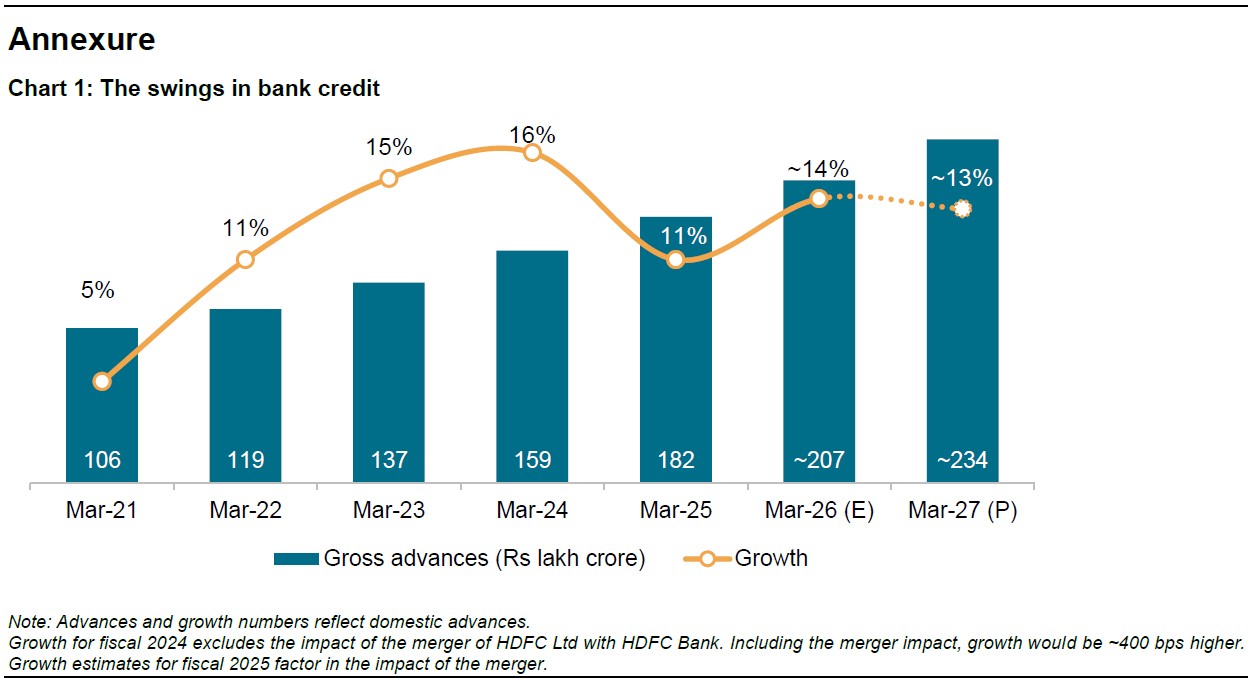
Chart 1: The swings in bank credit

For further information,

  • Media relations

    Ramkumar Uppara
    Media Relations
    Crisil Limited
    M: +91 98201 77907
    B: +91 22 6137 3000

    ramkumar.uppara@crisil.com


  • Analytical contacts

    Ajit Velonie
    Senior Director
    Crisil Ratings Limited
    D: +91 22 6137 3090
    ajit.velonie@crisil.com

  •  

    Subhasri Narayanan
    Director
    Crisil Ratings Limited
    D: +91 22 6137 3403
    subhasri.narayanan@crisil.com