• Alcobev
  • Revenue Growth
  • Supply Chain
  • Alcoholic Beverage
  • Ebitda
  • Ebitda Margin
April 22, 2026

Pain in the pack to tear margin of alcobev makers 150-200 bps

Revenue growth of the industry to also moderate to 5-7% due to supply chain constraints

Alcoholic beverage (alcobev) manufacturers in India are set to see their earnings before interest, taxes, depreciation and amortisation (Ebitda) margin decline by 150-200 basis points (bps) this fiscal due to a rise in packaging costs following supply-chain disruptions caused by the ongoing West Asia conflict.

Revenue growth is likely to slow to 5–7% (refer to Chart 1 in Annexure) due to bottle availability issues, in sharp contrast to the 11% CAGR1 the industry clocked over the last three fiscals.

However, despite lower cash flows, a reduction in inventory will provide temporary relief to the working capital cycle for alcobev makers.

This is as per a study of 31 alcobev makers (including 10 listed entities), which account for ~30% of the organised alcobev industry revenue of Rs 3.8 lakh crore.

The alcobev industry is currently battling a shortage of glass bottles. Notably, spirits and beer comprise more than 95% of the industry size. Packaging costs are higher for the beer segment, at 35% of net revenues, compared with ~25% for spirits. Around two-thirds of the packaging cost goes towards glass bottles.

The current geopolitical crisis has affected the supply of liquefied natural gas, a key component for manufacturing glass bottles. Hence, glass bottlers have currently cut down their production by ~ 35-40%, resulting in shortage across industries and a gradual rise in glass bottle prices.

Says Jayashree Nandakumar, Director, Crisil Ratings, “The cost of glass bottles is expected to increase 20% on average this fiscal, to Rs 280-300 per case. Given that the alcobev industry is highly regulated and manufacturers have limited ability to pass on cost escalations to customers, operating margins are expected to decline by 140-180 bps in the spirits segment; whereas the impact will be sharper in the beer segment, at 250-300 bps.”

The blended margin for the industry would decline by 150-200 bps to 11.5-12% this fiscal, assuming the supply chain disruptions continue through the first half of the fiscal, with no major revision in retail prices.

Also, amidst input price increases, packaging inventory has been gradually declining since the war began.

Says Sajesh KV, Associate Director, Crisil Ratings, “Players typically maintain packaging inventory of 50-60 days to manage supply disruptions. This is likely to drop to 20-30 days amid the ongoing West Asia conflict. The lower inventory position will result in near-term liquidity improving somewhat due to release of working capital for players. A prolonged disruption could, however, tighten supplies and exert further pressure on prices and procurement strategies.”

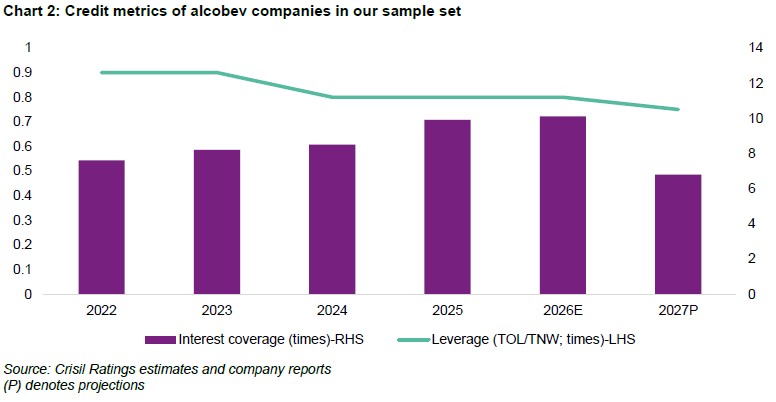
Despite debt-funded capital expenditure plans, balance sheets are likely to remain healthy due to prudent debt funding as in the past. Interest coverage ratio is likely to remain healthy at 6.8 times this fiscal (refer to Chart 2 in Annexure), while the ratio of total outside liabilities to tangible networth is likely to remain under control at 0.75 time.

The trajectory of the ongoing West Asia conflict, any potential change in the regulatory environment regarding excise duties, and volatility in input costs will bear watching.


1 Compound Annual Growth Rate
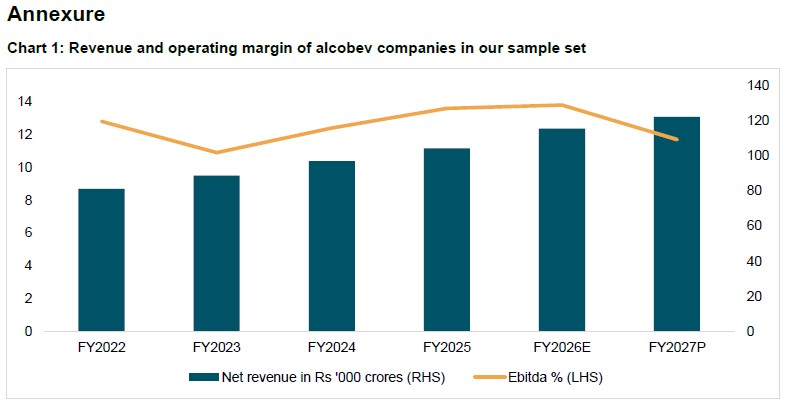
Chart 1: Revenue and operating margin of alcobev companies in our sample set
Chart 2: Credit metrics of alcobev companies in our sample set

For further information,

  • Media relations

    Ramkumar Uppara
    Media Relations
    Crisil Limited
    M: +91 98201 77907
    B: +91 22 6137 3000

    ramkumar.uppara@crisil.com


  • Analytical contacts

    Rahul Guha
    Senior Director
    Crisil Ratings Limited
    D: +91 22 6137 3085
    rahul.guha@crisil.com

  •  

    Jayashree Nandakumar
    Director
    Crisil Ratings Limited
    D: +91 44 6656 3466
    Jayashree.Nandakumar@crisil.com