• Sunflower Oil
  • West Asia
  • West Asia Conflict
  • Credit Profiles
  • Middle East Conflict
  • Operating Leverage
April 02, 2026

Sunflower oil consumption set to wilt ~10% amid geopolitical heat

West Asia conflict to drive up prices; strong balance sheets to keep credit profiles stable

Indian refined sunflower oil volume is poised to decline ~10% in the current fiscal, due to twin headwinds that will dampen demand. Firstly, supply-chain disruptions triggered by the Middle East conflict, and secondly, higher prices resulting from the pass-through of increasing logistics costs, will likely lead consumers to switch to cheaper substitutes such as rice bran and soybean oils. Revenues are, however, expected to remain flat during the year, as higher realizations would offset the volume drop.

Profitability of sunflower oil refiners should also remain stable with inventory gains from previously acquired low-cost inventory largely offsetting negative operating leverage from the volume dip.

Increasing crude prices and supply-side bottlenecks will tighten the inventory levels of domestic sunflower oil refiners in the short term. That said, this will also lead to a temporary release of working capital, thereby aiding cash flows. Moreover, strong balance sheets will help keep their credit profiles stable.

An analysis of nine sunflower oil refiners rated by us, accounting for ~70% of the industry revenue of Rs 36,000 crore, indicates as much.

For the record, refined sunflower oil accounts for 12–14% of India’s annual edible oil consumption of 25–26 million tonne. The industry depends heavily on imports of crude sunflower oil, making it vulnerable to global trade disruptions and geopolitical developments.

A large portion of the imports is from Ukraine and Russia. With the ongoing conflict in West Asia, vessels are taking longer routes, such as around the Cape of Good Hope, increasing voyage distance and transit time. Moreover, for vessels passing through conflict-sensitive regions, war-risk insurance premiums have risen. Consequently, the landed cost of crude sunflower oil for Indian refiners has increased.

Says Jayashree Nandakumar, Director, Crisil Ratings, “Since the West Asia conflict began, the average import price1 of sunflower crude oil has risen to $1,420–1440 per tonne currently, compared with $1,275 per tonne on average for the trailing 12 months. A weakening Indian rupee and higher shipping costs are further increasing the landed cost of crude sunflower oil in India.”

An increase in sunflower crude cost would eventually translate into higher retail prices of refined sunflower oil. Retail prices of refined sunflower oil are currently trading at Rs.170-175 per litre against ~Rs.150 per litre in January 2026. Moreover, as rice bran and soyabean oils are currently trading at a discount of Rs.10-20 per litre to sunflower oil, there could be a partial shift towards these substitutes. Hence, demand for sunflower oil is seen dropping by ~10% in fiscal 2027.
 

Despite the volume degrowth, profitability of refiners would stay firm given the ability to pass on price increases to end consumers albeit with a lag of 10-15 days. Also, refiners have firm hedging policies in place to avoid downside price risks. Moreover, price gains from the low-cost inventory will largely offset negative operating leverage arising from the volume dip. Hence operating margins of players are seen stable at ~4.8-5%.

Moreover, amidst the price increase, inventory levels with domestic sunflower oil refiners have been gradually declining since the onset of the war.

Says Rishi Hari, Associate Director, Crisil Ratings, “Refiners typically maintain raw material inventory of 30–45 days to manage supply disruptions and price volatility. However, inventory has dropped to 20–30 days amid the West Asia conflict-induced increase in prices. While it reflects supply uncertainty and slower replenishment cycles, the lower inventory position has had a marginally positive impact on near-term liquidity due to release of working capital for refiners.”

However, a prolonged disruption could tighten supplies further and exert pressure on prices and procurement strategies.

The healthy balance sheets of sunflower oil refiners rated by us, as reflected in total outside liabilities to tangible networth ratio of 1.8–1.9 times, cushions their credit profiles.

In the road ahead, global sunflower oil trade dynamics and the trajectory of the ongoing conflict will bear watching.


1 Average import price is for cost, insurance and freight (CIF) at Indian ports
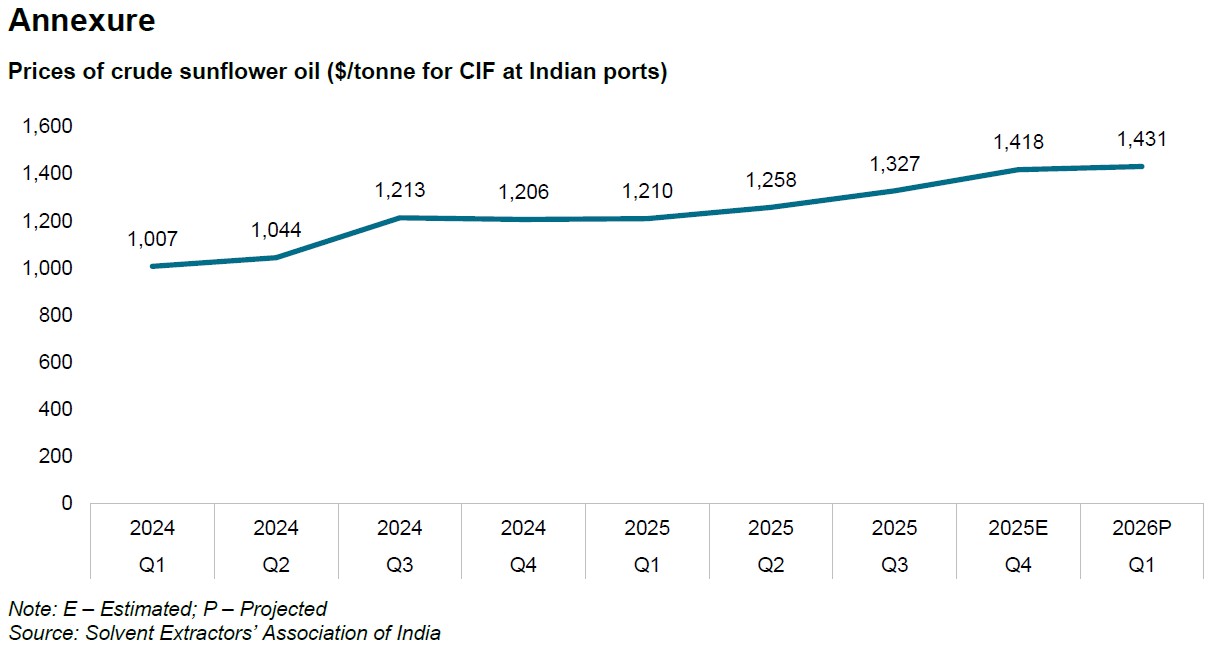
Prices of crude sunflower oil ($/tonne for CIF at Indian ports)

For further information,

  • Media relations

    Ramkumar Uppara
    Media Relations
    Crisil Limited
    M: +91 98201 77907
    B: +91 22 6137 3000

    ramkumar.uppara@crisil.com


  • Analytical contacts

    Rahul Guha
    Senior Director
    Crisil Ratings Limited
    D: +91 22 6137 3085
    rahul.guha@crisil.com

  •  

    Jayashree Nandakumar
    Director
    Crisil Ratings Limited
    D: +91 44 6656 3466
    Jayashree.Nandakumar@crisil.com