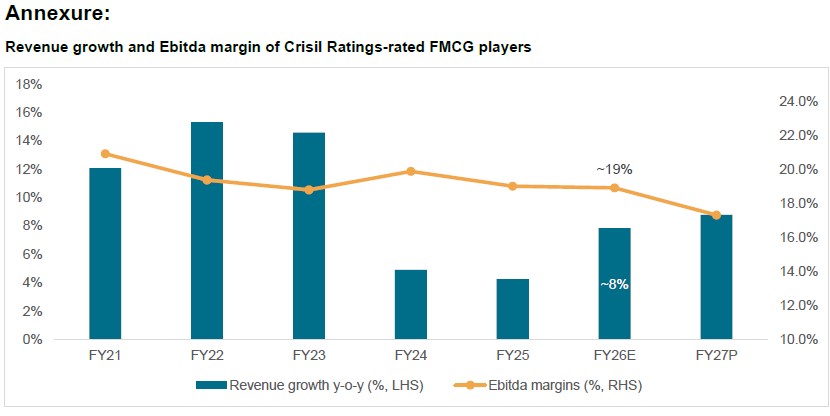
The organised fast-moving consumer goods (FMCG) sector is expected to post 8–10% revenue growth this fiscal, a tad higher than ~8% witnessed in fiscal 2026. The uptick in growth will be driven by a sharp 6–7% increase in realisations as players partially pass on the increase in prices of crude-linked inputs including packaging materials, emanating from the West Asia conflict.
However, volume growth is likely to moderate to 2–3% this fiscal from 5–6% in fiscal 2026, as inflationary pressures weigh on both urban and rural demand. Moreover, rural demand is also susceptible to prospects of a below-normal monsoon.
Consequently, the earnings before interest, taxes, depreciation and amortisation (Ebitda) margin of our rated FMCG players is seen declining 150–200 basis points (bps) this fiscal from ~19% in fiscal 2026 (refer chart in annexure).
Nevertheless, low leverage and healthy liquidity position should keep credit profiles stable.
A study of 74 FMCG companies, accounting for a third of the sector’s estimated Rs 6.6 lakh crore revenue in fiscal 2026, indicates as much.
By category, the food and beverages (F&B) segment generates nearly half of the sector’s revenue, with personal care (PC) and home care (HC) segments contributing a quarter each. Urban markets account for ~60% of revenue, with rural markets making up the rest.
Says Anuj Sethi, Senior Director, Crisil Ratings, “Household budgets, both rural and urban, will face inflationary headwinds1 this fiscal as average crude oil prices for this fiscal are projected at 30–35%2 higher on-year. As these price increases are passed on to the retail consumers, including through fuel price hikes, disposable incomes are likely to be hit. Furthermore, the rural market, which had outperformed the urban segment in the past two years, is expected to see a reversal of fortunes this fiscal, given the forecast of a below-normal monsoon3. Nevertheless, continuing benefits of the goods and services tax rationalisation4 undertaken in September 2025, along with increased allocation to welfare schemes5, will provide some demand support for the sector.”
While the industry is facing significant cost pressures due to the rise in raw materials, it is not uniform across segments. For instance, PC and HC categories, such as soaps, detergents, hair oil, and shampoos, are facing a sharper increase in input prices, as crude-linked inputs account for 30–40% of the overall raw materials for these segments, compared with ~15% for F&B.
Overall, the sharp rise in crude-linked input costs, including packaging, accounting for 25–30% of total raw material costs, will squeeze profitability of the companies.
Says Aditya Jhaver, Director, Crisil Ratings “Gross margins of organised FMCG players will decline 300–350 bps due to the rise in input costs, as pass-through of cost inflation will be partial amid competitive pressures and the risk of downtrading. In the milieu, companies are calibrating their advertising spends, focusing on cost efficiencies and negotiating with suppliers and distributors across the value chain. This is expected to limit the impact on operating profitability to 150–200 basis points, keeping operating margins relatively healthy at 17–18%.”
Despite margin compression, the credit profiles of FMCG companies we rate will remain stable, supported by healthy cash generating ability, strong balance sheets and sizeable liquid surpluses.
The uncertain macroeconomic environment impacting domestic consumption, duration for which crude oil prices remain elevated and vagaries of the monsoon will bear watching.
1 Crisil Intelligence estimates Consumer Price Index (CPI) to rise ~300 bps to 5.1% in fiscal 2027
2As of May 15, 2026, Crisil Intelligence expects brent crude oil prices to average between $90-95 per barrel for fiscal 2027
3Indian Meteorological Department (IMD) has predicted below-normal southwest monsoon at 92% of average rainfall for fiscal 2027
4Based on the analysis of major listed companies, GST rate rationalisation has led to 50–60% of the FMCG product portfolio moving to the 5% slab rate; only 8–10% of the product portfolio was under the 5% slab rate before the rate cuts
5Government schemes include support to farmers under “PM-Kisan” scheme, rural jobs under “Viksit Bharat - Guarantee for Rozgar and Ajeevika Mission (Gramin)” scheme as well as cash transfer schemes undertaken by various states