The protracted conflict in West Asia has been goading domestic companies to realign supply chains, navigate pricing issues, manage higher fuel and freight costs, and contend with a depreciating rupee.
From a credit-quality perspective, however, our analysis shows India Inc will remain resilient on the back of strong balance sheets, steady domestic demand and government-led capital expenditure, enabling it to navigate profitability pressures stemming from the lingering geopolitical uncertainties.
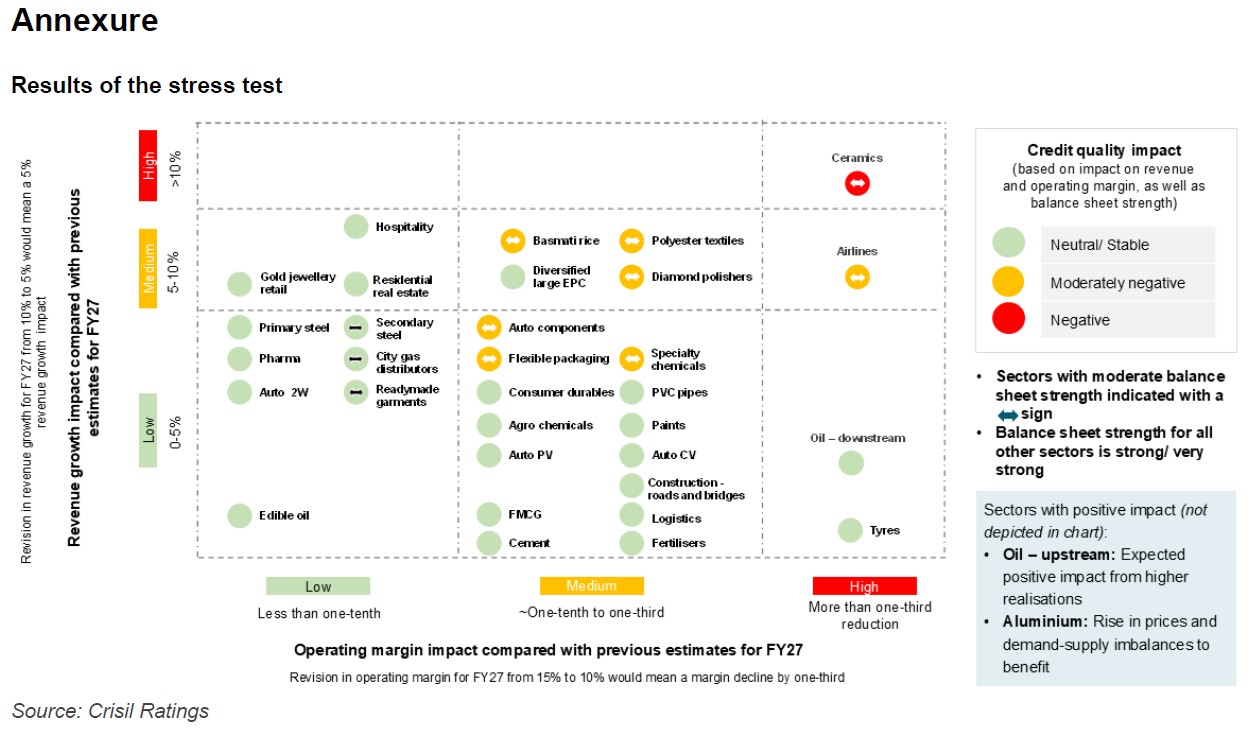
With the conflict and disruptions into their third month and the situation still evolving, we conducted a stress test of 34 sectors1, which account for 65% of our rated corporate debt.
We have assumed supply-chain disruptions could last for nine months this fiscal (compared with six months in our base case), with crude oil prices averaging $110 per barrel for this fiscal (versus a base case assumption of $95).
We assessed the impact on sectoral revenue, operating profitability and the resilience provided by balance-sheet strength to determine the impact on credit quality.
Based on the results, we infer that the prolonged supply-chain disruptions (as part of the stress test) could shave off corporate operating profitability by ~200 basis points (bps)2 this fiscal from the pre-conflict expectation of ~12%, with some sectors seeing a more pronounced impact.
Says Subodh Rai, Managing Director, Crisil Ratings, “For companies, managing costs and profitability will be a bigger challenge than achieving topline growth. Of the 34 sectors stress-tested, 22 would see operating profitability being culled more than 10% due to higher inventory costs and inability to fully pass on the burden to consumers immediately. On the other hand, even a partial pass-through can drive up realisations, resulting in a lower impact on revenue growth for most sectors. Further, credit profiles will be cushioned by controlled gearing levels and sustained domestic demand. Consequently, we foresee the credit quality of only eight sectors, accounting for 10% of our rated corporate debt, being materially impacted.”
Over the past decade, corporate India’s median gearing has halved to ~0.5 time as of March 2026, while interest coverage has doubled to over 5 times. Consequently, robust balance-sheets are providing sufficient headroom for India Inc to navigate the profitability pressures emanating from the West Asia conflict, thereby keeping credit profiles resilient. Balance-sheet strength should sustain this fiscal, even as working capital needs inch up.
Credit quality has been supported by policy interventions in times of non-linear events such as the Covid-19 pandemic and the tariff tribulations last year. The recently announced Emergency Credit Line Guarantee Scheme (ECLGS) 5.0 is timely in supporting MSMEs3—characterised by limited balance-sheet buffers and consequently higher vulnerability to the West Asia conflict—by alleviating credit quality pressures.
Our overall outlook for India Inc’s credit quality remains stable but cautious.
We outline below the sector-specific impact where there is a direct exposure to West Asia or significant linkages to crude oil-based products but limited balance-sheet cushion to absorb the impact4:
One sector will see a negative impact on credit quality:
- The ceramic sector will be the hardest hit due to supply-side disruptions caused by gas shortages in certain areas, which could reduce revenue by a third and profitability by half
Seven sectors would see moderately negative impact on their credit quality mainly because of lower operating profitability. For six of these, operating profitability is expected to fall by one-tenth to one-third, while for the seventh—airlines—profitability could reduce by around 50%.
- The airline sector will be impacted by airspace closures, higher fuel cost and rupee depreciation
- Crude-linked sectors, including polyester textiles, specialty chemicals and flexible packaging manufacturers, would be able to only partially pass on higher costs—that, too, with a lag
- Auto component makers will have limited flexibility to pass on higher production costs in the aftermarket and could see a lagged pass-through of higher input and freight costs
- For diamond polishers, sourcing through alternative hubs will increase procurement costs and affect operating profitability
- Basmati rice exporters would see lower offtake from key markets, impacting revenue and operating efficiency
As for rupee depreciation, our analysis shows most companies either have a natural hedge through trade or have forward cover for their forex exposure. Where there is no natural hedge, such as in the edible oil sector, companies have consistently demonstrated ability to pass on the higher cost to end-users. Additionally, the share of foreign-currency borrowings in India Inc’s corporate debt is low and largely hedged.
Among export-linked sectors, pharmaceuticals, textiles, readymade garments, shrimp processors and electronics manufacturers may benefit from the rupee’s depreciation.
Says Somasekhar Vemuri, Senior Director, Crisil Ratings, “While our outlook for India Inc’s credit quality remains stable, supported by strong corporate balance sheets and steady domestic demand, we maintain a cautious stance because of the uncertain trajectory of the West Asia conflict. If the strife and the stabilisation period are prolonged further, supply hiccups would exacerbate inflation and amplify demand disruption. Therefore, the crucial monitorables are the magnitude of the conflict and the extent and duration of the increase in fuel prices because these can impact our assessment of overall credit quality.”
1 These are the sectors exposed to the West Asia conflict either directly or indirectly, as mentioned in chart in annexure
2 This refers to the change in median operating margin across static pool of ~5,000 companies (including ~2,000 companies in 34 sectors) in the rated portfolio
3 Micro small and medium enterprises
4 The sectoral impact outlined in the scenario analysis does not necessarily mean all the companies in that sector will experience similar impact on credit quality. Individual credits may have case-specific nuances such as stronger balance sheets or parental support; hence, their impact on credit quality may be different from that for the overall sector.