

Other Sectors
ISTS waiver sunset casts shadow on 26 GW of renewable projects
Tapering of benefit will necessitate recalibration of debt coverage ratio and return expectations
Around 26-gigawatt1 (GW) of under-construction utility scale renewable energy projects, for which power purchase agreements (PPAs) have already been signed, may face moderation in cash flow following expiry of the 100% inter-state transmission system (ISTS) charge exemption on June 30, 2025.
These projects, which have experienced commissioning delays due to procedural, regulatory, and infrastructure-related challenges, may now be subject to a phased reduction in benefits.
The ISTS charge waiver, introduced by the Ministry of Power (MoP) in 2016 and subsequently extended2, was instrumental in encouraging renewable energy development by exempting eligible projects from ISTS charges. It enabled solar- and wind-rich states like Rajasthan and Gujarat to supply power cost-effectively to demand centres across India.
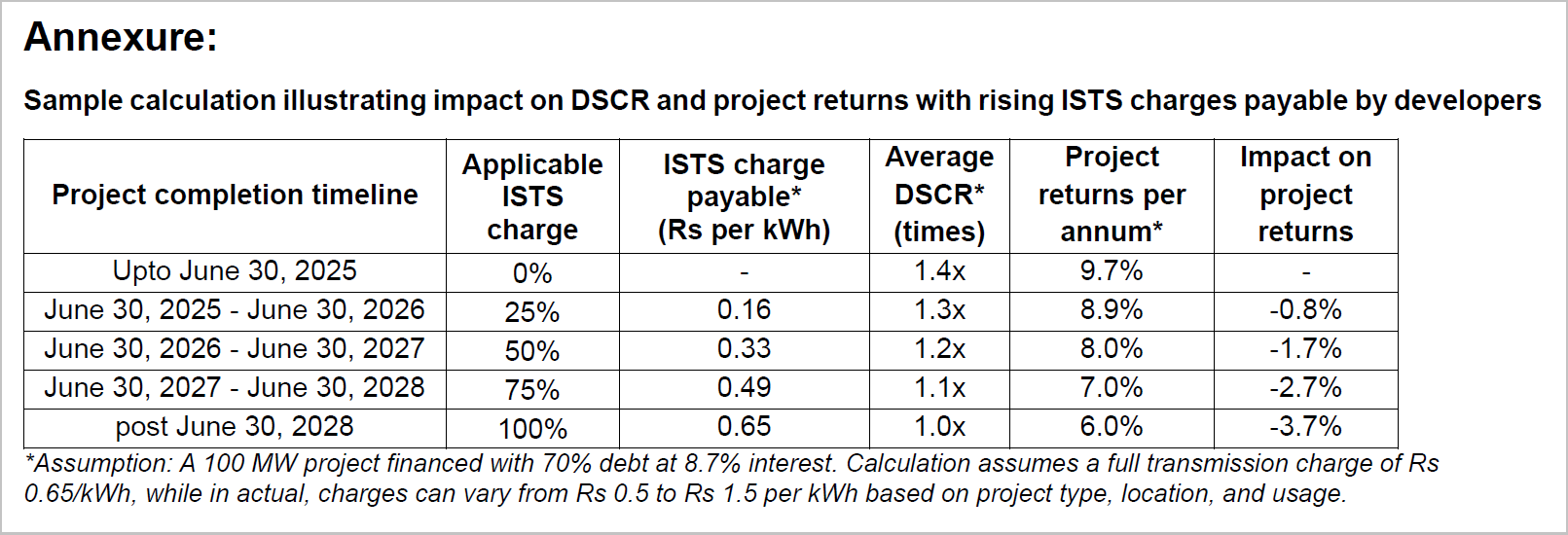
However, the incentive always had a sunset date. As part of a scheduled phase-down3, only projects commissioned by June 30, 2025, would continue to enjoy the full exemption for 25 years. Projects that are covered under the waiver policy but missed this deadline, would be eligible for partial concessions-75% waiver for those completed by June 2026, 50% for those completed by June 2027, and 25% for those completed by June 2028-after which the waiver will be fully discontinued. And, although ISTS charges are typically borne by the offtaker, developers for these capacities may be liable if delays are deemed solely attributable to them.
Transmission costs4, which vary by project type, location, and usage, typically range from Rs 0.5 to Rs 1.5 per kilowatt-hour (kWh)5. The reduction in waiver is expected to moderate long-term project cash flow, potentially affecting debt service coverage ratio (DSCR) and project returns. For instance, if a developer bears 25% of an assumed Rs 0.65/kWh transmission charge due to the waiver sunset, we may see DSCR decline from 1.4 times to 1.3 times (refer Annexure).
Says Ankit Hakhu, Director, Crisil Ratings, “Considering, around three-fourths of the affected capacity is expected to be commissioned by June 20266 and will still qualify for a 75% waiver, large scale sectoral impact and material downside in returns from the phase-down is expected to be limited. Additionally, most of these under-construction projects are backed by established developers, which provide financial flexibility. That said, if any project is impacted, they may see their project returns moderate by 80 to 370 basis points, depending on project type, bid competitiveness, and date of commissioning.”
Further, the delayed projects under analysis may still be able to claim full exemption if the delays are due to certain circumstances7.
Says Mohini Chatterjee, Team Leader, Crisil Ratings, “The circular allows for extension of waiver for any force majeure event, including the non-availability of transmission infrastructure, or for any other delay not attributable to the developer. However, approvals will be contingent on the decision of the concerned regulator. Considering these will be evaluated on a case-by-case basis, timely and satisfactory resolution of waiver-related disputes will be critical for the standalone credit profiles of these projects.”
All said, the government continues to support the overall renewables industry, with sharpening focus on grid stability, having extended the full ISTS charge exemption for battery energy storage systems and pumped hydro projects until June 2028.
1 Source: Central Electricity Authority (CEA), Quarterly report on under-construction renewable energy projects, March 2025
2 The last two extensions were via MoP’s January 2021 and June 2023 notifications
3 As per MoP’s notification dated June 13, 2025
4 Considers AC system ISTS charges
5 Source: Western Regional Power Committee, Regional Transmission Account (RTA) and Regional Transmission Deviation Account(RTDA)
6 As per CEA, Quarterly report on under-construction renewable energy projects, March 2025
7 CERC (Sharing of Inter-State Transmission Charges and Losses) Regulations, 2020, Fourth amendment
Analytica