

Other Sectors
Microfinance institutions face an extended road to recovery
Stabilisation of slippages from overleveraged portfolio, performance in top states crucial
The path to revival for microfinance institutions (MFIs1) is expected to be a challenging one with normalisation of profitability expected only by end of the current fiscal.
While the transition to the Guardrails 2.0 regime with effect from April 01, 2025, has limited the exposure of MFIs to over-leveraged borrowers, slippages from the legacy portfolio will keep asset quality under pressure. Furthermore, disruptions caused by ordinances2 pertaining to microfinance operations in Karnataka and Tamil Nadu could hinder the path to recovery. The ability to control slippages and manage credit costs, and thus profitability, will be crucial in the road ahead.
Our press release on April 9, 2025, underscored likely green shoots and headwinds on the way to recovery for MFIs.
Says Malvika Bhotika, Director, Crisil Ratings, “While the current bucket collections have stabilised at 98-99% and there has been some reduction in fresh slippages, around 14% of the assets under management (AUM) as on June 30, 2025, remains extended to borrowers transacting with more than three microfinance lenders. While this has reduced from ~23% (of AUM) as of December 31, 2024, the portfolio remains very vulnerable to slippages, especially after the Guardrail 2.0 regime limited fresh loans from more lenders to such borrowers.”
As per our estimates, almost a fourth of the portfolio with more than three lenders is in the PAR3 31-180 days bucket as on June 30, 2025.
Furthermore, the performance of Tamil Nadu, Karnataka and Bihar - together accounting for ~43% of the industry AUM - remains monitorable. The impact of the recent ordinance in Tamil Nadu (akin to the one in Karnataka and effective June 09, 2025) on MFIs will be key to how portfolio quality evolves in the state. For Karnataka, while the decline in collections after the ordinance has been stanched, overall collections are in the range of ~80-85% for the past few months, well below historic levels. The Bihar portfolio (~15% of AUM) remains under watch as well given the state goes to polls in the third quarter of the current fiscal. In the past, sociopolitical issues have impacted collections during polls in some states.
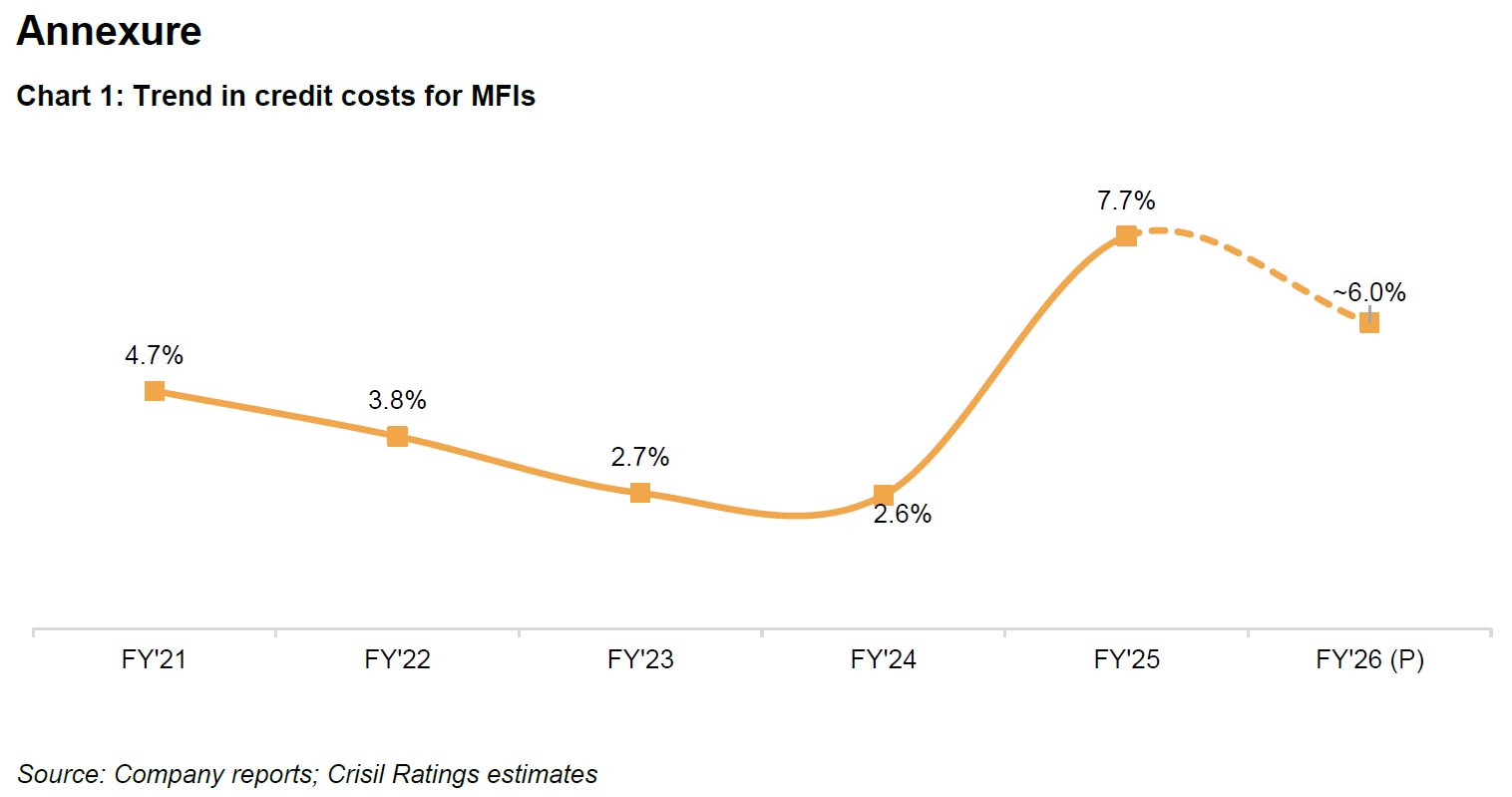
Says Prashant Mane, Associate Director, Crisil Ratings, “Given these factors, the credit cost for MFIs, while reducing somewhat from the 7.7% seen last fiscal, is still expected to remain high at around 6.0% this fiscal (refer to chart 1). Consequently, overall profitability is likely to normalise only by fourth quarter of this fiscal.”
The two pillars that continue to support the credit profiles of MFIs are healthy capital position and adequate liquidity at well-rated entities.
Nevertheless, the ability of MFIs to control slippages and navigate state-level issues will bear watching.
1 MFIs refer to non-banking financial company MFIs or NBFC-MFIs; analysis in this report is based on MFIs rated by Crisil Ratings representing 85% of the industry’s assets under management (AUM)
2 Refers to The Karnataka Micro Loan and Small Loan (Prevention of Coercive Actions) Ordinance, 2025, notified on February 12, 2025, and The Tamil Nadu Money Lending Entities (Prevention of Coercive Actions) Act, 2025
3 Portfolio at Risk
Analytica