- Credit Monitoring
- US Regional Banks
- US Community Banks
- Commercial Real Estate Loans
- Commercial and Industrial Loans
- Leveraged Finance
Fortifying US regional and community banks
Effective credit monitoring imperative to stave off macro blows



Seema Joshi
Global Head
Credit and Lending Solutions

Mayur Patil
Director
Credit and Lending Solutions

Apoorv Sharma
Sector Lead
Credit and Lending Solutions
As the US economy grapples with an uncertain environment, it has become imperative for regional and community banks to assess the potential increase in credit risk in their loan portfolios and to take necessary steps to build resilience.
Besides, amid heightening risks, regulators such as the Office of the Comptroller of Currency (OCC) and Federal Deposit Insurance Corporation (FDIC) are expected to tighten scrutiny and take serious measures such as imposition of penalties on non-compliant lenders.
To meet the twin objectives of timely assessment of heightened credit risk and meeting compliance requirements, banks need to strengthen and transform their credit monitoring practices for real-time assessment of risks and identify stress in the portfolios on time. Managing limitations around data availability and the use of models, tools and accelerators should further help monitor loans effectively.
Unique loan mix of regional and community banks calls for closer credit monitoring
The US banking sector is unique in its preponderance of regional and community banks, with all but 31 banks coming under this category and managing around 30% of the assets.
These banks are different from their larger counterparts in that their banking is more relationship-based than transactional and they tap the sections of the economy underserved by larger banks.
Further, a significantly larger proportion of their loan book is concentrated on niche and relatively high-risk loan asset classes such as leveraged finance, commercial real estate (CRE) and commercial and industrial (C&I) loans. These asset classes are more susceptible to an increase in delinquencies in the face of macroeconomic headwinds and uncertainties posed by the US government’s decision to impose tariffs on its trade partners, especially China.
Though the US-China talks held in Geneva on 10 May showed some green shoots in the form of substantial rollbacks and a 90-day pause, it would be premature to be too optimistic as any re-escalation could be just around the corner. In the light of the subsequent slowdown in growth, firm inflation, potential for high unemployment and the Federal Reserve (Fed)’s reluctance to reduce interest rates in the US, the decisions taken by the US government and its main trade partners over the next 6-9 months should be critical for the US as well as global economy.
Early signs of stress point to challenges for financial institutions
Fears of a slowdown were substantiated as the US reported 0.3% GDP de-growth in 1Q25, driven by high imports as importers built up inventories to protect themselves from the uncertainties.
Faced with the double whammy of slower growth and higher inflation, the Federal Open Market Committee kept the interest rates unchanged at 4.25-4.50% in its May 7 meeting, while expressing its intent to closely monitor inflation and unemployment data to shape the monetary policy over the rest of 2025.
According to the IMF’s April 2 reference forecast, the US GDP growth estimate for 2025 is down to 1.8% (0.9 percentage point lower than the January forecast), with tariffs accounting for 0.4 percentage point of the reduction. The IMF has also raised its US inflation forecast by about 1 percentage point to 3%.
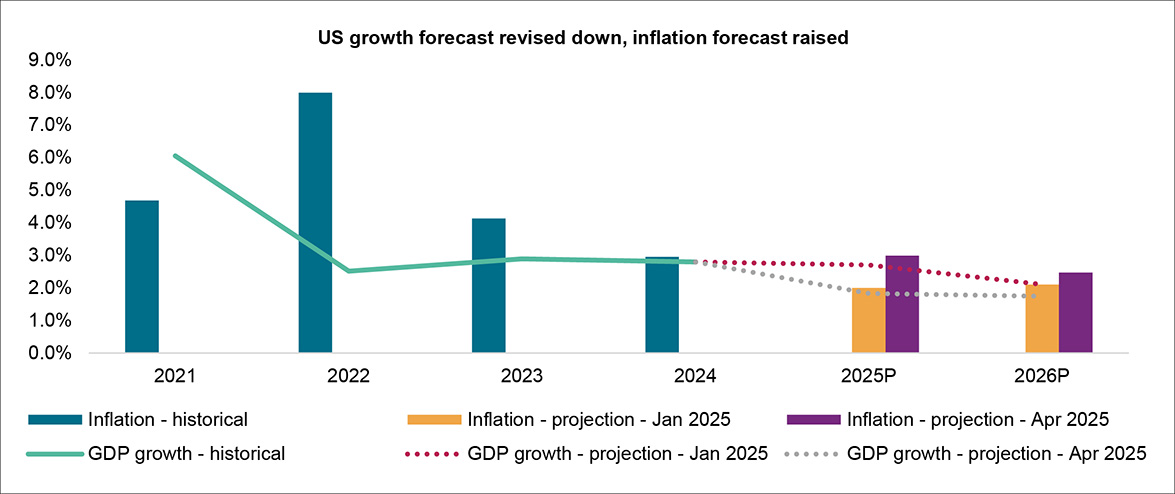
Source: IMF
Tariffs could translate into higher delinquencies for niche asset classes
Lenders face an uphill task with regard to their exposure to leveraged loans, with US leveraged loans default projected to rise to 1.75% by March 2026 from 1.23% in April 2025 (Source: S&P). This is due to the following reasons:
- An expected increase in the cost of procurement for borrowers which are dependent on international supply chains and directly impacted by tariffs, such as those engaged in the auto sector, steel and aluminium, and pharmaceuticals.
- Pressure due to potentially lower consumer spending, higher unemployment and higher labour costs for borrowers, in general, even if they are not dependent on international supply chains. This includes sectors such as hospitality, media, healthcare and retail.
Further, maturities are set to rise significantly in 2026 and 2027, increasing the probability of default further, especially for borrowers who fail to get their debt refinanced. Hence, now, it is all the more important for the lenders to rationalise their exposure to the leveraged loans segment and tighten the monitoring framework and processes.
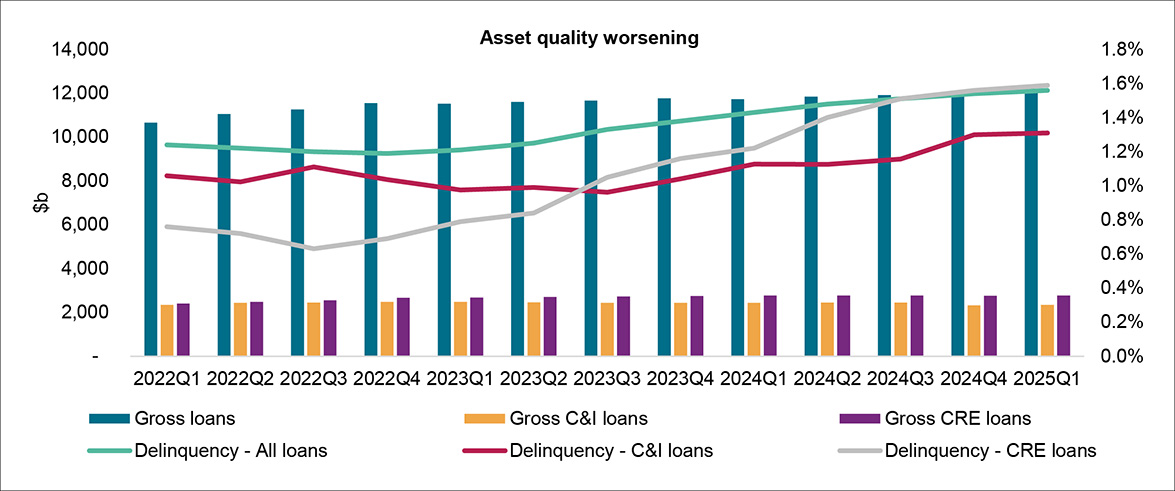
C&I loans have seen an increase in delinquency during the last five quarters, reaching 1.3% at end-1Q2025 from 1.0% at end-4Q2023 due to elevated interest rates (despite cuts), inflationary pressure and the high leverage of borrowers. In 2025, in the light of tariffs, C&I borrowers, who are typically small-sized and have relatively highly leveraged capital structures, should be more susceptible to the uncertainties and the downturn. As the passing on of higher costs to their customers would only partially alleviate the margin stress for these borrowers, the delinquency rate is expected to inch up further in 2025, necessitating heightened credit monitoring.
The tariff-induced uncertainty should affect various aspects of the CRE market as well, including construction expenses, property values, rental affordability and borrowing costs. Consequently, developers and builders are revising their budgets and underwriting processes to accommodate these rising expenses, which often result in project overruns, delays and/or cancellations, particularly for initiatives that are already operating with narrow profit margins amidst prolonged inflationary pressure.
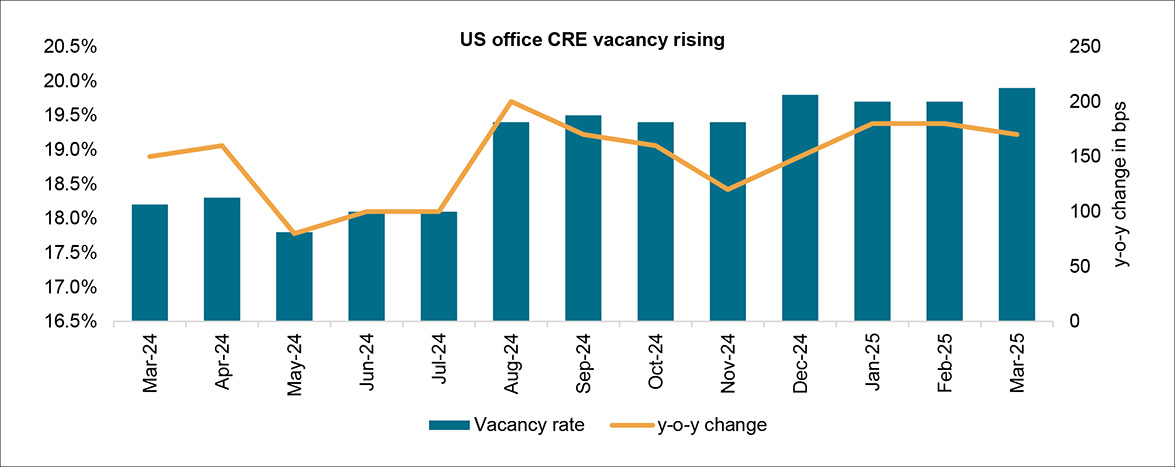
Further, companies facing higher costs due to tariffs may slow down hiring, encourage work from home, or, in severe cases, even resort to layoffs, further impacting the already stressed office CRE sector. As shown below, US office vacancy has significantly increased over the past year and was almost 20% at end-March 2025, +170 bps y-o-y. Office utilisation has also mostly been range-bound (50-55%) during the last two years, leading to the conclusion that remote-work culture would dominate the dynamics of the office CRE space, at least in the medium term. Consequently, in 2024, 25 million square feet of office transactions were in distress, up 39% from the previous three-year average of 18 million square feet (source: Commercial Edge).
Furthermore, the recent decision of the Fed to hold the rates will also adversely impact the property valuations and the debt-service requirements (~$500 billion CRE loan maturities due in 2025), impacting the credit risk faced by the banks due to CRE exposure. As shown below, CRE delinquency has steadily been rising since 3Q-2022, starting from a healthy 0.6% and gradually increasing to 1.6% at end-1Q-2025. Hence, the lenders should be careful regarding the monitoring of the CRE loans in their portfolio, along with developing strategies for diversifying their portfolio to decrease concentration in the CRE domain.
Data and talent pool constraints hobble banks’ bid to tighten credit monitoring
Banks face several roadblocks in strengthening their monitoring processes. These include:
- Information opacity: Outdated technology and fragmented data flows hinder timely decision making with most of the banks still operating on outdated credit and risk infrastructure with largely manual data ingestion. This leads to data gaps impacting effective decision making.
- Borrower data: For the small-sized borrowers, data on current financial condition, historical cash-flow trends, medium-term prospects, etc. is difficult to obtain on time. Hence, lenders find it difficult to accurately assess the adequacy and stability of cash flows, and have to grapple with lack of clarity on the seasonality and cyclicality of the borrower’s business
- Collateral data (such as valuation reports) obtained by the banks is often not reliable or is dated and does not reflect the true market value of the collateral, leading to incorrect lending decisions (including pricing decisions) taken by the banks
- Lack of availability of credit domain experts: Domain expertise driven talent gaps put a strain on regional banks with concentrated exposures and thin internal credit restructuring capacity. Lenders often face difficulties in finding and retaining personnel with relevant skill sets in the field of credit risk management in a cost-effective manner
- Issues faced in the usage of tech-enabled solutions: Tech solutions involve significant amounts of investments, which are prohibitive for smaller lenders, given their relatively modest financial capacity to make such investments. In addition, the lack of sufficient amount of good-quality data with use of legacy systems and talent pool impedes leveraging of tech solutions by the banks to draw insights from the data and take timely and well-informed decisions. The models/scorecards supporting these technological tools need regular validations and updates, in the absence of which lenders tend to run the risk of bearing the costs due to false positives and false negatives
Banks need effective and advanced credit monitoring to alleviate the impact of the uncertainties
To tackle the roadblocks, banks need to efficiently utilise the experience and learnings of credit domain experts and design and implement processes that focus on handling data gaps and quality issues, while also utilising alternative data sources to aid decision-making.
Banks need to invest in the development and timely validation and update of scorecards to improve internal credit-rating processes.
To enhance their preparedness amid constantly evolving economic landscapes, banks need to conduct scenario analysis and stress testing on their credit portfolios and also leverage early warning trigger libraries. These prudent risk-management practices can be topped up by leveraging technological innovations such as those offered by Generative AI or Machine Learning, while simultaneously managing the risks posed by excessive reliance on these technologies.
In a nutshell, the current geopolitical challenges and related uncertainties in the overall economy call for closer monitoring of the credit portfolio by regional and community banks in the US. Since these banks are exposed to high risk and vulnerable asset classes, it is important for them to pre-empt the increase in risk and minimise credit losses.
Further, as regulators are likely to be more vigilant during such times, leading to heightened scrutiny on banks to improve their credit-risk management and governance practices, banks need to develop robust data management practices; develop, validate and periodically update the internal rating scorecards; adopt scenario analysis, stress testing, and early warning systems; and leverage the latest technological innovations with the oversight of domain experts.
To learn more, contact us at: Contact.CLS@crisil.com
Subscribe to our blogs