• CV
  • Operating Margins
  • Commercial Vehicle
  • Domestic Demand
  • Goods And Services Tax
  • Light Commercial Vehicles
April 24, 2026

CV volume driving to record, but growth to slow at 5-6% this fiscal

GST-led recovery holds; West Asia crisis may weigh on exports and operating margins

India’s commercial vehicle (CV) industry is expected to clock a record overall volume of ~12.4 lakh units in fiscal 2027, surpassing the previous peak of fiscal 2019. The industry had a strong outing in fiscal 2026, with a 13% rebound. Coming on that high base, growth is expected to moderate to 5–6%.

Domestic demand will remain supportive, driven by infrastructure-led activity, steady replacement demand, and continued benefits from improved affordability following rationalisation of Goods and Services Tax (GST) rates last year. Exports, however, could see some near-term disruptions due to the ongoing developments in West Asia.

Our analysis of four CV manufacturers, accounting for ~94% of industry volumes, indicates as much.

The industry is broadly categorised into light commercial vehicles (LCVs) and medium and heavy commercial vehicles (MHCVs), with buses forming a sub-segment within each. The domestic market drives around 92% of the overall volume, with exports accounting for the remainder.

Fiscal 2026 marked a strong domestic recovery, driven by several factors. The GST rate cut from 28% to 18% in September 2025 significantly improved purchase economics, unlocking deferred demand. Additionally, easing interest rates, improving freight utilisation, and a pickup in infrastructure and mining activity reinforced the recovery.

Says Anuj Sethi, Senior Director, Crisil Ratings, “Domestic demand momentum is expected to continue this fiscal, albeit with some growth moderation owing to higher base. LCVs, accounting for ~60% of the industry volume, are projected to grow 5-6%, driven by e-commerce and last-mile delivery demand, while MHCV volumes are expected to expand 4-5%, supported by freight movement and infrastructure spending. The ongoing shift toward higher-tonnage vehicles, aided by improved road infrastructure, could moderate volume growth even as underlying demand remains steady.”

Within LCVs, vehicles above 2 tonne gross vehicle weight (GVW) now account for ~73%, up from 60% in fiscal 2020 (refer chart in annexure), as fleet operators increasingly prioritise payload efficiency over unit addition. For MHCVs, the completion of both dedicated freight corridors1 (DFC) introduces competition from a viable rail alternative for long-haul freight. The extent to which bulk demand migrates to rail will bear watching for replacement volumes.

The bus segment is expected to grow 3–4% in fiscal 2027, supported by replacement demand and government-led electric bus procurement. Although buses remain a small sub-segment, electrification in this category is expected to progress faster than in any other CV category, with penetration still in low single digits but rising steadily.

Says Poonam Upadhyay, Director, Crisil Ratings, “Exports, at ~8% of overall CV volume, may see a sharp deceleration to 2–4% growth in fiscal 2027 from ~17% in fiscal 2026. West Asia, accounting for nearly a quarter of exports, is the key reason, with shipping disruptions deferring dispatches rather than reflecting lost demand. Nevertheless, India’s growing presence as one of the top MHCV producing nations provides a strong base, and finalisation of trade agreements with key economies could help increase export growth over the medium term.”

Revenue growth is expected to marginally outpace volume growth, driven by calibrated price increases. However, rising input costs (such as steel, aluminium, and fuel) due to the geopolitical situation in West Asia may compress operating margins by 40-50 basis points, from ~12% in fiscal 2026. A sharper or more sustained rise in costs could exacerbate this, as aggressive price pass-throughs risk negatively impacting demand.

Adding to this cost environment, compliance requirements—including Advanced Drive Assistance System mandates for new models from April 2026, extending to all production from October 2026, Corporate Average Fuel Efficiency-III from April 2027, and proposed Bharat Stage VII shortly after—are mounting in quick succession. With research and development, tooling, and certification investments required in parallel, vehicle prices are likely to move higher through fiscals 2027 and 2028. This could support near-term replacement demand.

Despite moderating volume growth and some margin pressure, the industry’s credit profile remains stable, underpinned by strong cash flows and healthy balance sheets. The expected annual capital expenditure of ~Rs 5,500 crore this fiscal, consistent with last year, is directed at modernisation and regulatory compliance, and is expected to keep the capex-to-Ebitda (earnings before interest, tax, depreciation and amortisation) ratio below 0.3 time.

In the milieu, fluctuations in commodity prices, inflation, interest rates, and geopolitical developments affecting logistics costs remain monitorable as these could significantly alter the demand and margin outlook.

1 Two DFCs are the eastern DFC (Ludhiana to Sonnagar) and the western DFC (Dadri to JNPT, Mumbai), with the latter fully commissioned in April 2026
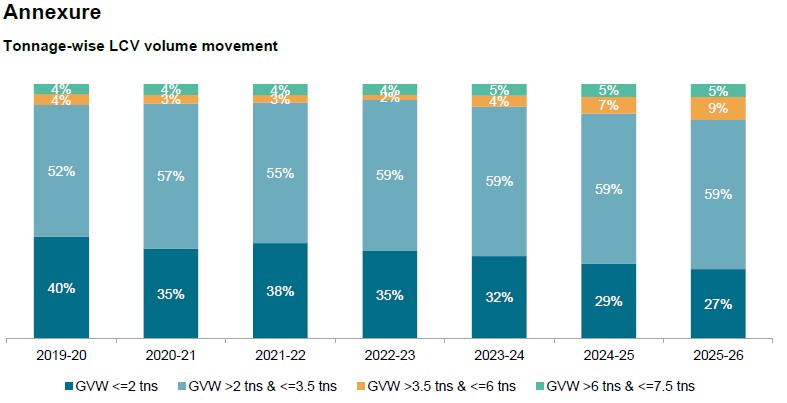
Tonnage-wise LCV volume movement

For further information,

  • Media relations

    Ramkumar Uppara
    Media Relations
    Crisil Limited
    M: +91 98201 77907
    B: +91 22 6137 3000

    ramkumar.uppara@crisil.com


  • Analytical contacts

    Anuj Sethi
    Senior Director
    Crisil Ratings Limited
    D: +91 44 6656 3108
    anuj.sethi@crisil.com

  •  

    Poonam Upadhyay
    Director
    Crisil Ratings Limited
    D: +91 22 6137 3386
    poonam.upadhyay@crisil.com