Explore Crisil, a company of S&P Global
Formerly known as Global Research & Risk Solutions
April 22, 2026
 Blog
Blog
Blog
A structural reset for credit risk capital
April 22, 2026
Blog
Blog
New NPR moves banks from model-based framework to rule-based capital discipline
 Share
Share





A more standardised, granular approach
The 2026 US Basel III Notice of Proposed Rulemaking (NPR), issued by three US federal banking agencies (the Federal Reserve, the Federal Deposit Insurance Corporation and the Office of the Comptroller of The Currency) fundamentally restructures the credit risk capital framework for American banking organisations.
In this note, we focus on credit risk-related requirements of the NPR, outlining key regulatory changes, impact and implications for banks.
The Category I and Category II institutions, including global systemically important banks (GSIBs), will be required to adopt the new expanded risk-based approach (ERBA), replacing the existing internal ratings-based (IRB) approach. Category III, Category IV and smaller banks will move to a revised standardised approach (revised SA), with the option to elect ERBA subject to eligibility criteria and supervisory approval.
ERBA, the new credit risk framework
The ERBA replaces the IRB approach with a more standardised yet risk-sensitive methodology. Capital requirements are determined using external credit ratings and prescribed risk drivers such as loan-to-value (LTV) ratios and cash-flow dependence for real estate and product characteristics for retail exposures.
ERBA also introduces the new securitisation standardised approach (SEC-SA), replacing the existing simplified supervisory formula approach with a more granular, Basel-aligned formula. It features a lowered 15% supervisory floor for standard securitisations and a 100% floor for more complex or non-traditional securitisations. Equity exposures remain under the simple risk-weight approach, which is largely unchanged except for minor refinements to adjusted carrying value calculations.
Unlike IRB, ERBA eliminates internal model inputs such as PD (probability of default) and LGD (loss given default), relying instead on regulatory risk-weight grids applied consistently across portfolios. This improves comparability and transparency for regulators while substantially reducing model risk for banks. However, it limits capital optimisation opportunities and increases reliance on external ratings and observable metrics.
From a capital perspective, ERBA redistributes requirements, lower for highly rated and well-collateralised exposures (including high-quality senior securitisations) and higher for unrated or riskier portfolios. Overall, it represents a clear shift from a model-driven to a standardised, externally anchored system, with significant implications for bank strategy, pricing, portfolio composition, securitisation structuring and equity investment decisions
Revised SA for Category III and IV banks
The revised SA is specifically tailored for Category III and IV banking organisations and smaller banks that remain under SA. It delivers targeted improvements in credit risk sensitivity while maintaining the simplicity of overall framework.
The most material change is a new LTV-based risk weight system for qualifying residential mortgage exposures, further differentiated by cash-flow dependence (owner-occupied vs rental/investment properties), replacing the existing flat 50% (for residential) and 100% (for commercial) treatment. Risk weights for corporate exposures are reduced from 100% to 95% and all other assets not otherwise assigned from 100% to 90%.
Overall, these changes provide modest risk-weighted asset (RWA) relief on core lending portfolios while materially improving risk sensitivity and alignment with ERBA.
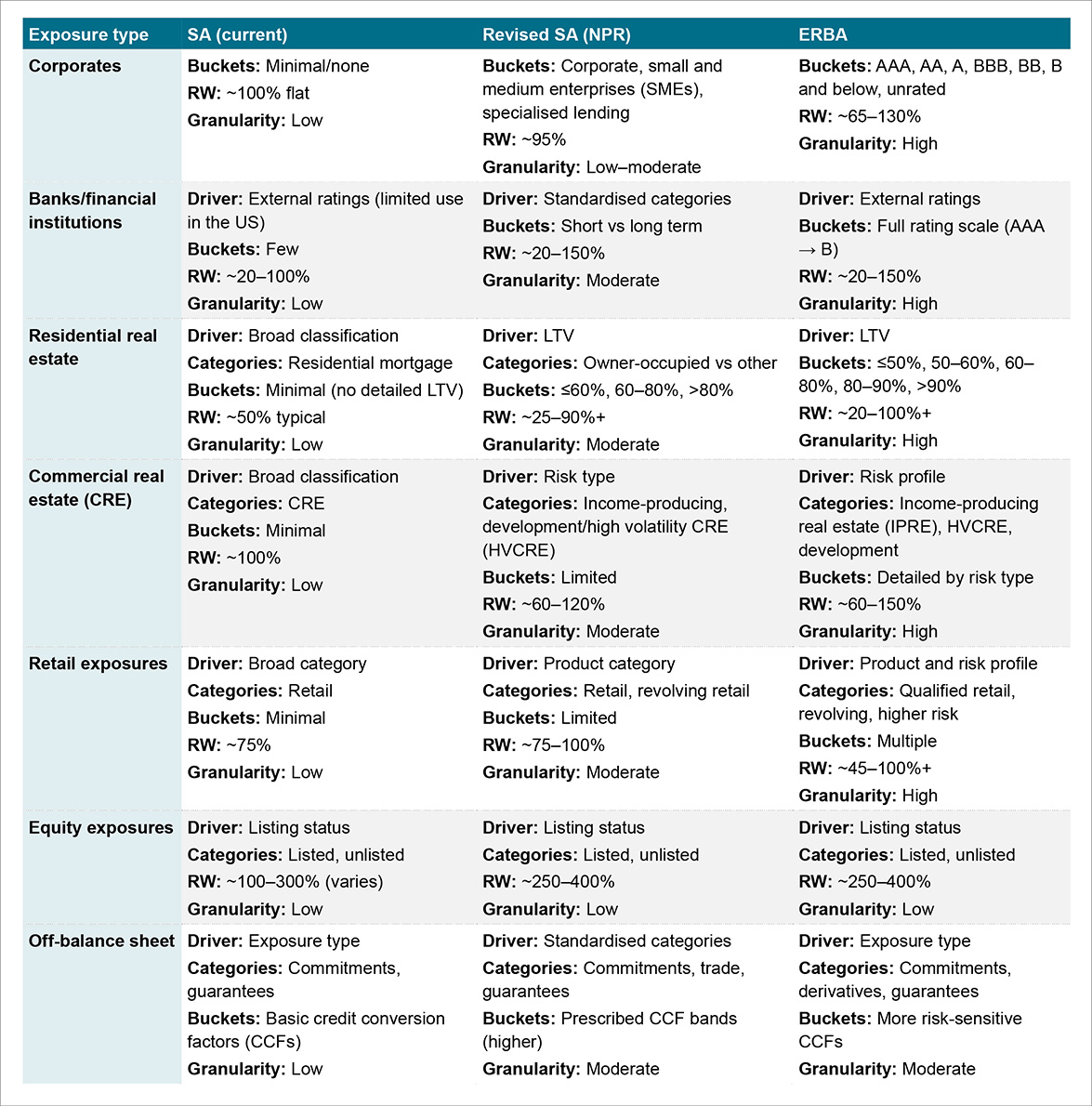
Credit risk framework comparison: Current SA vs revised SA vs ERBA
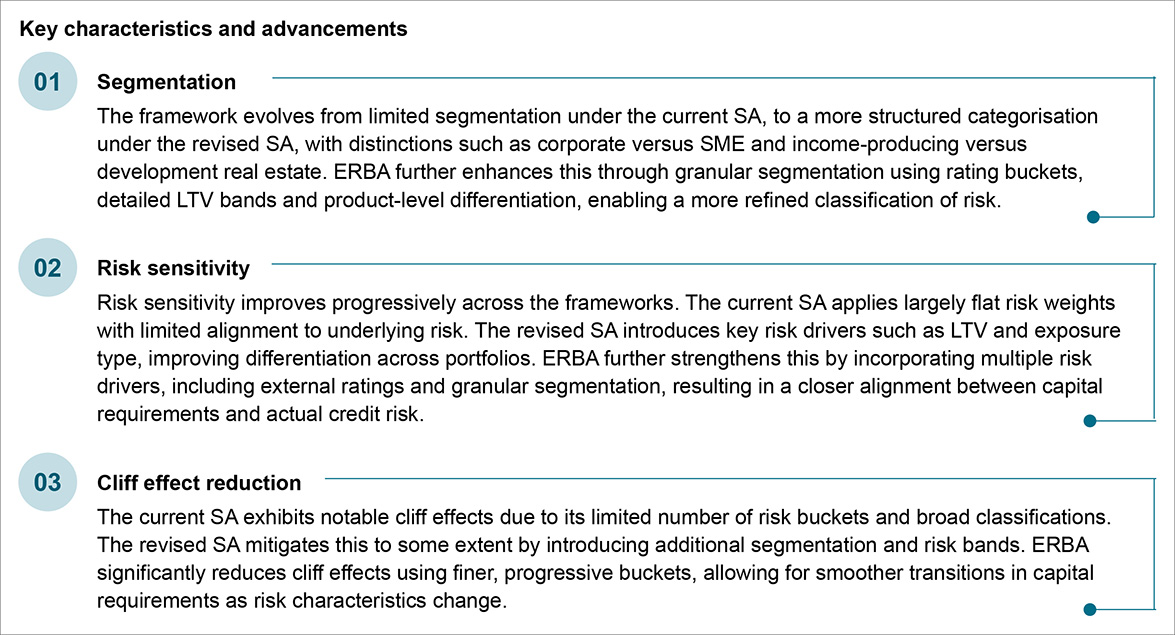
The new NPR marks a clear shift toward enhanced risk sensitivity, consistency and comparability across institutions. The current SA is relatively simple but has limited risk differentiation, applying broad and largely uniform risk weights across exposures. The revised SA strengthens this framework by introducing more defined exposure segmentation and risk drivers. ERBA further advances the framework by incorporating external credit ratings and more granular risk buckets, thereby improving alignment between regulatory capital requirements and underlying credit risk.
Challenge for Category I and II banks
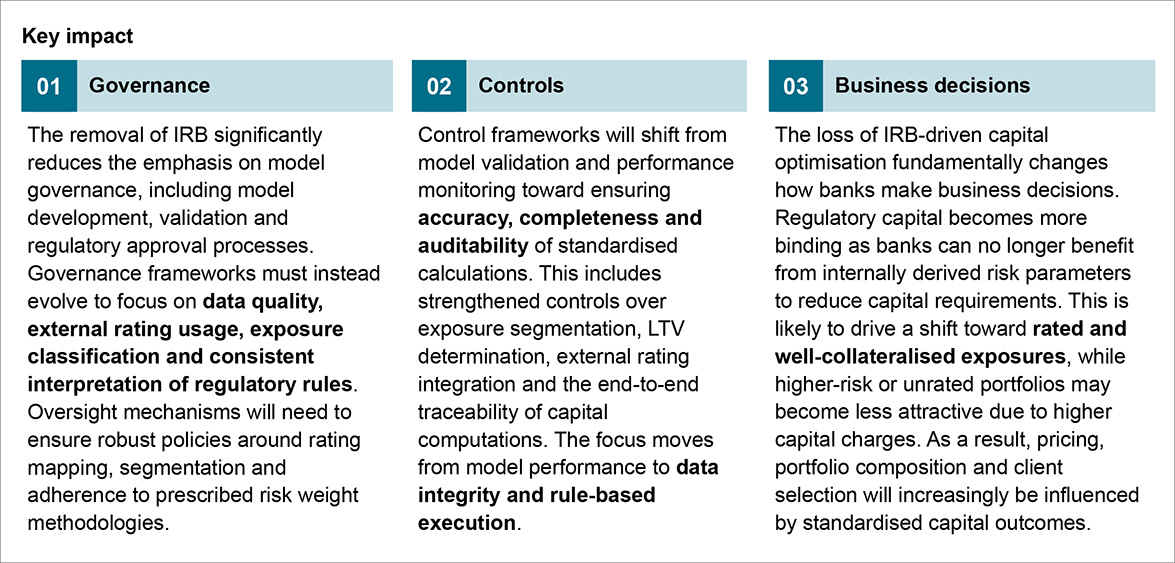
Under the 2026 NPR, Category I and II banks are no longer permitted to use IRB approaches for credit risk capital, marking a shift from a model-driven framework to a standardised, externally anchored methodology. This removes the capital efficiency benefits of internal models, leading to higher capital requirements for most portfolios while improving the comparability across the banking system and preserving the core simplicity of standardised methodologies. The removal of internal models also eliminates the necessity for a 72.5% output floor given the purely standardised framework.
Securitisation and credit risk transfer economics under new NPR
The 2026 NPR introduces a more structured and standardised framework for securitisation and credit risk transfer (SRT/CRT), with capital determined under the SEC-SA within a single-stack regime. This replaces IRB flexibility and aligns capital with prescribed rules based on tranche position, attachment/detachment points and underlying asset risk.
A key improvement is the retention of the p-factor at 0.5, compared with the 2023 NPR proposal of 1.0. Within SEC-SA, the p-factor governs how sharply risk weights increase across tranches. A lower p-factor results in a less steep capital increase for mezzanine and junior tranches, preserving SRT economics, whereas the higher p-factor would have materially increased capital and reduced CRT effectiveness. The proposal also reduces the securitisation risk weight floor from 20% to 15%, which sets the minimum risk weight for securitisation exposures.
However, under the single-stack framework, capital relief is based on standardised RWA, which limits the benefit of structuring. While the lower p-factor and reduced risk weight floor provide some support compared with the 2023 proposal, CRT becomes less effective for capital optimisation and more focused on actual risk transfer.
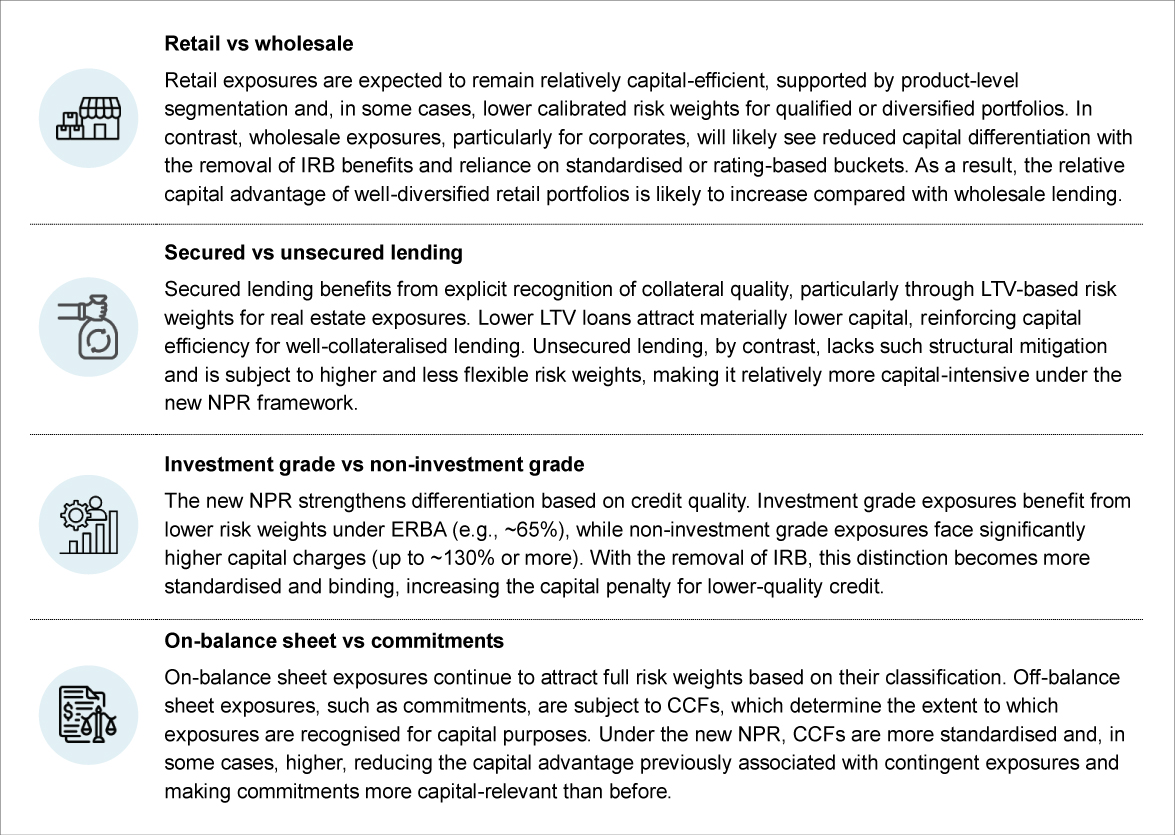
Comparative capital impact across key dimensions
Impact on multinational banks across jurisdiction
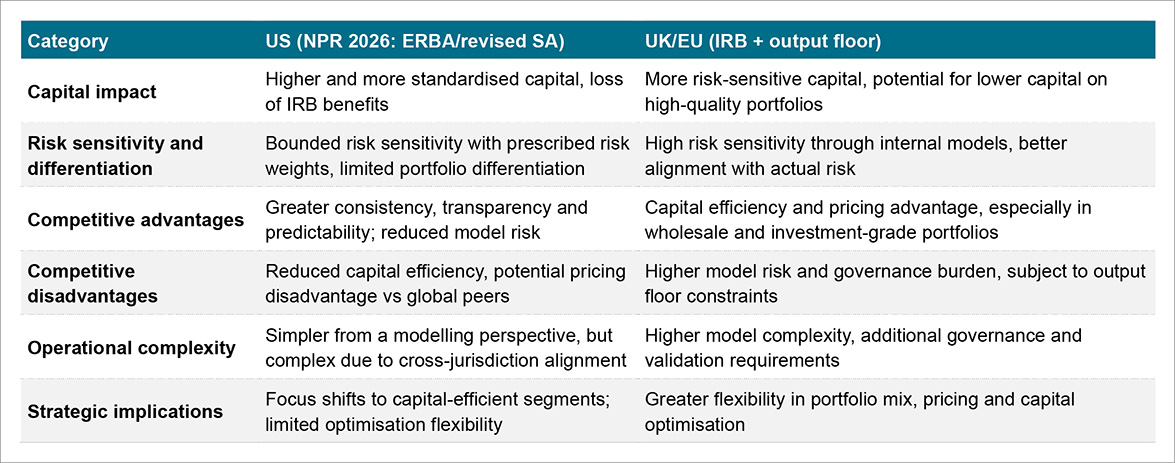
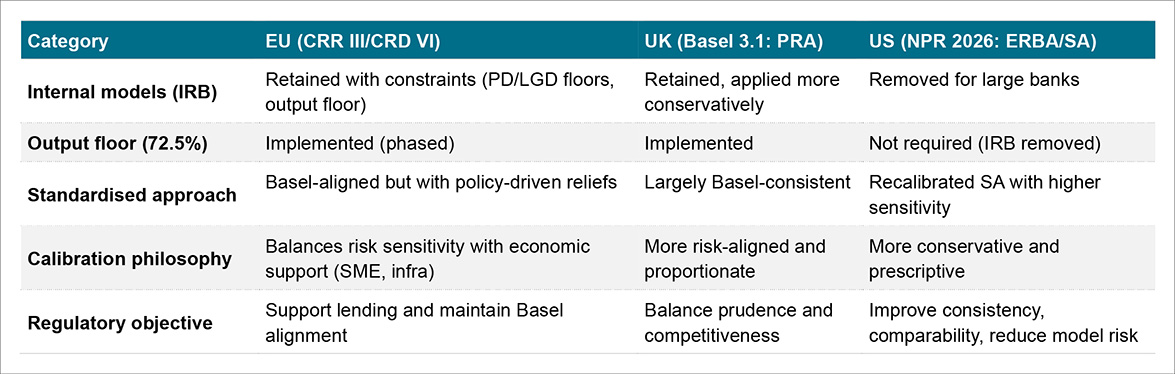
Global comparison: EU vs UK vs US (credit risk capital)