• Broking Firms
  • Securities Transaction Tax
  • SEBI
  • Average Daily Turnover
  • Margin Trading Facility
  • Press Release
February 10, 2026

For broking firms, diversification the key to shield from policy shifts

Those with multiple revenue sources more resilient than standalones

Diversification has emerged as a vital strategy for the broking industry, which is set for some headwinds following the increase in the securities transaction tax (STT) on derivatives proposed in Union Budget 2026-27.

The proposed STT hike comes close on the heels of substantial regulatory changes introduced by the Securities and Exchange Board of India (SEBI) over the past few quarters1 (refer to Table in annexure).

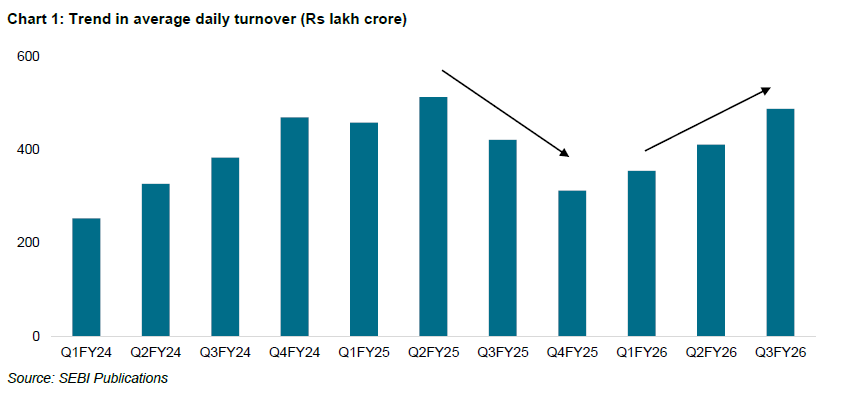
Those changes - aimed at curbing speculative activities, protecting retail investors and enhancing market transparency - have led to lower average daily turnover (ADTO) volume across capital market segments. The ADTO had dropped ~25% in the second half last fiscal. Despite some recovery, the volume remains below previous highs (refer to Chart 1 in annexure) and has resulted in a 6% on-year drop in the revenue of the broking industry2 in the first half of fiscal 2026.

In this evolving milieu, Crisil Ratings analysed the business performance of 25 players (during fiscal 2025 and first half of fiscal 2026) categorised into three sets3: 1) traditional brokerages (including discount firms) earning more than half of their revenue from transaction broking and trading business, 2) diversified players earning less than half of their revenue from this stream, and 3) entities engaged primarily in proprietary trading. Non-broking and non-trading revenues for this categorisation includes fee income from distribution, wealth management and investment banking and interest income from margin trading facility (MTF).

Says Malvika Bhotika, Director, Crisil Ratings, "Our analysis of 25 players engaged in the broking businesss hows that entities with diversified revenue streams have typically navigated market fluctuations adeptly, while entities where transaction broking fees or proprietary trading business constitutes the predominant share of revenues, have faced decline in revenue during such periods."

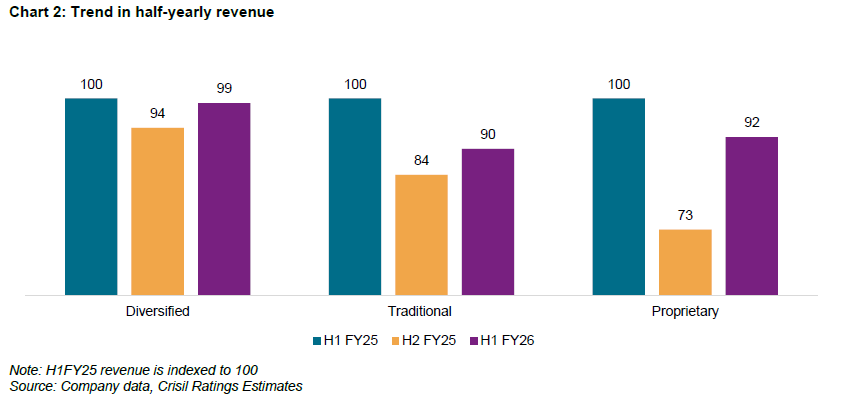
Diversified capital markets players, on their part, have shown higher resilience in performance. Around two-third of their revenue was from non-broking and non-trading activities putting them in a better position to absorb market volatilities and hence, their revenue has seen the least impact (refer to Chart 2 in annexure).

On the other hand, traditional broking players were impacted more in periods of volatility, with revenue falling ~15% in the second half of fiscal 2025 compared with the first half, led by lower market activity as well as streamlining of charges levied on customers. Many players have made changes to brokerage rates and are levying charges for certain services that were offered at nil cost earlier. Additionally, focus on enhancing the MTF book led to the revenue share of this segment rising ~400 basis points (bps) on-year in fiscal 2025. However, these measures have not been entirely sufficient to offset the dent in revenue, with revenues in the first half of fiscal 2026 remaining below the year ago period despite some increase vis-à-vis the previous six-month period.

The third category of proprietary players bore the brunt of the impact. Says Prashant Mane, Associate Director, Crisil Ratings, "With the regulatory measure of reducing weekly expiry products resulting in fewer arbitrage opportunities, proprietary players saw revenue drop by ~25% during the second half of fiscal 2025 over the first half, with a slight improvement in the first half of fiscal 2026 owing to some stability in market volume. Going ahead, the proposed hike in STT could have a higher impact on proprietary traders, including high-frequency traders and arbitrageurs, who account for ~60% of the market volume."

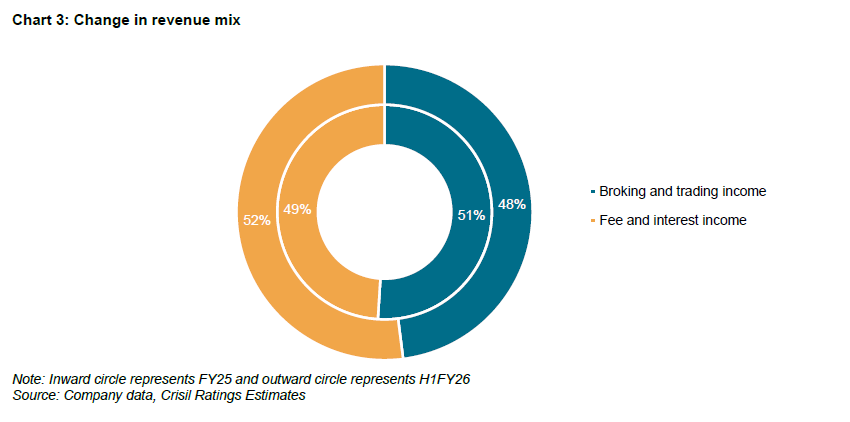
The findings underscore the importance of diversification. Additionally, the proposed STT hike on derivatives trading could also potentially affect market liquidity and trading volumes. While increasing interest income from MTF has provided some cushion, increasing revenue from other sources has become crucial. Also, while most broking players have initiated steps towards diversification (refer to Chart 3 in annexure), their ability to revamp their revenue structure to cushion against market volatility, either on account of regulatory changes or any external events, will bear watching.


1 Refer to Crisil Ratings’ press release ‘Raft of recent regulatory moves to curb profitability of brokerages’
2 Based on a representative set of 25 players
3 Based on revenue mix for fiscal 2024
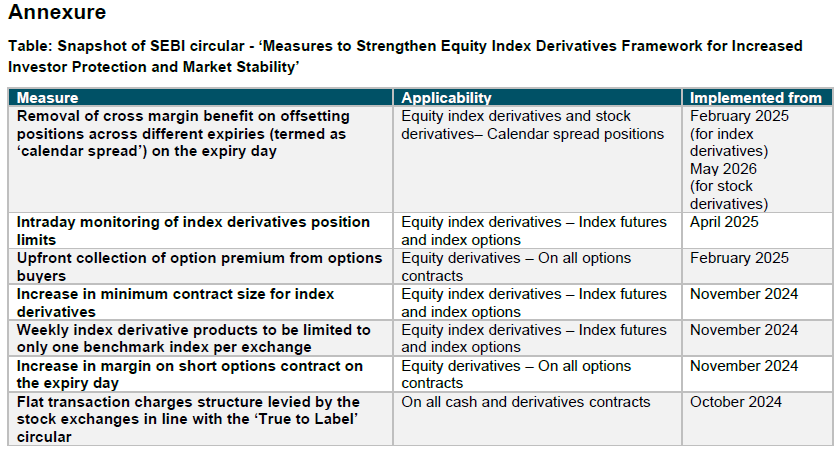
Snapshot of SEBI circular - ‘Measures to Strengthen Equity Index Derivatives Framework for Increased Investor Protection and Market Stability’
Trend in average daily turnover (Rs lakh crore)
Trend in half-yearly revenue
Change in revenue mix

For further information,

  • Media relations

    Ramkumar Uppara
    Media Relations
    Crisil Limited
    M: +91 98201 77907
    B: +91 22 6137 3000

    ramkumar.uppara@crisil.com


  • Analytical contacts


    Ajit Velonie
    Senior Director
    Crisil Ratings Limited
    D: +91 22 6137 3090
    ajit.velonie@crisil.com

  •  


    Malvika Bhotika
    Director
    Crisil Ratings Limited
    D: +91 22 6137 3272
    malvika.bhotika@crisil.com